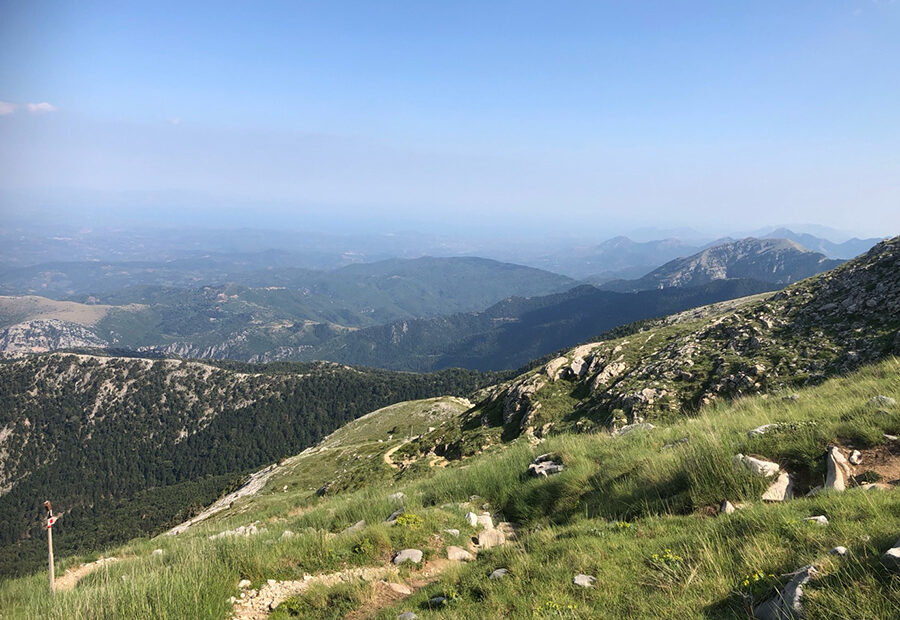
Welcome to our new ‘Mountains of Greece’ series. The aim is to produce an archive of mountain-by-mountain posts exploring the literary and archaeological heritage of the mountains of Greece, together with some hiking routes and reflections on the role of the mountain landscapes of Greece in the 21st century.
We’re starting here with the first in a series of weekly posts on the mountains of the Peloponnese. Please share and subscribe! We hope you enjoy reading!
Climbing the Profitis Ilias peak of Mount Taygetos
Taygetos is the highest mountain in the Peloponnese, at 2404 metres. It’s a huge mountain range: it stretches for more than 60 miles from one end to the other. If you drive down from the northern Peloponnese to Sparti (ancient Sparta) the first glimpse of the mountain is breathtaking: it’s like a vast wall towering up above the city and the surrounding plain.
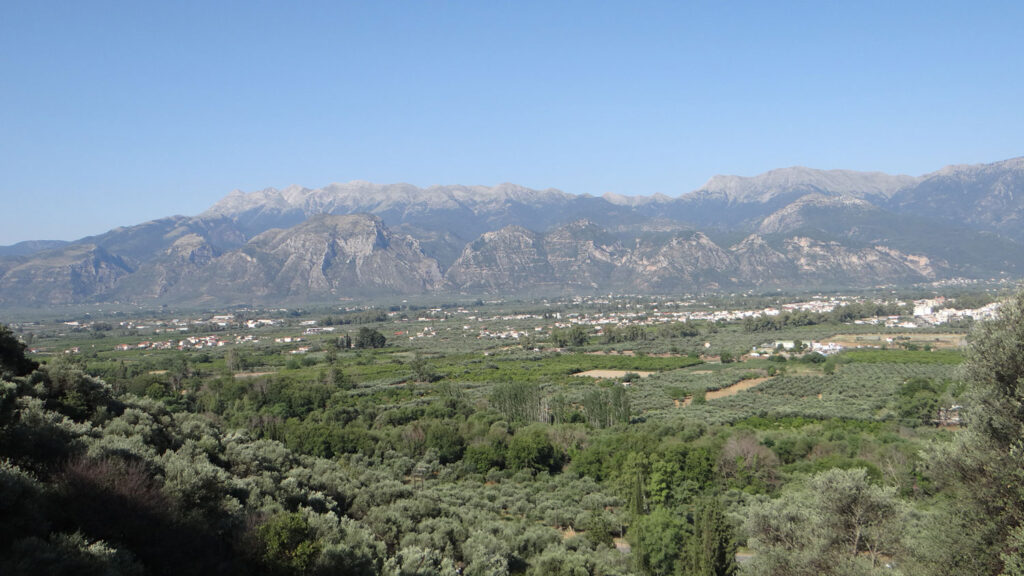
Today’s route takes you into some of the most extraordinary landscapes of the Peloponnese, up to the highest summit from the east side of the mountain.
Patrick Leigh Fermor on Mount Taygetos
It’s not just an amazing place to hike: the mountain also has a fascinating literary heritage.
For a 20th-century example you can look at the writing of Patrick Leigh Fermor, who describes walking over the range from east to west, down to Kardamyli, which would be his home for many decades, although he didn’t know it at the time.
This is one of my favourite passages of 20th-century mountain writing. Leigh Fermor describes an otherworldly landscape:
A wilderness of barren grey spikes shot precipitously from their winding ravines to heights that equalled or overtopped our own; tilted at insane angles, they fell so sheer that it was impossible to see what lay, a world below, at the bottom of our immediate canyon. Except where their cutting edges were blurred by landslides, the mountains looked as harsh as steel. It was a dead planetary place, a habitat for dragons. All was motionless. There was not even a floating eagle, not a sound or a sign that human beings had ever trodden there, and immense palisades of rock seemed to bar all way of escape.
Leigh Fermor, Mani: Travels in the Southern Peloponnese, pp. 13-14

It’s very hard to know from his description what route Leigh Fermor took, although it was probably well to the north of the main summit. Here’s one hair-raising attempt to retrace that journey in the 1980s.
Taygetos in antiquity
What about the mountain’s ancient heritage?
Sometimes it’s the smaller mountains in Greece where we see more records of human engagement—for example, more evidence of worship on the mountain by local communities, and more of a presence in ancient mythical texts.
Taygetos fits with that pattern: there’s no sign of any sacrificial activity on the summit, and relatively little about this mountain in ancient Greek literature compared with some of the smaller mountains of the northern Peloponnese. But still there are a few amazing exceptions.

A heroic vendetta: Lynceus, Castor, Polydeuces
One of the most distinctive examples is a tiny snippet that survives from an early epic poem the Cypria. It’s quoted by an ancient commentator on Pindar, Nemean 10:
At once Lynceus went up Taygetos, trusting in his swift feet, and going up to the highest point he looked over the whole island of Pelops the son of Tantalus. And quickly the glorious hero spotted them with his sharp eyes inside a hollow oak, both of them together, horse-taming Castor and the prize-winner Polydeuces. And <mighty Idas> stabbed the great oak, standing close to it.
Cypria fragment 16
We don’t know exactly what is happening here – there were many different versions of the story in circulation in antiquity – but we can reconstruct the basics. Castor and Polydeuces (Pollux in Latin) are the brothers of Helen, whose abduction by Paris to Troy was the cause of the Trojan war. They had previously rescued her from being abducted by the Athenian hero Theseus, but they don’t go with the Greeks to Troy, and this seems to be the incident that eliminates them from the Trojan War plot.
Another source tells us that they were spotted rustling the cattle of the brothers Idas and Lynceus (in some versions Castor and Polydeuces had also stolen their brides). Here Castor and Polydeuces seem to be waiting in ambush for their enemies, concealed in an oak tree.
Lynceus is from Messenia; presumably Castor and Polydeuces have taken the cattle from there and travelled south-east to their native Sparta. Lynceus pursues them, via Mount Taygetos. Castor at least seems to have been killed in the ensuing fight, along with Lynceus and Idas.
Viewing like a god
This is an extraordinary fantasy of human far-sightedness and speed.
Gods in the Iliad often look down from mountaintops on human activity on the earth below, Zeus especially—it’s a way of conveying his (almost) omniscience.
In later literature we often see military leaders looking down from mountain summits or slopes, occupying that position of quasi-divine authority.
But still there aren’t many passages like this one, where we see a human character from myth viewing from a mountain summit in the same way as Zeus. When you’re up on the highest summit perhaps you can look out to the trees far in the distance down below (as Patrick Leigh Fermor’s account of the barren rocky peaks makes clear, you have to look a long way). Can you imagine that your enemies are there, waiting for you down below? Perhaps you can see the ghost of a movement or a telltale glint of light on metal that gives them away. All you need to do then is get down to them from the summit, moving with the speed of a god, like Lynceus, over the rocks and scree.
The route
The classic route up to the summit way involves parking at Manganiari.
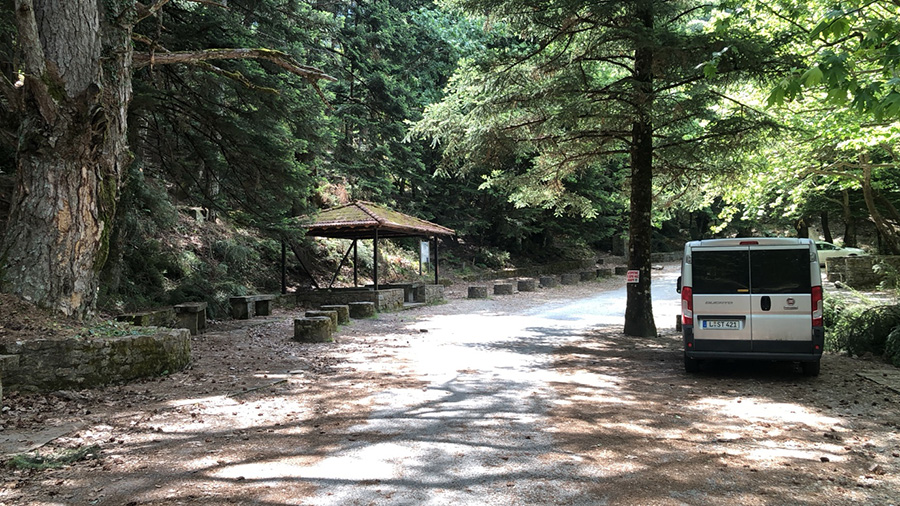
From there it’s about 1400 metres of ascent. First you climb up steadily through thick pine forests to the Varvara refuge, at just over 1500 metres. You can drive up to there on the dirt track if your car is up to it, but I didn’t feel brave enough in my underpowered hire car, and most of the guidebooks suggest four-wheel drive only – and that would anyway involve missing the beautiful walk through the forest.
Above the hut the path becomes more rocky for a while.
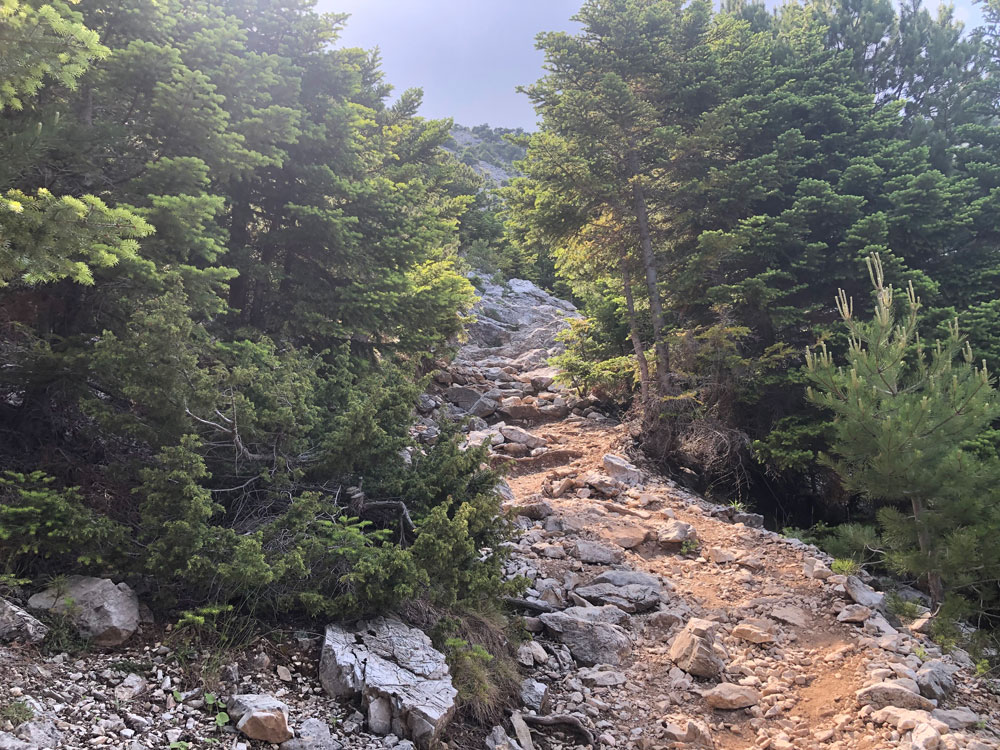
You come out above the tree-line on grassy slopes.
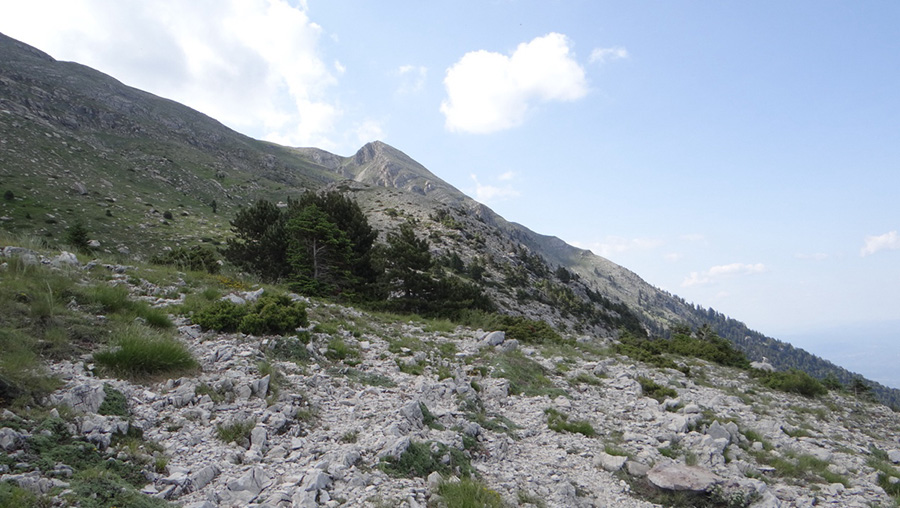
The route is beautifully clear here, with paint splashes and signposts.
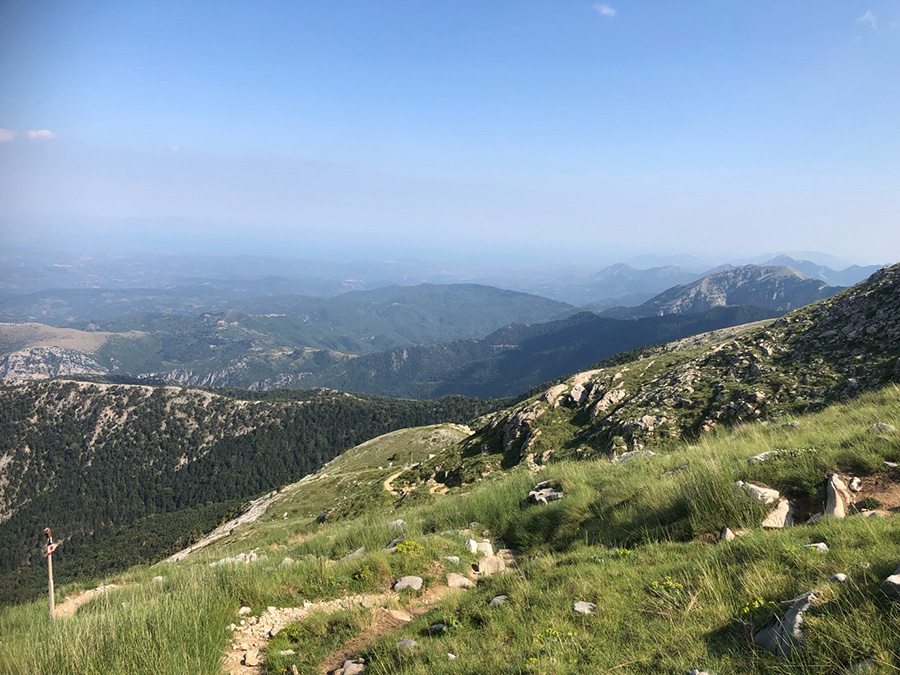
Once you get to about 2000 metres you turn sharply left, and then climb steeply up the Plakes route, through a gap in the ridge at Portes, and then up to the pyramid-shaped Profitis Ilias summit, with its famous chapel.
If you have good visibility it is a stunning climb. There are amazing views from the top – east across to Mount Parnonas, and west over the Messenian Gulf.


From Manganiari to the summit and back is 14 km, with 1370 metres of ascent.
If you want more detail, there’s an excellent description of the route from the Varvara refuge onwards in Michael Cullen’s Landscapes of the Southern Peloponnese (2019) in the ‘Sunflower Books’ series (route number 17); also another great description on the ‘Just for One Summer’ website.
The start point for the route is here. The downloadable GPX file is below.