Mount Kyllini (or Ziria) is the second highest mountain in the Peloponnese after Taygetos. The highest peak is at 2375 metres.
Today’s route takes you up to the Cave of Hermes, and then on to the main summit.

A wooden statue of Hermes
It’s a thrilling landscape to set foot in if you know even a little bit about the mountain’s mythological heritage.
This is the mountain of Hermes. The Greek travel writer Pausanias tells us that
beyond the tomb of Aipytos is the highest of the mountains in Arkadia, Kyllene, and there is a ruined temple of Kyllenian Hermes on the mountain summit … The image of Kyllenian Hermes is made .., of juniper wood, and I would guess that it is about eight feet in height. (8.17.1).
Wooden statues have a special mystique for Pausanias, linked with ancient ways of honouring the gods, and all the more precious for the fact that they are so vulnerable to the passing of time.
Did Pausanias himself make the long journey up to the summit to see it? There is plenty of of other evidence from his work and elsewhere for religious tourism in quite high mountain environments.
I often wonder what happened to the statue. Could there traces of it scattered around still on the summit ridge?

Marble statue of Hermes, 2nd century CE, by Satdeep Gill, is licensed under CC-BY-SA-4.0

The Cave of Hermes in Greek poetry
Pausanias was living in a world where those traces of Hermes and his worship had faded a little, in the second century CE. If we want to catch a glimpse of Hermes moving through this high-mountain landscape we can look back to the Homeric Hymn to Hermes, which was probably composed around 500 BCE.
It tells the story of how Hermes, on the day of his birth, travels from his cave on Mt Kyllini to the meadows of Pieria around Olympus, to steal the cattle of Apollo.
You can visit the cave today (route details below). It’s not possible to get into the inner chambers without ropes and helmets and torches, and from the entrance you can only see a few metres down into the darkness, but even if you don’t have the chance to explore in person, you can enter into it in the imagination.
In the Hymn it matters that it is dark, for it’s the place where Hermes’ mother, the nymph Maia, sleeps with Zeus in secret:
There the son of Kronos used to sleep with the beautiful-haired nymph in the depth of the night, so long as sweet sleep held white-armed Hera, out of sight of the immortal gods and mortal humans. (Homeric Hymn to Hermes 6-9)
Hermes and the cattle of Apollo
Maia gives birth to a son, Hermes, who is ‘versatile and cunning, a robber, a rustler of cattle, a bringer of dreams, a spy in the night, a door-watcher, who was soon to display glorious deeds among the immortal gods’ (13-16).
He’s up and about causing trouble on the day he is born ‘Craving meat, he leapt up from the sweet-smelling mansion to the summit, debating with himself a dizzying trick of the kind that thieves carry out in the black nighttime’ (64-7).
He runs all the way to Pieria near Mount Olympus to steal the cattle of his half-brother Apollo, then sneaks home into the cave before dawn:
twisting sideways he slipped through the keyhole of the mansion like an autumn breeze, or like a mist. He went straight through the cave to the rich holy place in the middle, treading gently … and quickly glorious Hermes reached his cradle. (146-50)
We can just imagine him slipping through the narrow entrance of the cave into the grand caverns underneath.
Apollo follows not far behind. As he searches the cave we get a glimpse of its richness:
A delightful fragrance pervaded the holy mountain, and many long-legged sheep were grazing on the grass … Having peered round every corner of the great house, he took the shining key and opened up three innermost shrines, which were full of nectar and pleasant ambrosia. There was much gold and silver lying within them too, and many of the nymph’s purple and white clothes, the kind of things that the sacred houses of the blessed gods contain. (231-2)
They are a long way from the vastness and grandeur of the houses of the gods on Olympus: Hermes has his own space quite separate from Zeus and the Olympian gods.
But if we put Olympus aside, Maia’s cave, with its ability to wrap the whole mountain in beautiful fragrance, is a place of fantasy more luxurious than almost any other in the mountains of Greece.
The route
The easiest way to the main summit starts from the ski car park to the north of the mountain, through the village of Ano Trikala.
You go up first to the left of the ski lift (this is the view back down to the car park).
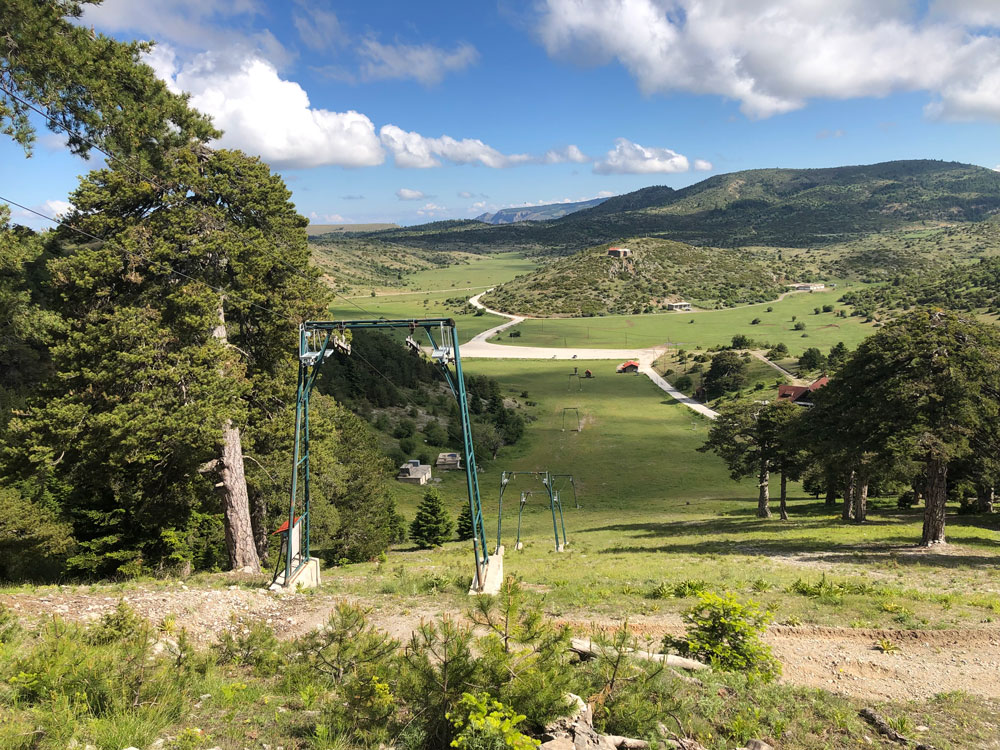
You get to the path to the Cave of Hermes pretty quickly, after about 1 km. The turn is hard to spot: the path takes you down quite a steep mountainside that doesn’t initially look very promising, and the signpost had fallen to the ground when I was last there in June 2025.
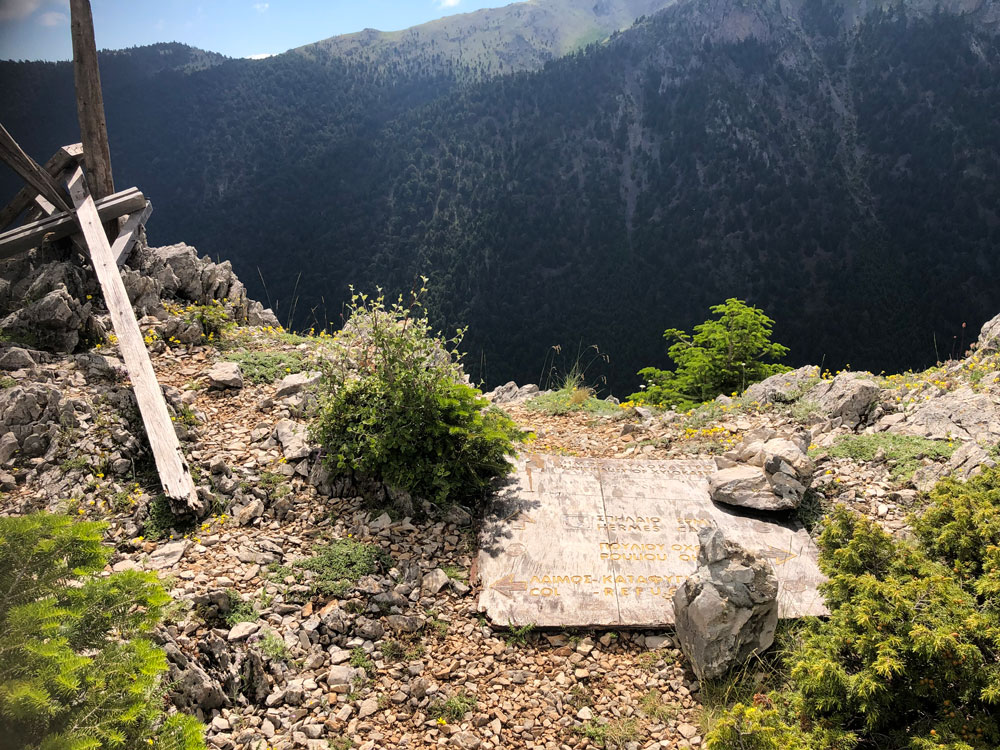
But once you find it it’s a good path, and it takes you very soon to the mouth of the cave.
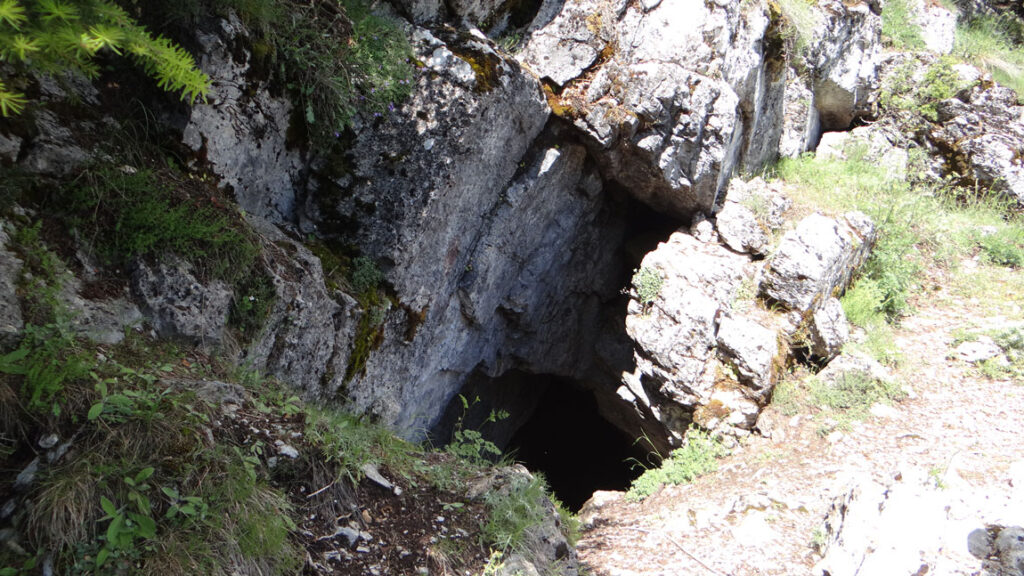
The cave was a place of worship in antiquity, despite the fact that it was a long way from any large settlement in the ancient world: various dedicatory items have been found there.
One of the stalacmites in the cave has also been used recently as an important evidence for climate variation in antiquity over a period of several thousand years.
You can lower yourself a little way down using the fixed rope, but exploring any further would need some specialist equipment and expertise (see here for a video of the descent).
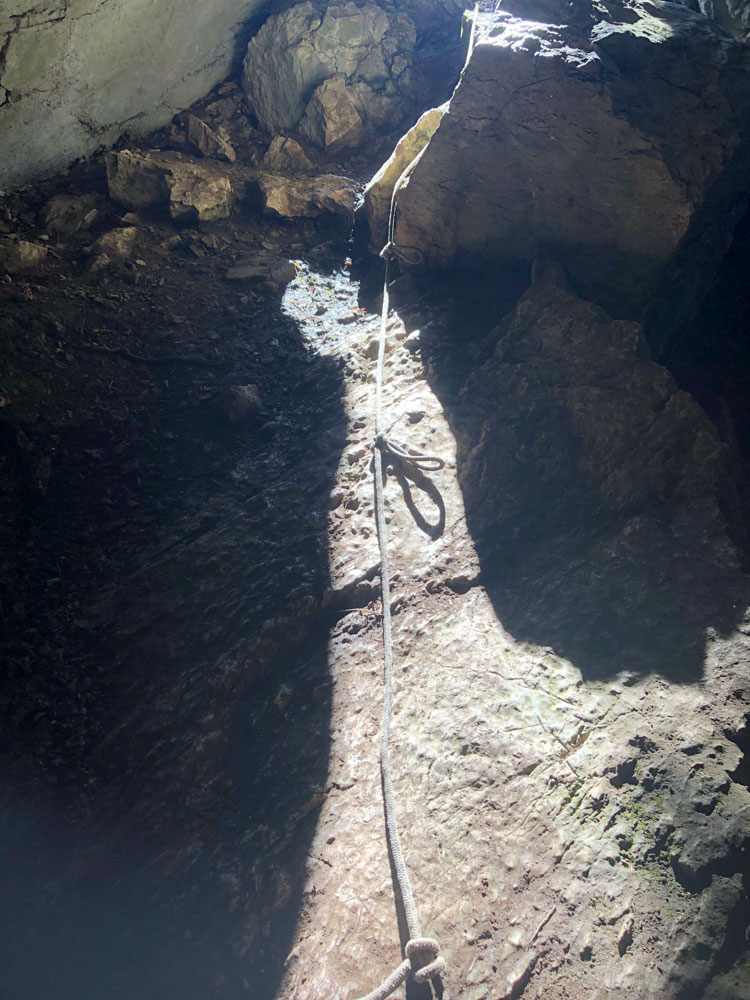
There are breathtaking views across to the vast scree slopes of Mikri Ziria on the other side of the valley.
To go up to the main Kyllini summit from there you first rejoin the path at the broken signpost. There are various possible routes up to the summit, but the route I particularly like follows the wide track to the south, takes a right fork, and then almost immediately branches off to the right into the trees. The path at that point is not marked on the Anavasi map, and it’s not regularly used, but it is signposted sporadically with red paint splashes, and it takes you steadily up through beautiful forest carpeted with flowers in late spring and early summer.
You fairly soon rejoin the path on the map, just to the south of ‘Refuge B’, then up through grassy meadows (this is the view back towards Mikri Ziria).

There is then a final slog up rocky slopes, following the paint splashes, to the main summit. There are views across to the huge mass of Mount Chelmos in the west (on the right-hand side of the picture here), and the other mountains of the Peloponnese stretching away to the south.
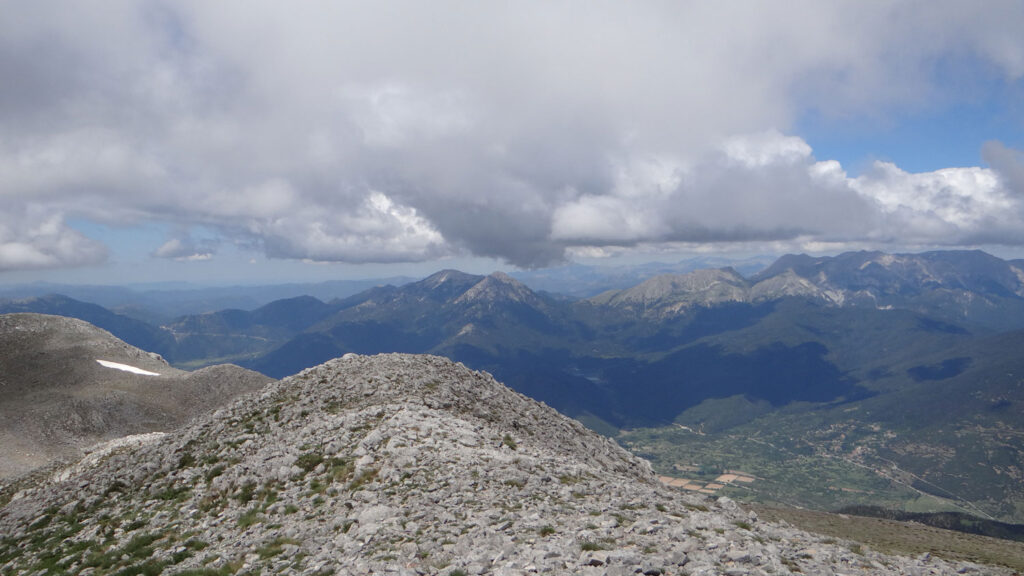

From the Ziria ski car park to the summit, and back by the same route, is 13 km and 900m metres of ascent.
For a good account of ascending in the spring in snow, see here.
The start point for the route is here. The downloadable GPX file is below.