This walk takes you up to the site of one of the most famous fires in ancient Greek literature, on the summit of Mount Arachnaio in the northeastern Peloponnese.

Fire
The mountains of Greece have always been places of fire.
That has been true in increasingly horrifying ways over the last decade or so: there have been wild fires and exceptionally high temperatures in Greece yet again in the last month (July 2025).

Athens wild fires, 2021, photo by Anasmeister on Unsplash
The media historian John Durham Peters, in his 2015 book The Marvelous Clouds, suggests that the preference for storing and delivering fire invisibly in modern culture (for example through electricity) makes us worse at dealing with the real thing.
He looks back to classical antiquity (and various other premodern equivalents around the world) as a time when fire was integrated much more intimately within human culture, not least in the sacrificial fires on Greek mountain summits.
That’s not so say that fire was always viewed straightforwardly as a benevolent force in antiquity. It could be an object of celebration; it could also bring disaster. In the passage I want to look at here it is both.
Intervisibility
The summit of Arachnaio is an amazing place, but it is very little visited.
It has an important archaeological heritage: we will write about that in another post.
But the thing that draws me back there more than anything is the mountain’s mythical significance. When you stand on the summit there, or even when you see it from below, you are entering into a landscape of Greek myth not quite like any other.
‘Intervisibility’ was important for ancient mountains – in other words the ability to see the mountain from other mountains, or from cities on the plain (for example looking up at the smoke of sacrifice on the summit), and to see those places from the mountain in turn.
Arachnaio is at the centre of one of the ancient world’s most extraordinary celebrations of that phenomenon.
The watchman and the last beacon
The key passage is from Aeschylus’ famous Oresteia trilogy, which tells the story of the murder of the Greek general Agamemnon by his wife Clytemnestra on his return from Troy, and Clytemnestra’s murder in turn by their son Orestes. The first play, the Agamemnon, opens with a watchman looking out for news of the victory of the Greeks, waiting in the darkness on the palace roof in Argos for a fire to shine out from the mountaintop.
The watchman doesn’t name the mountain, but we know it is Arachnaio (or Arachnaion, in ancient Greek) from the words of Clytemnestra herself several hundred words into the play.
The message has travelled, she says, by a series of beacons, from Mount Ida in Turkey, near to the city of Troy, via Mount Athos and Mount Kithairon, and various other less well known and in some cases less easily identifiable summits, until finally it reaches Arachnaion for the last leg of its journey:
They kindled and sent on, with abundant strength, that great beard of flame, so that it would pass forward blazing above the headland that looks over the Saronic narrows [i.e. the gulf that separates Attica from the Argolid]. Then it swooped down on the lookout post nearest to the city, when it came to the heights of Arachnaion. From there it fell upon this house of the Atreidai, this light not unfathered by the fire of Mount Ida … Such, I tell you, is the token and the proof sent by my husband to me from Troy. (Aeschylus, Agamemnon 305-16)
Beacon chains and media theory
There is evidence for chains of summit beacons like this being used for military messages in the Hellenistic and Roman periods, but it can’t have been a common or familiar phenomenon, and that doesn’t alter the almost miraculous quality of this description for Aeschylus’ original audience.
The flame leaps from mountain to mountain almost like a divinity: the gods and goddesses of the Iliad and Odyssey are regularly described stepping from mountain to mountain as they travel across the Mediterranean from Olympus.
This passage from Aeschylus has been foundational in modern media theory as an image of communication across distance: John Durham Peters discusses that too in The Marvelous Clouds (thanks to Jonathan Westaway for pointing that out to me!)
Disaster in Argos
It takes an effort of imagination, surrounded by wind turbines on the ridge, but when you stand on the summit of Mt Arachnaio you have the opportunity to project yourself into the role of the anonymous watchers waiting on the mountain summit – referred to only in the most oblique of terms by Aeschylus, in the phrase (‘they kindled’) – to send on that message of fire on its last leg.

Except that we know what they do not know, that they are about to set in motion one of the ancient world’s most horrifying and famous stories of violence and revenge, a tale of bloodshed that will unfold in the city of Argos that you can still see in the distance from the peak today.
The route
Mount Arachnaio is the tallest mountain in the Argolid. It stands at 1197 metres above sea level, to the northeast of Nafplio. It’s visible from miles away by the wind turbines on the summit ridge.

It’s easy to visit if you’re at Epidauros and have a car: just 15 km or so to the west.
From Lygourio you take the road that leads north towards the village of Arachnaio. There’s plenty of parking just below the saddle between the two peaks, at the church of Agios Ioannis Theologos.
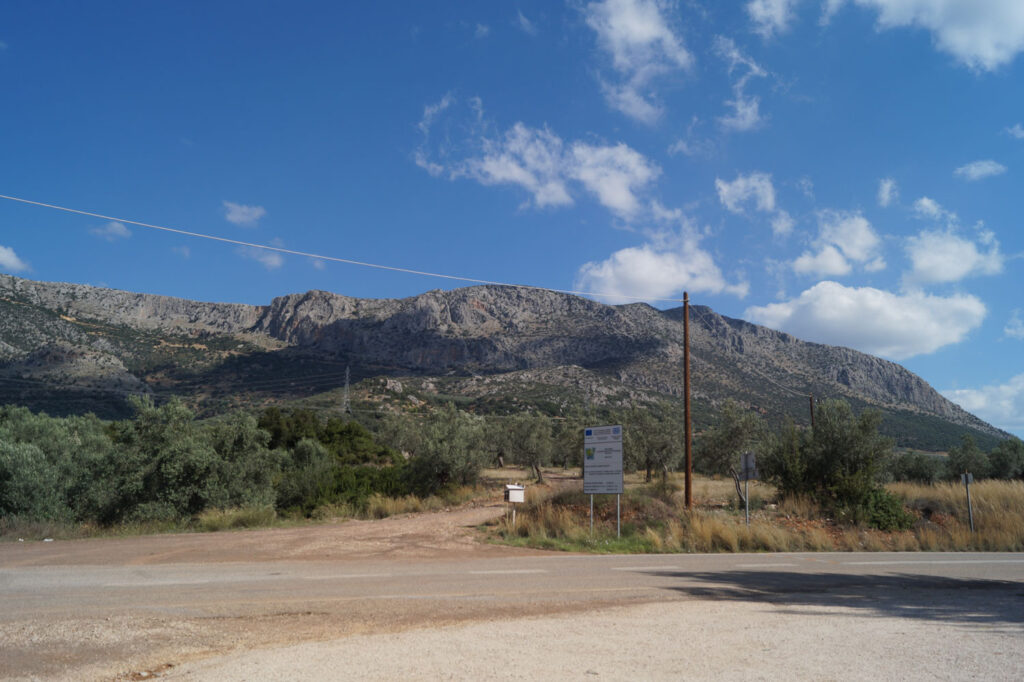
Mount Arachnaio from the church of Agios Ioannis Theologos, is licensed under CC-BY-SA-4.0

You can just walk up the wind farm access road, but the route below offers a slightly more roundabout and more attractive alternative: it goes west for 1 km, then turns to the south and zig-zags up to the summit.

To the summit and back is about 9 km, with 400 metres of ascent.
The start point for the route is here. The downloadable GPX file is below.