Mount Parthenion (1215 metres) stands at the very eastern edge of Arkadia in the Peloponnese. I don’t think it’s very often climbed, but it’s a fascinating landscape.
It’s not a beautiful mountain in a conventional sense: there are vast wind turbines all the way along the summit ridge.
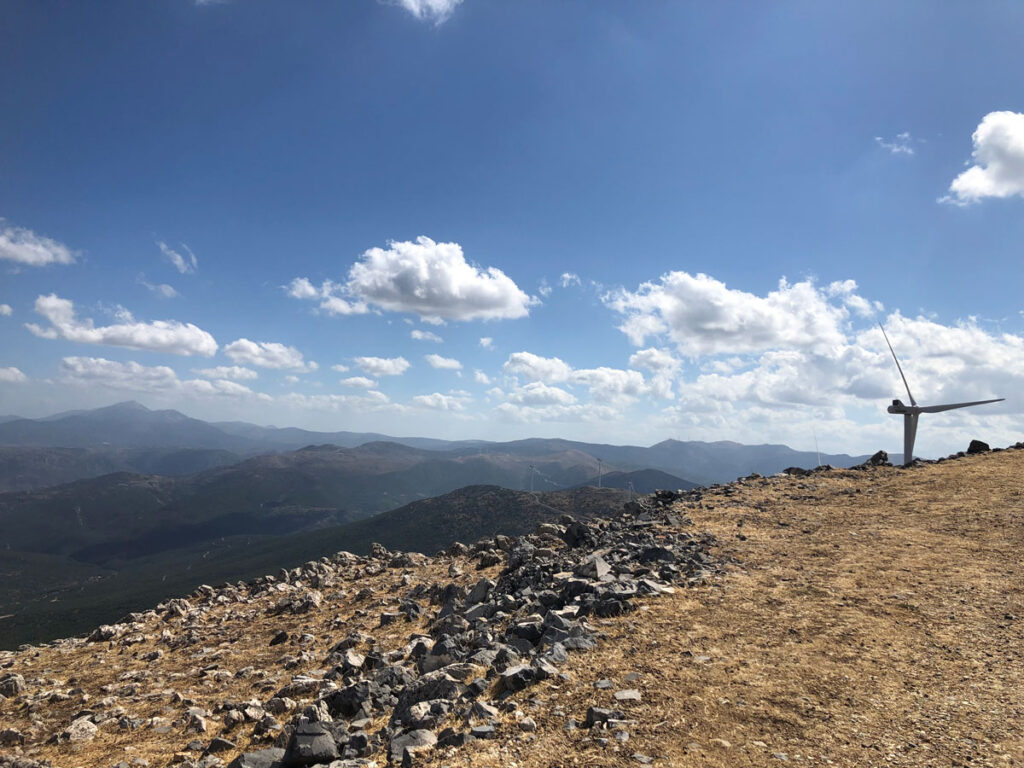
But I think this is an amazing place to visit if you know about some of its mythological connotations.
Pan and Pheidippides
In the ancient imagination Parthenion was a place of strange encounters. The problem is that the detail of many of these stories is hard to find.
The exception is the most famous one: the story from Herodotus (Histories 6.105) about the god Pan appearing to the herald Pheidippides (or in other versions Philippides) before the battle of Marathon. Pheidippides runs all the way to Sparta to get help against the Persians, and then back to Athens. On his way past Mount Parthenion, he encounters the god Pan, who calls out to him by name and rebukes him for the Athenians’ neglect of his worship. The Athenians make up for it by dedicating to him the cave of Pan on the Acropolis.
It’s a good story, but it barely scratches the surface of the mountain’s mythological heritage… That famous encounter with the god Pan has drowned out most of those other stories.
Helen and Paris on Mount Parthenion
There’s even one later source which at tells us that it was the place where Helen was seduced by Paris and taken off to Troy.
The ninth-century Byzantine bishop, Photius, who left long summaries of many ancient texts that do not otherwise survive, cites from a collection of anecdotes by the grammarian Ptolemy Hephaestion, otherwise known as a Ptolemy Chennus, i.e. Ptolemy the Quail.
Photius’ summary includes lots of tantalising and haunting images, reimagining key moments from Greek myth and history. The tiny glimpse he gives of Mount Parthenion is no exception:
Some say that Helen was taken away by Alexander [the common alternative name for Paris] when she was hunting on Μount Parthenion, and that she followed him as if he was a god, stunned by his beauty. (Photius, Library 190)
We have to imagine the context: how did Helen come to be there (50 km north of her home in Sparta)? Why is she hunting? Is that detail intended to associate her with the virgin hunting goddess Artemis? And what is Paris doing there?
But the effect is all the more powerful for that: this is an intense moment of enchantment, which momentarily overturns the power of Helen’s beauty, giving her a taste of her own medicine.
[There’s an odd mistranslation of this passage circulating quite widely online which says that she ‘followed him like a dog’. That’s a very memorable and quite shocking image—as if Helen is following Paris down from the mountainside like one of her own hunting dogs—but unfortunately it’s not what the Greek says! I think it must come from one source that misspells ‘god’ as ‘dog’ in the English translation, and then has been endlessly recopied].
Telephos
But perhaps the most extraordinary stories of all are the tales of various children exposed on the mountainside.
The practice of leaving unwanted children in hostile terrain to die was a very common motif in ancient literature. Oedipus on Mount Kithairon is just the most famous example.
The most famous exposed child on Mount Parthenion was Telephos, the son of Auge and Herakles. The story is told in several different ancient texts. Herakles stopped off with king Aleos in Arkadia on his travels and seduced Aleos’ daughter Auge. When Auge’s pregnancy began to show Aleos sent her off to be drowned in the sea:
But as Auge was being led off to Nauplia and was near Mount Parthenion, she was weighed down by the pain of labour, and she stepped aside into the undergrowth as if to perform a certain necessary act; and having given birth to a male child, she abandoned the baby, hiding it in some bushes. (Diodorus Siculus, Library 4.33.6)
Auge is sold into slavery.
As for the baby that had been exposed by Auge on Mount Parthenion, some cowherds belonging to Korythos the king found it being suckled at the breast of a deer, and brought it as a gift to their master. (4.33.11)

Herakles discovering his son Telephos, Museo Archeologico Nazionale, Naples

Some of the figures in this image (a wall painting from Herculaneum in Italy) are a bit hard to identify, but the bottom left is definitely Telephos suckling, and looking down on him his father Herakles, discovering him (in what seems to be an alternative version) presumably still on the slopes of Mount Parthenion – although other mountains claimed this story too: Pausanias (9.31.2) describes seeing a version of the same image on Mount Helikon.
Atalanta and Parthenopaios
If we dig around even a bit more in the sources we start to discover that other babies too were exposed here.
According to Hyginus (Fabulae 99) the famous Arcadian heroine Atalanta exposed her own son Parthenopaios on Mount Parthenion at exactly the same time, and both boys were found together.
Yet another source, Aelian’s Varia Historia 13.1, tells us that Atalanta herself had previously been exposed on Mount Parthenion, and suckled by a bear.
Atalanta was famous later as a huntress, at home in the wild mountains of Arkadia. Her involvement in this complex of stories show us that Mount Parthenion, even if it was less high and less wild than some, and right on the border with Argolis, was still seen in antiquity as an Arkadian mountain, with all the connotations of antiquity and miraculous happenings that that brought with it.
Keep your eyes open, if you go to Mount Parthenion: you don’t know quite what you might find!
The route
As far as I can see there are various possibilities for getting to the summit. One option is just to follow the wind farm access road to the south. There also seem to be some paths from the village through the forest and up to the southern end of the ridge, but I haven’t tried them.
I think the best approach is from the north, up to the highest summit–although I wouldn’t say it’s a relaxing route: it’s very steep and rocky.
From the village you head north along a narrow road, with views through the vines up to the ridge.

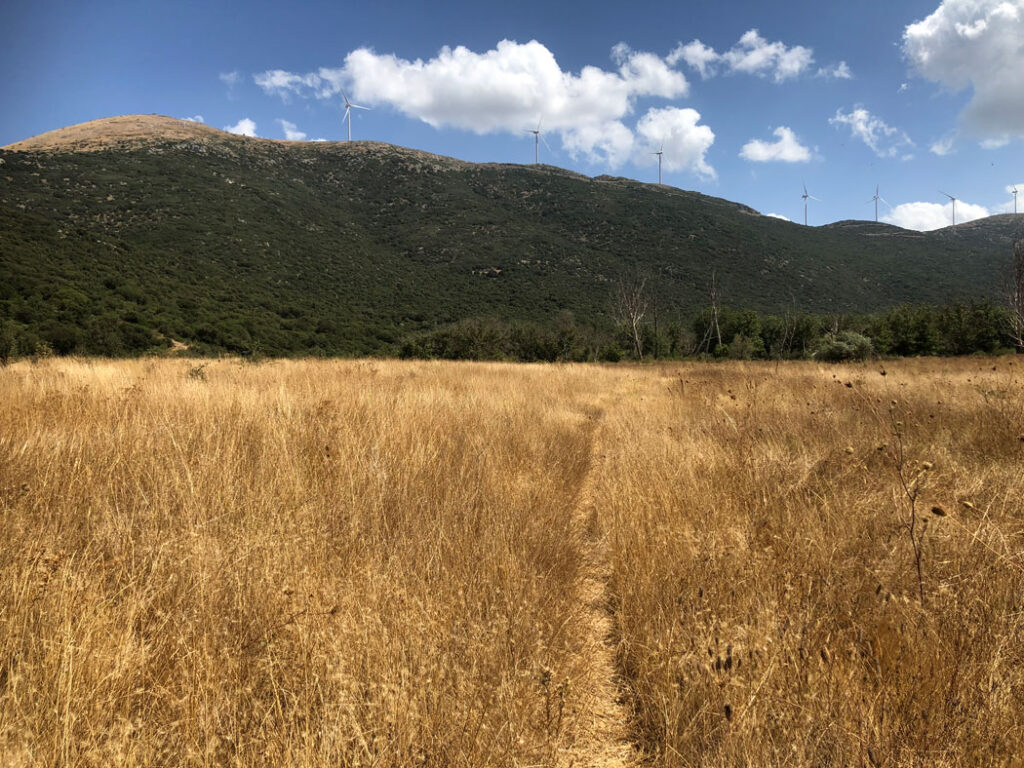
After about 1.5 km you branch off to the right, following the path over the fields, and then up on to the ridge line via a steep, low-sided gully (visible here as the diagonal line in the centre-right of the image):

Alternatively you can avoid the cut across the fields by joining the main track a little further north: that’s probably just as quick even if longer in distance.
You pass the chapel, and follow the dirt track up another very steep ramp. From there you can just pick your own route over the rocky ground, slogging your way straight up to the summit.

There’s an amazing sense of height up there.

You could walk along the summit ridge if you want to and make a loop, but we turned round and went down pretty sharply: there were some unexpected goats right up under the wind turbines at the summit, and a not-very-welcoming dog close by!
As we drove away we saw yet more wind turbines under construction just a few miles to the west…


To the summit and back by this route is 11 km, with about 600 metres of ascent.
The start point for the route is here. The downloadable GPX file is below: