This walk takes you up to the Mytikas peak of Mount Olympus, the highest summit in Greece.
It gives you a glimpse of how the mountain was imagined in Greek epic. And it looks at some of the ways in which the gods of Olympus descend from the summit in the Iliad – some more painful than others!

Olympus as dwelling place of the gods
Olympus is by far the most frequently mentioned mountain in ancient Greek and Roman literature (see the topostext Olympus page here for a comprehensive list of the 800 or so passages!)
But it’s surprisingly hard to find any lengthy description of it.
The vast majority of passages, both in epic poetry and beyond, refer to Olympus just in a few words, as the dwelling place of the gods.
We have a few passages where we hear that offerings left on the summit remain undisturbed: the idea is that Olympus is so high that it occupies a space far above the wind and the weather.

Not true, of course! But it does at least imagine a scenario where humans have been there to find out—and there is indeed some limited archaeological evidence for ritual activity on one of the lower summits: we will write about that in another post.
But in Greek poetry Olympus is almost without exception beyond the reach of humans. In many passages in the Iliad it seems to refer to an abstract ‘heaven’ rather than a mountain. And in nearly all of these cases, the dwelling places of the gods on Olympus are described by Homer and others in ways that have almost no connection with any realistic mountain landscape.
Hephaistos’ fall
One of the most famous examples is from Book 1 of the Iliad, where we see the gods feasting on Olympus. The lame god Hephaistos calms a quarrel between his mother Hera and Zeus. He reminds Hera about the punishment Zeus inflicted on him on another occasion, when he tried to intervene in a similar squabble:
For once before in the past, when I was eager to defend you, he seized me by the foot and hurled me from the sacred threshold. For the whole day I was swept downwards; then just as the sun was setting I fell to the ground in Lemnos, and there was little life still left in me. (Homer, Iliad 1.590-93)
The quarrel dies down, the gods feast together in harmony, and then
when the bright light of the sun went down, they went off to bed, each to his own home, where for each of them the renowned Hephaistos, lame in both legs, had built a house, with his cunning skill. (1.605-8)
Certain features of this story fit quite nicely with the landscape of the Olympus summits. There are multiple peaks, some with extraordinary rock formations that could almost seem like fantasy dwelling places for the gods. On Mytikas there is a dizzying sense of height, so that Hephaistos’ day-long plummeting to earth can seem momentarily plausible, as you stand there on the summit, perhaps peering through the mist for a glimpse of the vast drop below.
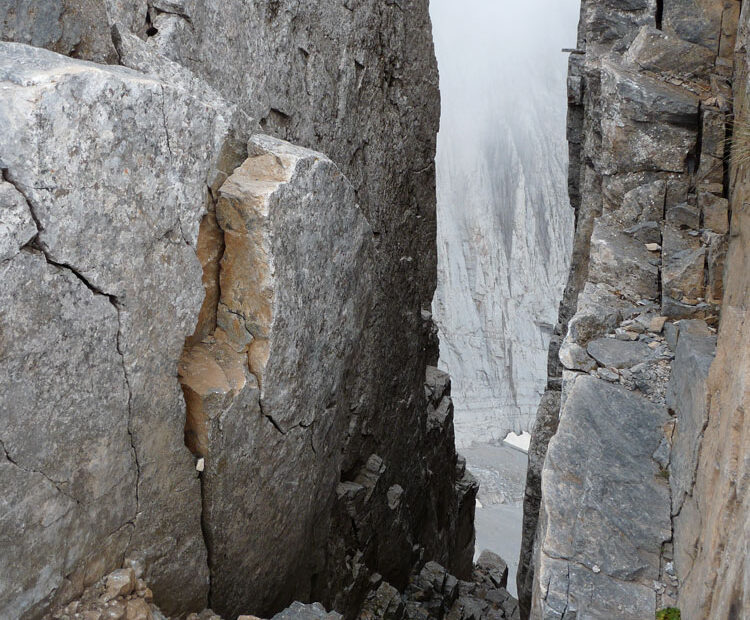
But still, Homer’s version of the homes of the gods is really nothing like a mountain.
Hera’s descent
There is just one passage (Iliad 14.225-30) where the poet does seem to be envisaging a geographically accurate Thessalian location for Olympus. Hera is on her way to enlist the help of the god Sleep. Once she has done that she seduces Zeus on the summit of Mount Ida near to Troy, and then sends him to sleep, so that he will not be able to defend the Trojans on the battlefield.
Her journey is a wonderful example of the common image of Olympian divinities stepping from one mountain peak to the next:
Hera, darting down, left the peak of Olympus, and stepping on Pieria and lovely Emathia, she rushed over the snow-covered mountains of the horse-herding Thacians, over the highest peaks, and did not touch the ground with her feet; and from Athos she went over the swelling sea, and she came to Lemnos, the city of godlike Thoas, where she met with Sleep, the brother of Death.
Here Olympus is located more or less in the right place, in northern Greece.
Not only that, but it’s striking that Hera has the same destination as Hephaistos when he is flung down from heaven by Zeus to Lemnos. I hadn’t noticed that detail before, and I’m not aware of anyone else who has commented on it.
One of its functions is to tie this moment together with the passage in Book 1. It brilliantly and economically depicts Hera’s action among other things as a delayed revenge for her humiliation at the hands of Zeus in Book 1, and for the life-changing injuries to Hephaistos.
The route
One of the things we want to do with this website is to make it possible to explore the mountains of Greece as both real and imaginary spaces even if you can’t go in person!
But if you do want to give it a try (or if you just want to get a feel for the mountain from a distance!) the standard route up to Mytikas is below.
The route starts from the Prionia car park west of Litochoro. You might not find space in the main car park, but there are plenty of plenty of options for parking further back down the road if not.
The path goes up through beautiful forest to the Agapitos refuge.

You might pass mules ferrying provisions up and down the path.

From the refuge you zig-zag up steeply up, first through tree cover, and then on bare rocky ground.

There are spectacular views across to the Mytikas summit and the stripes of rock (known as zonaria) beneath it.

At 2490 metres you branch up to the Skala summit.
If you’re lucky you might see some of the Balkan chamois that are quite common on Olympus at high altitude.
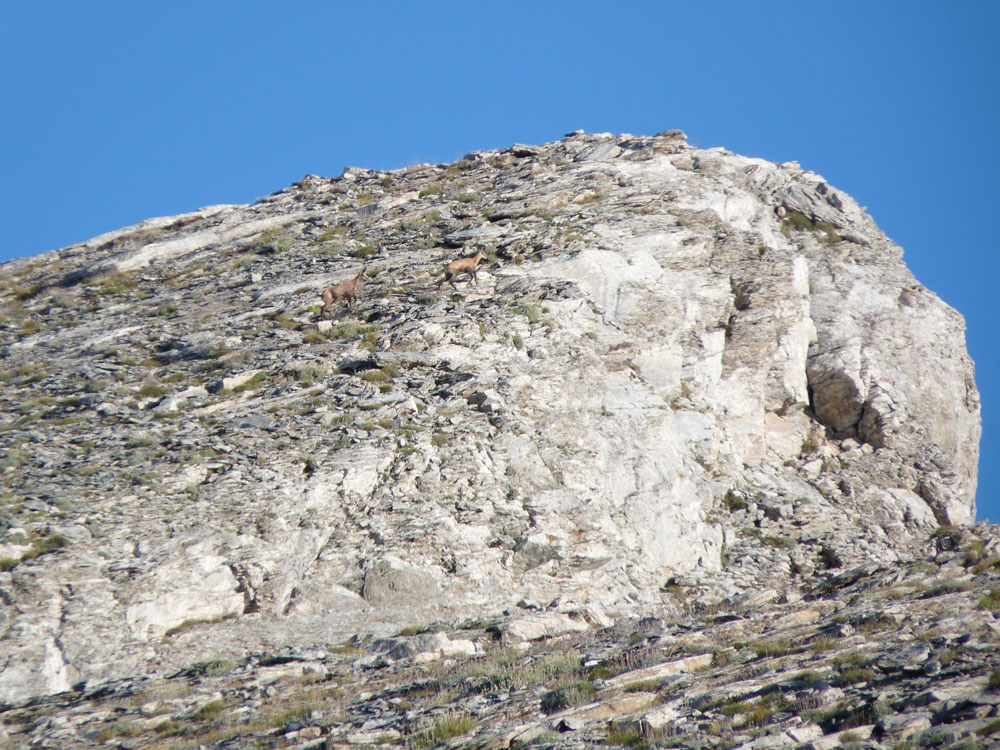
From there the route gets more challenging. First you drop down a little way from Skala into the labyrinth of rocks high up on the east face of Mytikas, before clambering upwards, following the paint splashes, to reach the vertigo-inducing Mytikas peak (2918 metres).
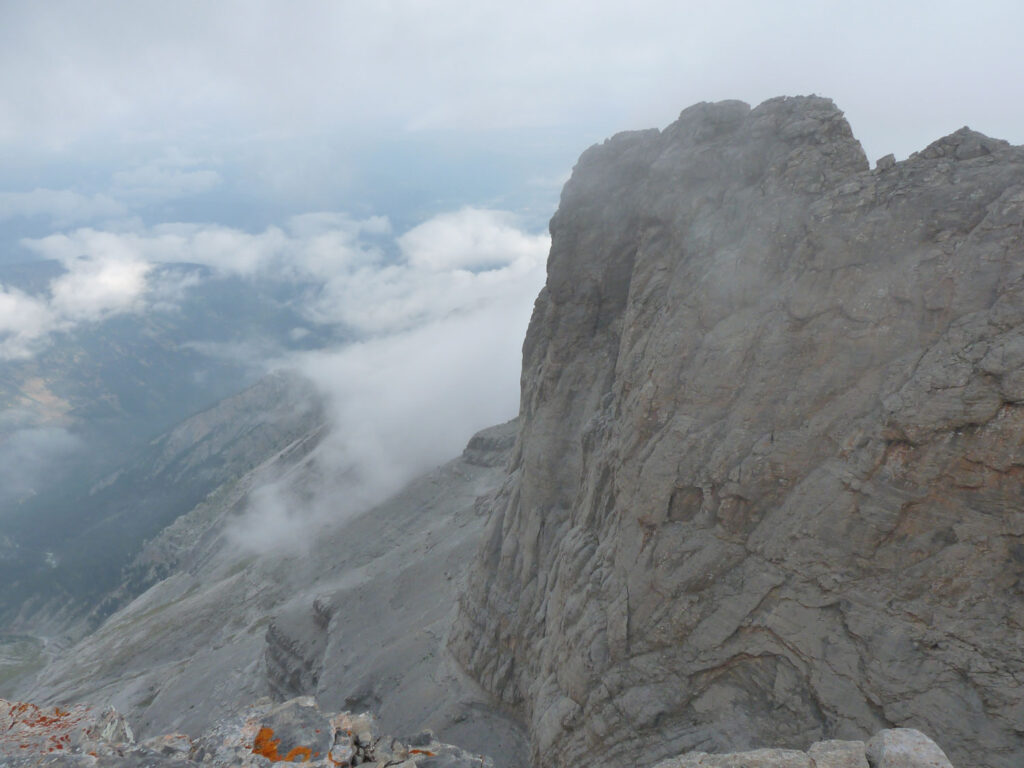
You can either retrace your steps, or else carry on eastwards from the summit, picking your way down a steep scramble through the Louki Couloir.

That brings you to a clearly marked track that leads southwards along the zonaria, then rejoins the path to the refuge that you came up on.
This is a serious scramble. In summer with good weather it’s relatively straightforward, and fine without a rope for anyone with a fair amount of hiking experience and a good head for heights. In winter or in bad conditions it could be very dangerous, especially if you don’t have the right kit and the right expertise.
It’s important to follow the route markers rather than sticking rigidly to the .gpx file if you find there are moments where they don’t match exactly!
For other accounts of the route you could have a look at the official website of the Agapitos website, which has good descriptions of both the scramble from Skala, and the Louki couloir route.
See here for spectacular panoramic photos from a wide range of Olympus summits (Olympus is the most multi-peaked mountain in Greece, with more than 50 peaks in total).
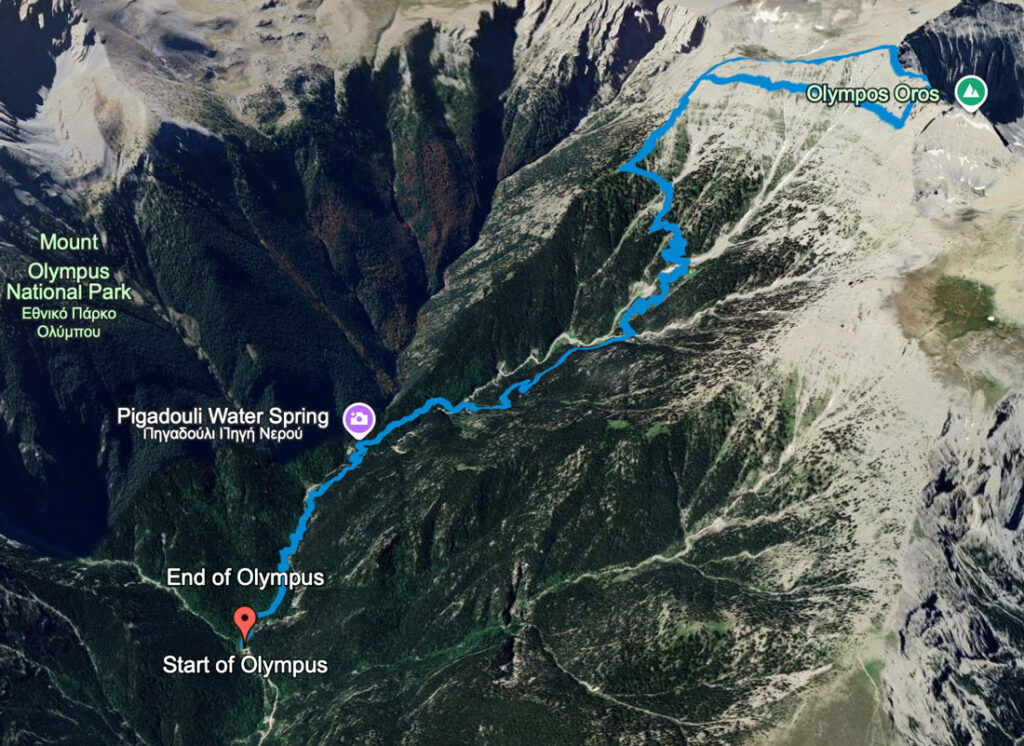
It’s possible to do the route in a day, but it’s a very long trip: it’s 17 km and 1800 metres of ascent from the Prionia car park and back.
Many people choose to stay in the Agapitos refuge overnight and go up to the summit first thing in the morning from there, and you might find that’s a more pleasant option (the refuge sleeps more than 100 people, and you can get a good evening meal).

From the refuge to the summit and back is 6.5 km and 850 metres ascent (although much slower than it sounds: it is slow progress over the rocks!)
The start point for the route is here. The downloadable GPX file is below.