This walk gives you a glimpse of the forested landscape of Menalo, setting out from the beautiful village of Stemnitsa.
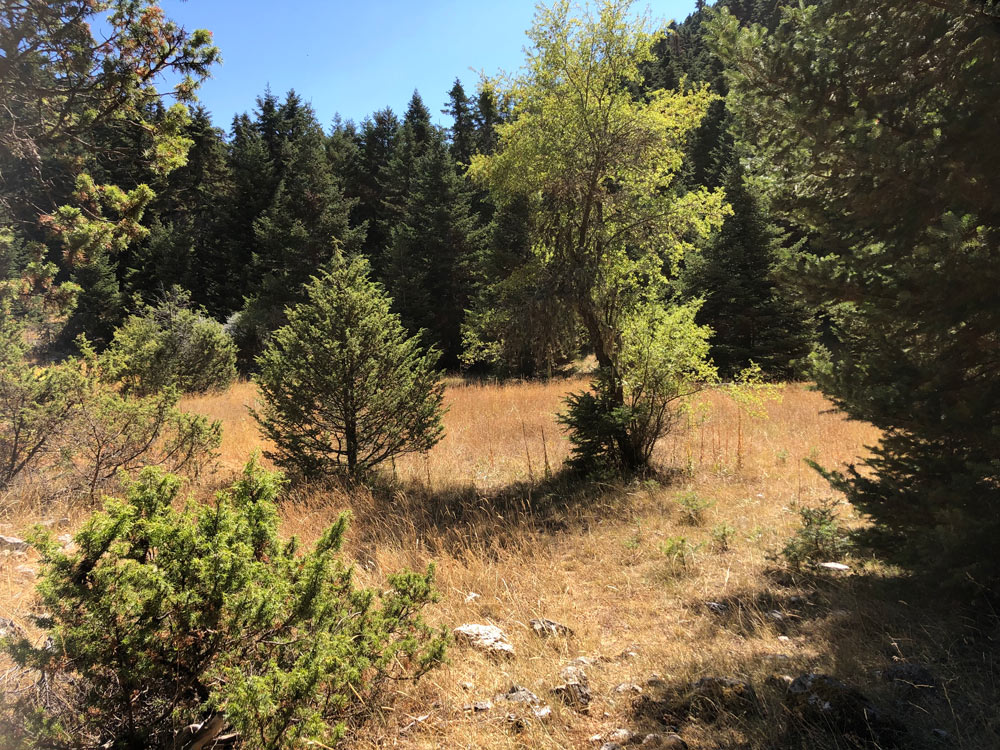
If you’re interested in the history of Menalo, going up to the summits feels like it’s missing the point. Like a lot of Greek mountains Menalo (Mainalon in ancient Greek) has been referred to in the singular from antiquity onwards, but it’s actually a huge range stretching for several days’ walk across the central Peloponnese, rather than a single peak. For ancient writers the whole region was marked by some very powerful imaginative associations.
Menalo in Ovid’s Metamorphoses
It is particularly linked with a series of Arkadian heroines, among others with the nymph Callisto. Her story is told by the Latin poet Ovid in his Metamorphoses.
First Callisto is spotted by Zeus as he travels through Arkadia. Ovid tell us ominously:
no other nymph who set foot on Menalo was more favoured by Diana [i.e. the Roman name for Artemis] than she was; but no pre-eminence lasts for long. (Ovid, Metamorphoses 2.415-16)
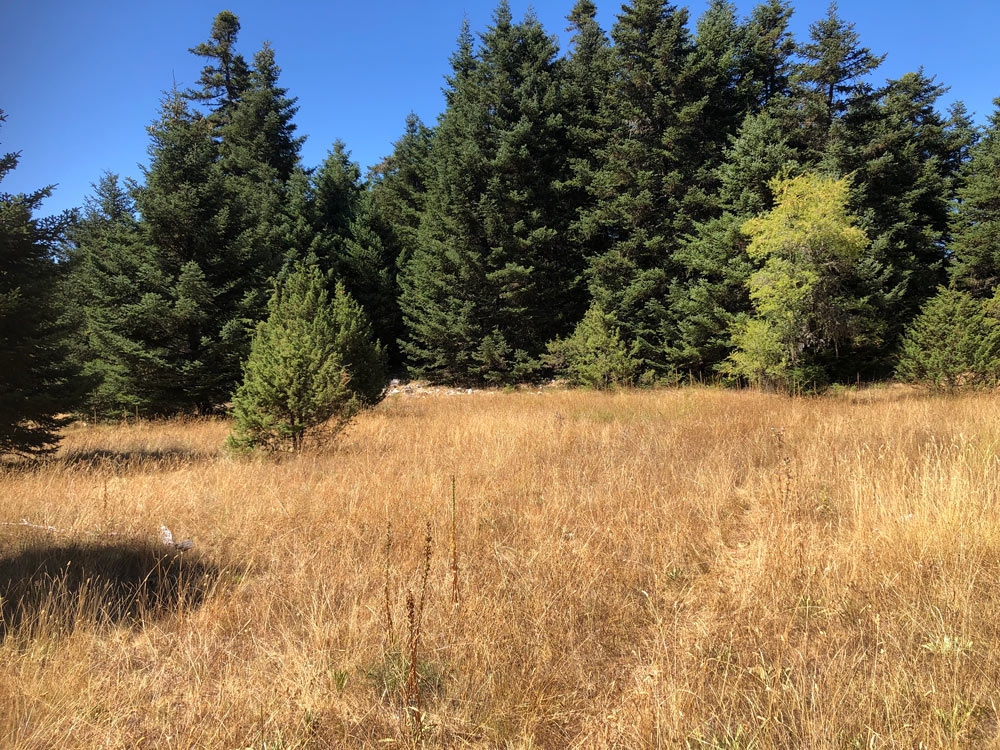
It is the middle of the day. The nymph goes into the shade of the ancient forest, lying down on the grassy ground with her head pillowed on her quiver. Zeus disguises himself as Diana and forces himself on her, despite her struggle to resist.

Jupiter and Callisto, Angelica Kauffman, 1760s, private collection (the eagle is the giveaway…)

At first ‘the forest is hateful to her, and the woods that know her secret’ (2.438). But soon enough her former life claims her back:
But see, Dictynna [i.e. Diana], accompanied by her chorus of nymphs, approaches along the heights of Menalo, proud of her slaughter of wild beasts; she sees Callisto and calls out to her (2.441-3)
Callisto is brought back into the fold.
Nine months go by. Hot with hunting Diana and her train come to a cool grove with a stream flowing through it, and the goddess decides that they will bathe in it. Callisto holds back out of shame, but they compel her to join them in stripping naked, and her secret is discovered.

Diana and Callisto, Sebastiano Ricci, 1710s, Gallerie Accademia, Venice
_Diana_and_Callisto_by_Sebastiano_Ricci_-_Gallerie_Accademia.jpg)
Diana banishes her and she ends up transformed into a bear, hunted by own son Arcas.
In Ovid’s version of the mountain, Menalo is a hidden landscape: a place of shady forests and unexpected streams, a place of secrets.
Pan
But above all this is the territory of Pan. It’s one of several Arkadian mountains he spends his time on.
Theocritus invokes the god in one of his pastoral Idylls:
O Pan, Pan, whether you are on the high mountains of Lykaion, or ranging over great Mainalon. (1.123)
Pausanias says that
They regard Mount Mainalon as especially sacred to Pan, and those who live around it say that they can actually hear Pan playing his pipes. (8.36.8)
But my favourite passage is the description of him in the Hymn to Artemis, by the Hellenistic poet Callimachus.
The poet describes the goddess as a child, first of all precociously demanding from Zeus all the things she needs to get her hunting career underway (‘give me twenty nymphs, who will take care of my boots and swift dogs … and give me all the mountains’, 15-18), then turning up at the hut of Pan in Arkadia:
Pan was cutting up the flesh of a Mainalian lynx so that the breeding bitches could eat it as food. And the bearded god gave you two half-white dogs, three chestnut, one speckled, which can even bring down lions, when they seize them by the throat, dragging them still living to the fold. And he gave you seven Cynosurian dogs, swifter than the winds (88-94)
for hunting deer and hares and porcupines.

Hunter with dog, Red-figure lekythos, Sicily, 5th century BCE, Museum of Fine Arts, Boston
_detail.jpg)
This scene is a very rare example in Greek literature of Artemis and Pan meeting, despite the fact that these are the two most mountainous of all Greek divinities in Greek myth (Andrew Faulkner has made that point in a fascinating article, ‘Et in Arcadia Diana’, published in the journal Classical Philology in 2013).
They are usually kept apart from each other, perhaps partly because Pan’s reputation for sexual predation would be a dangerous thing to bring into contact with the virgin goddess Artemis (but not an issue in this case, with Artemis still so young).
It’s as if they inhabit slightly different spaces in the mountain ecosystem, always slipping past each other just out of sight among the trees.
Mainalian lynx
I particularly love that image of the mountain god cutting up the lynx for his dogs.
I think we’re probably meant to envisage the hut of Pan on Mount Lykaion, but the text leaves open the possibility that it is on Menalo—and certainly that is where the lynx is from.
It’s possible that a small Balkan lynx population does cling on in northern Greece even today. There were regular sightings on mountains in the Peloponnese in the late nineteenth century. It’s tantalising to imagine them there flitting through the forests.
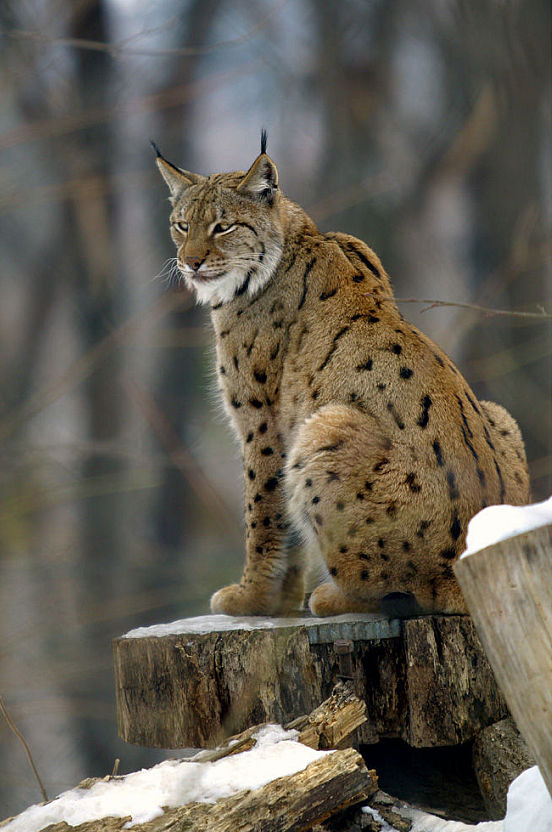
Lynx, Schönbrunner Zoo, Vienna

But of course this would have been a fantasy landscape even for Callimachus’ original audience in the third century BCE. The reference to the lions makes that clear: it takes us into the mythical time period of Herakles, with his hunting of the Nemean lion.
Arcadian stereotypes
Of course it’s easy to fall into the old stereotypes of Arkadia as an idyllic, isolated, pastoral landscape. Those images probably don’t do the region any favours, even if they attract some extra tourists in the short term.
In the 21st century this is a place that it is shaped by its interaction with the urban sphere (I have learned a lot from reading Metaxia Markaki’s work on that just in the last 24 hours!)
That was true in antiquity too. We tend to think of mountains as isolated places, and many ancient writers present them in those terms, but in practice they were often closely intertwined with the urban world, both economically and politically.
But maybe looking back to the ancient world can at least help us to understand where those images of idyllic isolation come from, and why they are still so powerful and persistent…
The route
Menalo is full of wonderful places to walk. As always, the Anavasi series has all the maps and route suggestions you could need.
I haven’t done it myself, but if you are feeling ambitious you can follow the long-distance Menalon trail (75 km, in eight stages). Mike Cullen and Tim Salmon have a good description in theirTrekking in Greece, or you can see the website with detailed mapping here.
This route is on a much smaller scale. It gets you up into the secluded forests of western Menalo very quickly.

From the east end of Stemnitsa you follow a narrow track climbing steadily up to the northeast (trail 11a on the Anavasi hiking map 8.5, ‘Mainalo, Artemisio, Lyrkeio, Farmakas, Ktenias’).
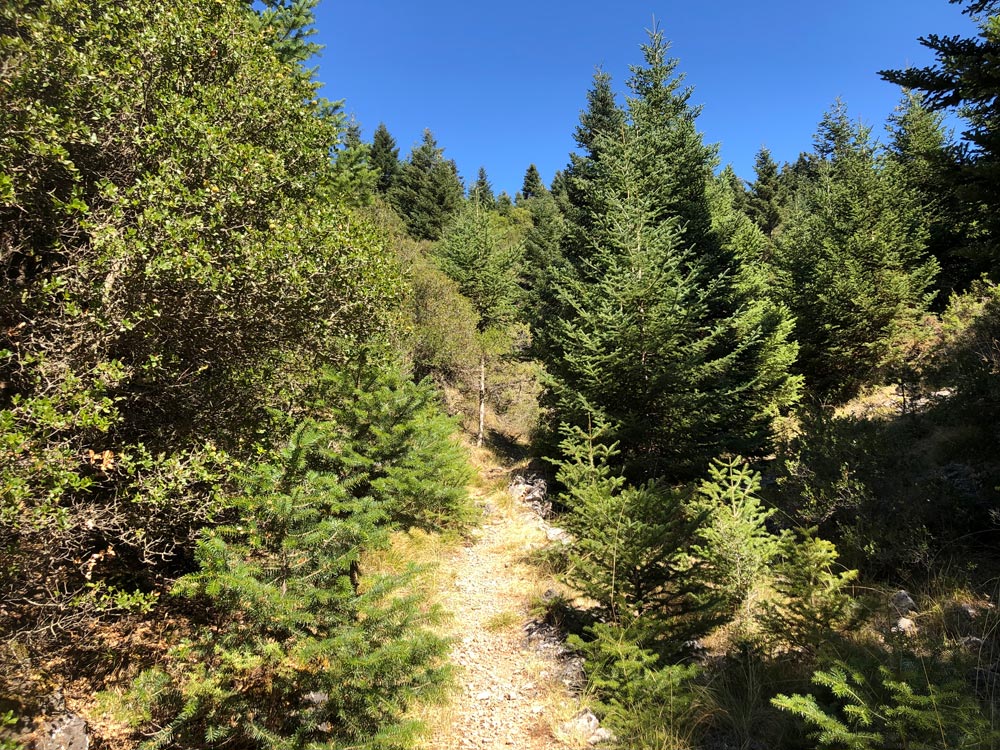
You’re hemmed in by trees on both sides, but then every so often the path opens up into a secret clearing, most spectacularly so at Kournovrisi.

It feels like a magical place, a place you could inhabit without anyone knowing you are here. I can just imagine Pan camped out here with his dogs, head bowed over his lynx skin, not expecting the demanding young visitor who is about to appear out of the trees.
There are lots of options for making a good circular route from there. The version suggested below loops round to the west, following the Menalo trail for a short distance, then back down into Stemnitsa, past beehives and an old monastery perched high up on the hillside.


The round trip is 13 km, with about 450 metres of ascent.
The start point for the route is here. The downloadable GPX file is below.
Thanks to Nena Grintzia at Mpelleiko for route advice!