This is the first in a series of four posts on the mountains of Attica: Hymettos, Penteli and Parnitha.
The long ridge-line of Imittos (Hymettos in ancient Greek) is visible from right across Athens. From the south east of the city it almost feels like you can reach out and touch it.
But what it’s like to explore up there? And what’s it like to explore the much more untrodden terrain of the mountain’s mythological heritage?
Honey
There is archaeological evidence for worship of the god Zeus near to the summit: we will come back to that in another post.
But what role did the mountain play in Greek literature and mythology?
On the whole the mountains around Athens don’t have a strong mythological presence, perhaps because they were so much associated with economic uses in antiquity. Hymettos was famous for its honey, thyme and marble.
There are some exceptions. Several sources tell the story of the philosopher Plato as a baby: his parents took him up the mountain after his birth to conduct a sacrifice on his behalf. While he lay on the ground a swarm of Hymettian bees filled his mouth with honey, signalling the sweetness of his tongue.
Cicero mentions the story in his work On Divination (1.78), but without locating it on Hymettos. The full version is in a work by the Neoplatonist writer Olympiodorus from the sixth century CE: he seems to be envisaging the story in the Cave of Pan at Vari in southern Hymettos (you can read more about the cave on the Topostext page here, or for a good recent account of descending into the cave see here).

‘Cave of Pan near Sunium’, Simone Pomardi, with Edward Dodwell, 1805

Procris and Cephalus
But the most common Hymettos story is the tale of Procris and Cephalus. You can find plenty of webpages that summarise it in a sentence or two, but what do you find when you dig into the original texts and look a bit more closely at the way they imagine the mountain?
The longest version is in the work of the Roman poet Ovid. In Book 7 of Ovid’s Metamorphoses, Cephalus tells his story.
Mount Hymettos lies at the heart of it, as a place of hunting and divine encounter.
First of all, Hymettos is the venue of Cephalus’ abduction (not long after his marriage to Procris) by the goddess Aurora (Dawn):
It was the second month after our marriage rites when yellow Aurora, early in the morning, having driven away the shadows of the night, set eyes on me as I was spreading out my nets to catch the antlered deer, from the summit of always flowering Hymettus, and carried me away against my will. (Ovid, Metamorphoses 7.700-704)
Why is Hymettos described as flowery here? One answer is that unmarried girls are often abducted from flowery meadows in Greek mythology. Persephone (or Proserpina) is a famous example, as described in the Homeric Hymn to Demeter, or in Ovid, Metamorphoses Book 5 (so not long before the lines from Book 7 that I have just quoted).
Here the tables are turned, and Cephalus is put in the position of one of those vulnerable women.

The abduction of Cephalus, Antikensammlung Kiel B 787

Cephalus resists Aurora’s advances, proclaiming his love for his wife Procris, and she sends him back in disgust, telling him that ‘you will wish that you had not had her’ (7.713)

Aurora and Cephalus, Marcantonio Franceschini (1648-1729)

Death on the mountain
Later Cephalus and Procris are estranged, and then reconciled. Cephalus resumes his hunting back on Hymettos. He doesn’t seem to have learned his lesson:
In the early morning, when the sun had barely touched the peaks with its first rays, I used to go, as a young man does, to hunt in the woods, and no servants came with me, or horses or keen-scented dogs or knotted nets. I was safe with my javelin. (7.804-8)
Should he really be exposing himself to the dawn on the mountaintop again?!
When he is tired he rests in a cool place and calls upon the breeze (aura) to soothe him. Someone overhears, and assumes that Aura is the name of a nymph (has Cephalus told anyone what happened with Aurora? has he got a reputation?) and tells Procris.
She follows him next time he goes hunting. Cephalus overhears her approaching, assumes she is an animal, and kills her with his javelin.
Edward Dodwell and the colour purple
In the version in the Metamorphoses the setting of this death scene is not identified as Hymettos explicitly, but in another version, in his Ars Amatoria, Ovid gives a detailed description of the mountain and the idyllic resting place of Cephalus, which he identifies as ‘near the purple hills of flowery Hymettus’ (AA 3.687).
The colour of Hymettos is really important in many of these passages: for example, the yellow or golden colour of Aurora, or the purple hills in that last passage.
The early nineteenth-century travel and painter Edward Dodwell talks about Hymettos in terms of colour and light too. He describes travelling up there to paint a panorama of the city below from one of the summits, riding uphill ‘over the bare and shining surface of the rocks’.
Like Ovid he remembers the colour purple above all:
Hymettos is remarkable for its purple tint, at a certain distance; particularly from Athens, about an hour before sun-set, when the purple is so strong, that an exact representation of it in a drawing, coloured from nature, has the appearance of exaggeration.
(For a longer discussion of Dodwell’s trip up Mount Hymettos, see here).
Light
Imittos seems to be associated especially with an intense experience of light and colour in antiquity and in the work of modern travellers who were familiar with classical texts, and I think it’s easy to see why if you go up there today.
I haven’t ever been on Imittos at dawn, so I can’t comment on Ovid’s Aurora scene. But I have been there several times towards the end of the day. I’m not sure if I recognise the purple colour, but certainly there is an extraordinary impression of light from the summit ridge at that time. There are spectacular views down to the city in the plain below, a vast sea of stone and glass and metal glinting in the setting sun.

Reading Ovid with the present-day landscape of Imittos in mind helps us to see the mountain as a place of spectacular light and colour.
It also helps us imagine ourselves into an emptier, more enchanted, perhaps more threatening mountain landscape, far away the presence of the modern city.
The route
There are countless trails on the western side of the mountain, winding up through the trees. You could spend half a lifetime getting to know them. The mountainside is busy with people walking and cycling at the weekends.
But still it’s easy enough to be alone up there.
I walked on this path without planning it. I had a couple of hours to spare before going to the airport, so I parked at the Kaisariani monastery in the northern area of Imittos and wandered uphill from there.
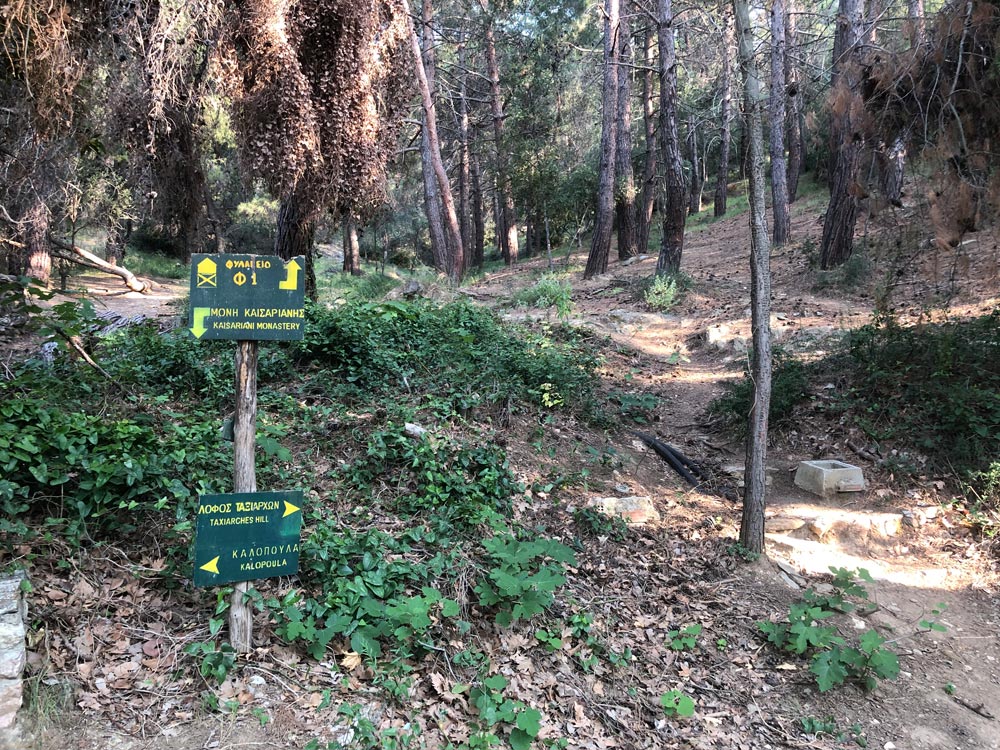
There are plenty of alternative paths on the lower slopes above the monastery—you don’t need to follow this route exactly.
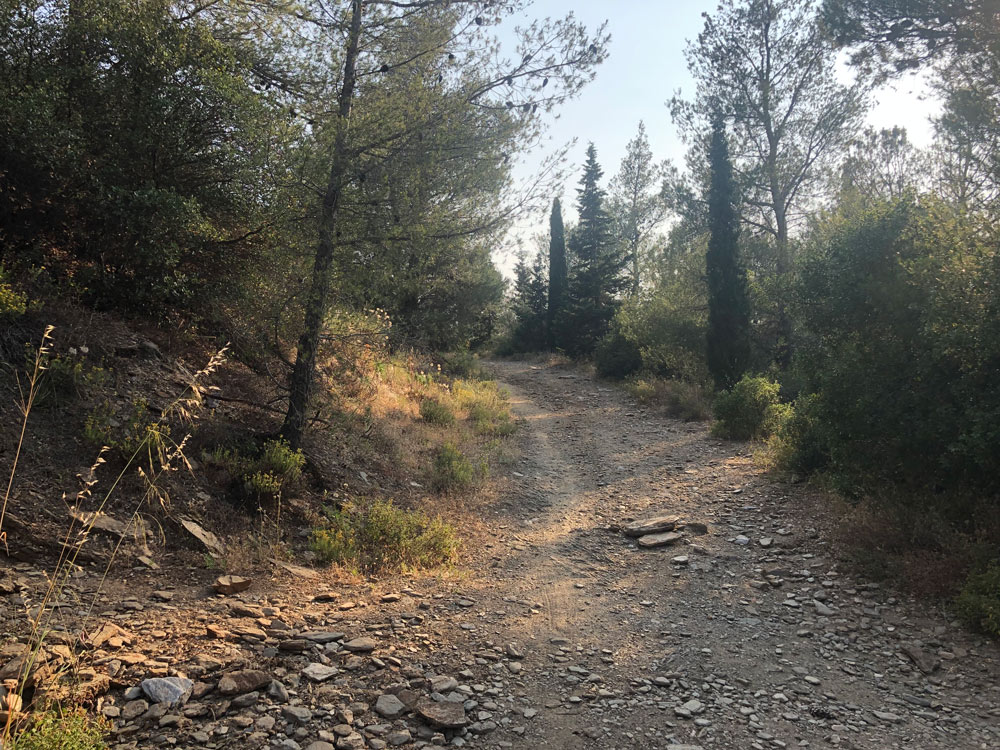
At about 575 metres above sea level you join a dirt track at a hairpin bend. You go uphill along the track to the south-west, for 500 metres or so, along to the next hairpin.
Then instead of following the track sharply round to the left you go straight ahead on a faint path up into the undergrowth.
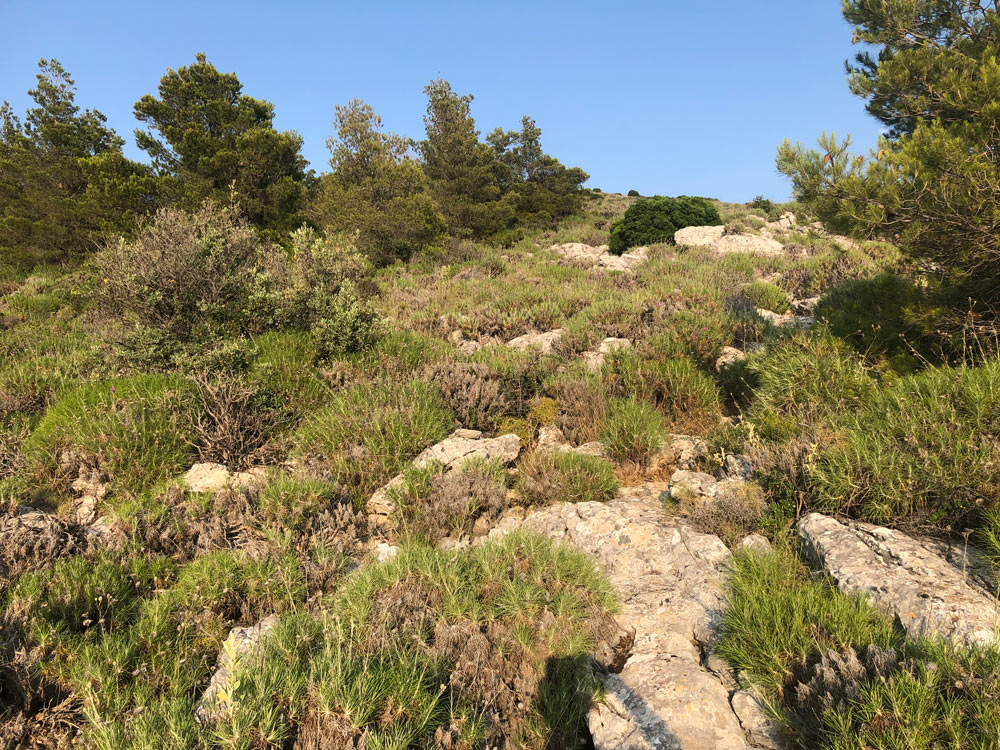
The path is marked with a dotted line on the Anavasi map. It wanders its way up through rocks and bushes. You have to keep your eyes peeled for the occasional paint splashes marking the way. There were spiders’ webs stretched all over the path: I don’t think many people come up here. On your right, to the south, there are vertiginous views down to the abandoned Kakorema quarry (it’s not a good walk to do if the visibility is bad).
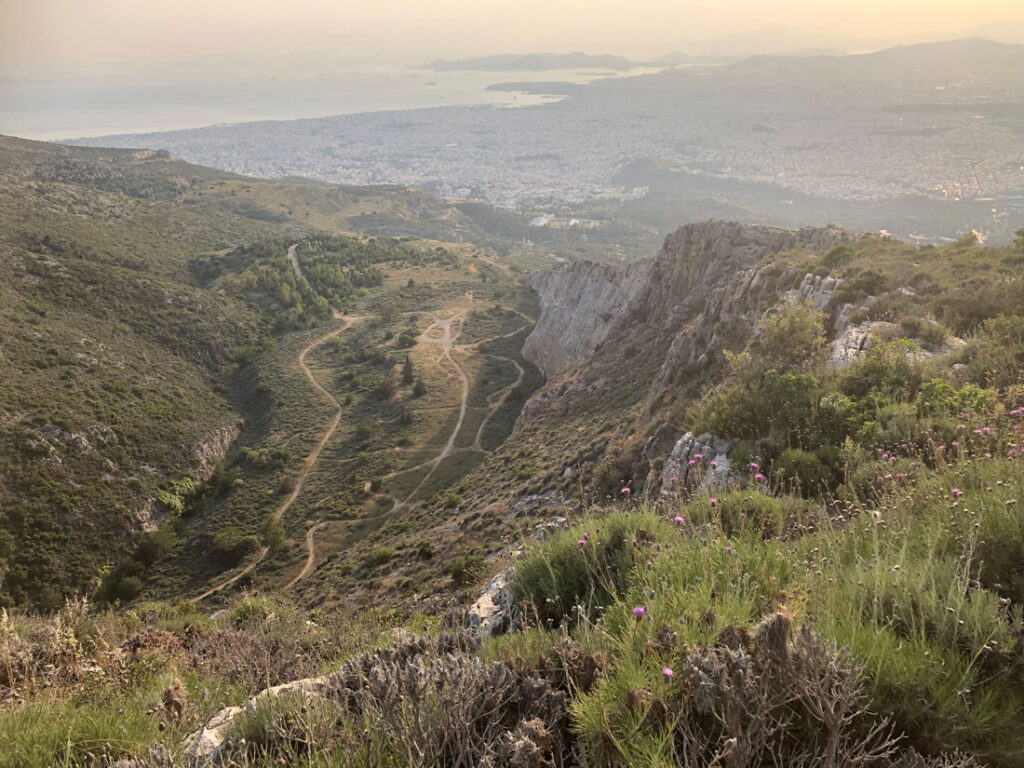
It feels like a route to do slowly, feeling your way along the path.
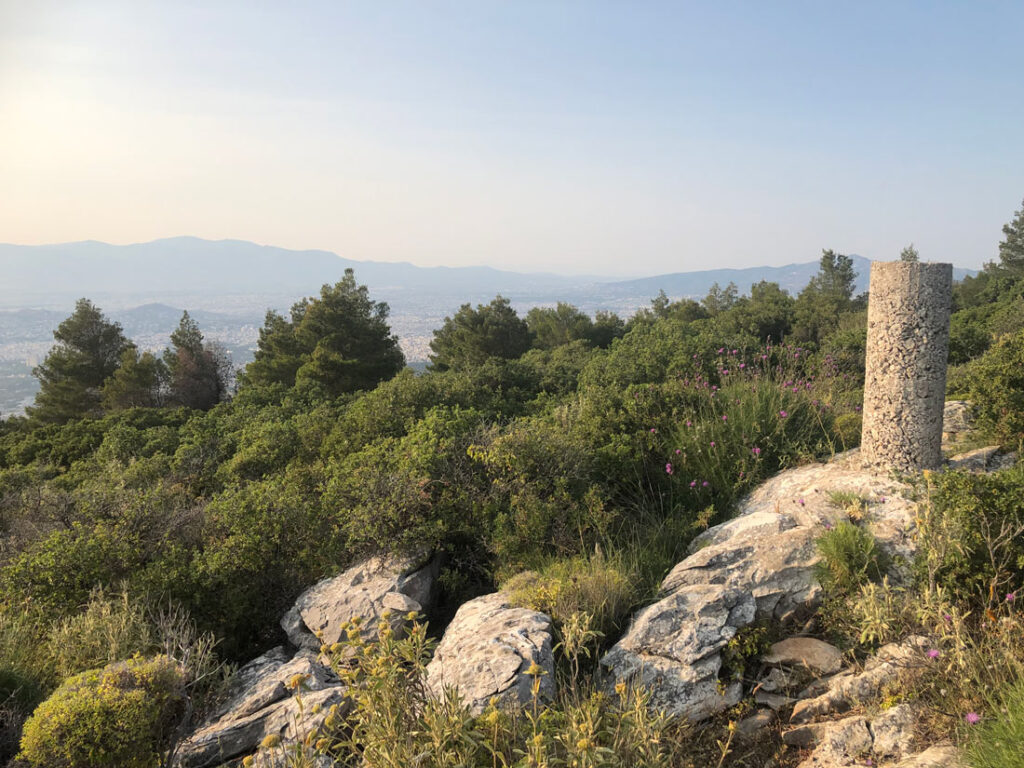
You’re soon enough up at the high point at 738 metres (I’m not sure if it even has a name), with glittering views back down to the city and the sea in the distance.
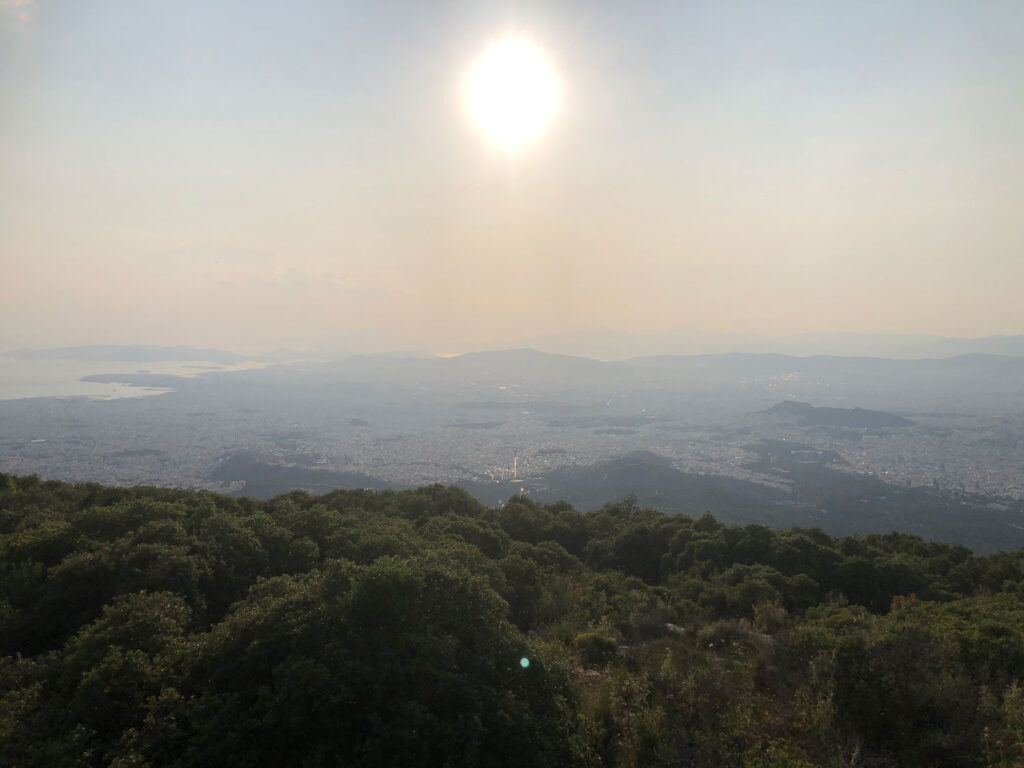
You can retrace your steps from there, or else go on downhill a little way to the north-east: that brings you out on a higher section of the same dirt track, and from there back down to the monastery.

The round trip is 6 km, with about 400 metres of ascent.
The start point for the route is here. The downloadable GPX file is below.