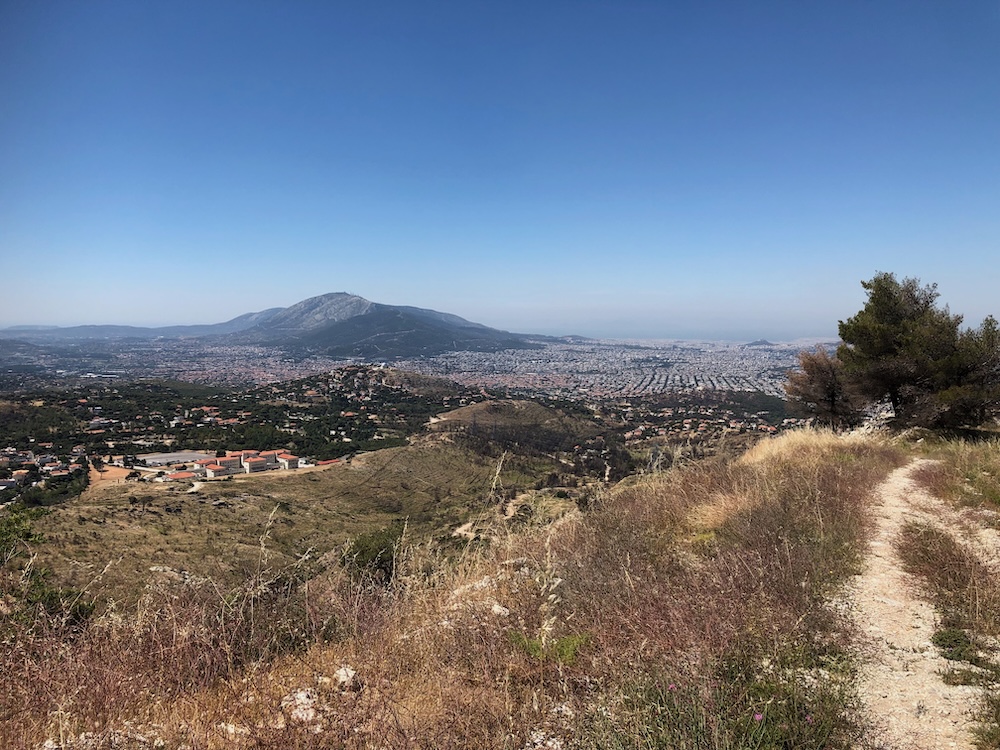
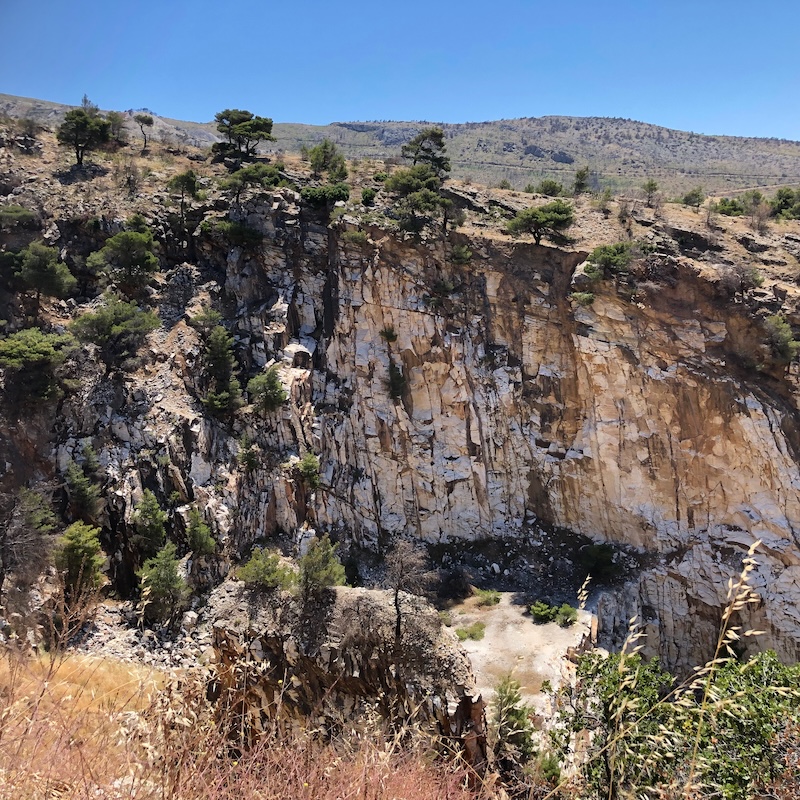
Penteli, north-east of Athens, is the mountain of marble. This short hike takes you up into the foothills to see the ancient quarries.
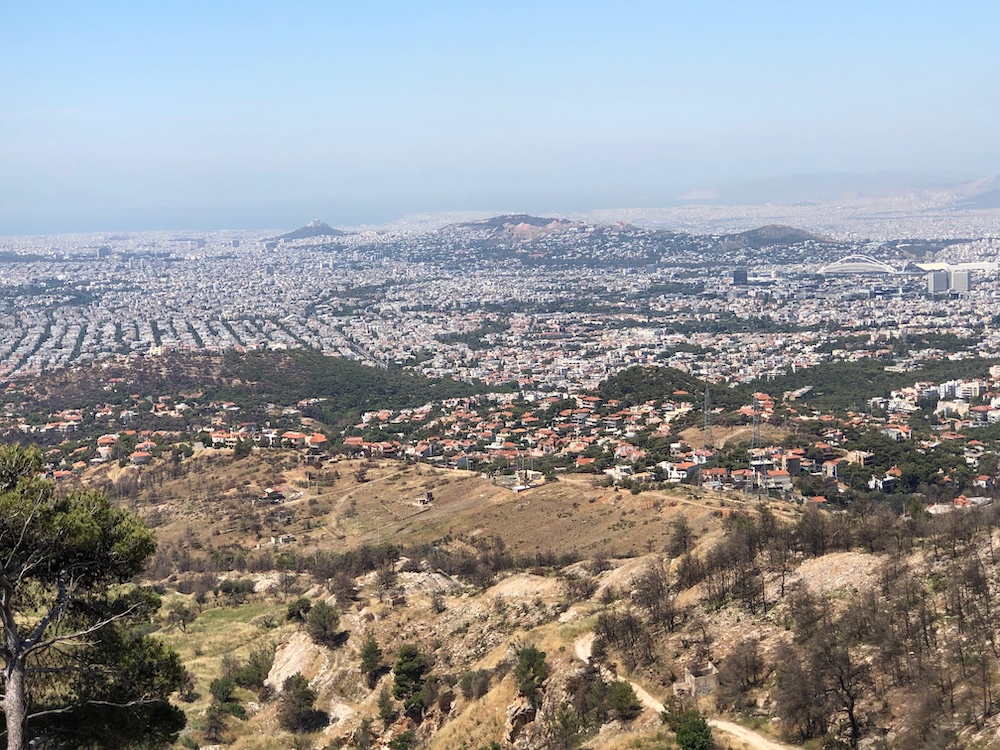
Brilessos (Pentelikon) in antiquity
There are a few passages from Greek and Latin literature that deal with other aspects of the mountain’s identity (in other words not to do with marble!), sometimes using its alternative ancient name Brilessos.
For example, there’s one obscure version of the story of Oreithyia, daughter of king Erechtheus of Athens (from a fragment of the poet Simonides), where she is snatched away from Brilessos by the north wind Boreas (but most versions of the story locate this scene elsewhere).
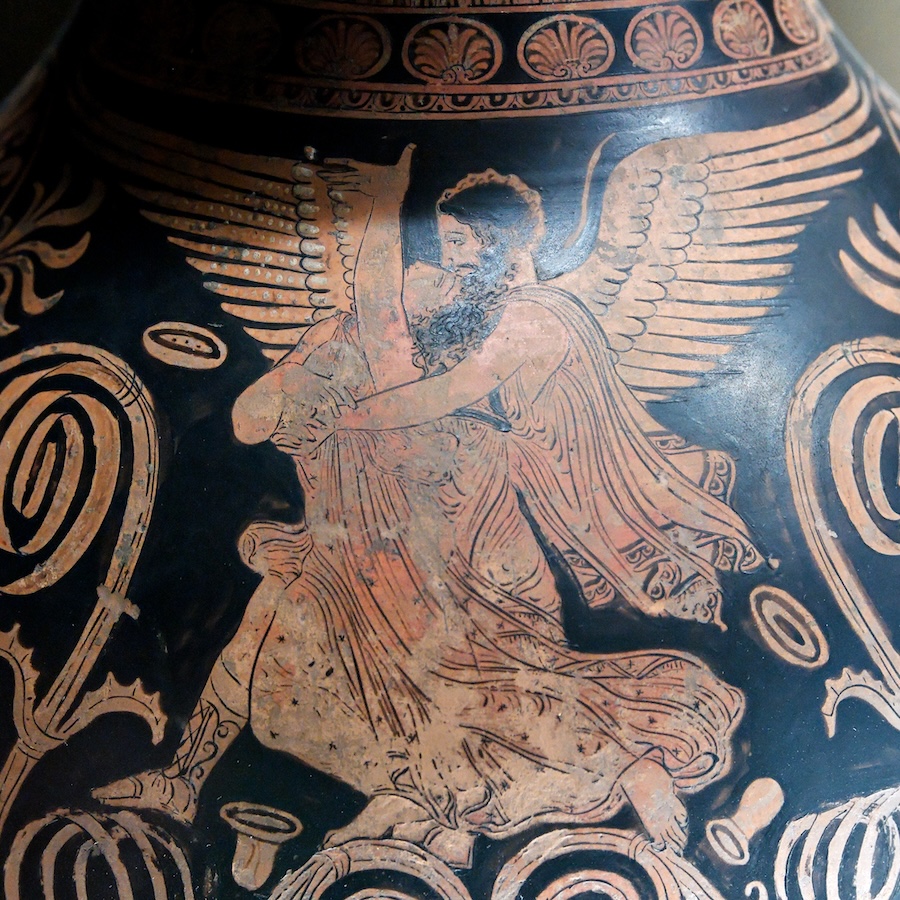
Abduction of Oreithyia by Boreas, Apulian red-figure oenochoe, ca. 360 BC, Louvre

There’s a beautiful passage from Book 2 of Alciphron’s Letters – comic, fictional letters that reimagine the lives of the farmers of classical Attica. The letter writer describes the honeycombs he is sending to his friend as a gift:
They are white in appearance, and drip with streams of Attic honey, of the kind which bursts into flower on the flanks of Brilessos. (2.20)
This honey is not itself from Brilessos, but the letter writer seems to know what Brilessos honey is like. Can we imagine him up there in that empty landscape, neglecting his fields, hunting for this sweet, white treasure?
Pausanias describes a statue of Athene on the summit, but there is very little archaeological evidence for religious activity on the summit: just some scattered concentrations of pottery fragments.
The marble city
But the overwhelming bulk of the ancient evidence is about the famous Pentelic marble.
Famously the Parthenon was built largely of Pentelic marble, and the same was true for many other buildings in ancient Athens.
There’s a wonderful passage from the orator Aelius Aristides, from a speech in praise of Athens delivered in the second century AD. It comes in a section where he is praising the landscape of Attica:
As for the brightness and the charm of the mountains, who would not admire it? – these mountains that have such an excess of ornament that they themselves ornament the cities. (Panathenaicus 21)
He is referring, of course, to marble. This is an unusual expression of the widespread ancient phenomenon where the identity of particular cities, and their religious and economic life, was very closely tied to the mountains that lay close to them.
Aristides offers us an extreme version of that idea: in this case the mountains are actually present within the city – absorbed within its architectural fabric – as well as surrounding it, as sources of defence and wealth and beauty.
Pentelic marble in Pausanias
But the reach of Mount Penteli goes even further. It’s really interesting to look through Pausanias’ Periegesis – his account of the geography and history of mainland Greece, written in the Roman empire around the same time as Aristides’ speech – and put all his references to Pentelic marble side by side with each other.
When you do that you start to see that Mount Penteli is everywhere, not just in Pausanias’ description of Athens, but in his discussion of cities and sanctuaries right across the Greek world.

White marble, Kymi harbour, Evia

To some extent that’s just a reflection of the reality. The ancient marble trade had a huge scale and complexity. Marble provenance studies have been a growing subfield of classical studies: it’s possible from small samples to work out exactly where particular pieces of marble were quarried. Pentelic marble is found very widely even in the western Mediterranean.
But for Pausanias I think it’s much more than that—it’s part of his powerful vision of the interconnectedness of Greece. His obsession with Pentelic marble – which as far as I can see hasn’t ever been discussed before – seems to be a kind of physical manifestation-in-stone of the way in which Athens has shaped the wider culture of Greece.
How do you exhaust a mountain? Herodes Atticus and the Panathenaic stadium
When Pausanias mentions statues and temples built of Pentelic marble, it’s striking that they have often been funded by Athenian benefactors or made by Athenian artists.
The controversial Athenian billionaire Herodes Atticus, more or less Pausanias’ contemporary, is one of them. He built the huge Panathenaic stadium in Athens from Pentelic marble.
A marvel to look at is the stadium of white stone … This was built by the Athenian Herodes, and the greater part of the quarry on Pentelikon was exhausted in its construction. (1.19.6)

But Herodes also adorned other places in Greece with the stone of Mount Penteli. At Olympia
in place of the old statues Herodes the Athenian dedicated new images of Kore and Demeter, made of stone from Pentelikon. (6.21.2)
The stadium at Delphi, Pausanias tells us,
was made of the kind of stone that is common around Parnassos, until the Athenian Herodes rebuilt it with stone from Pentelikon. (10.32.1)
There are other examples of Athenian influence too, dating from hundreds of years before Pausanias was writing. At Aegeira, in Achaia, he records ‘a sanctuary of Zeus with a seated image made of stone from Pentelikon, the work of Eukleides the Athenian’ (7.26.4).
In Megalopolis in Arcadia, Pausanias describes a sanctuary of Zeus ‘Saviour’. Zeus is seated on a throne, and next to him stand a personification of the city of Megalopolis on the right and a statue of Artemis on the left, made from Pentelic marble by the Athenian artists Kephisodotos and Xenophon (8.30.10).
Greece as a marble network
For Pausanias, perhaps more than any other ancient writer, the mountains play a central role in shaping Greek history, Greek religion, Greek identity. Part of that is the way they have shaped the architectural fabric of Greece, even at sea level: Pausanias’ repeated mentions of Pentelic marble make that clear.
In the ancient imagination, each mountain in Greece was part of a network, in contact with other mountains and other places in the Greek world, through a web of interconnections.
If you reach down to the ground on Mount Penteli and pick up one of the chips of marble that are scattered all around, you are touching the whole of Greece.
The route
This route takes you up to the ancient marble quarries. It more or less follows route number 4 on the Anavasi 1:16,000 hiking map (1.3) for Mount Penteli.
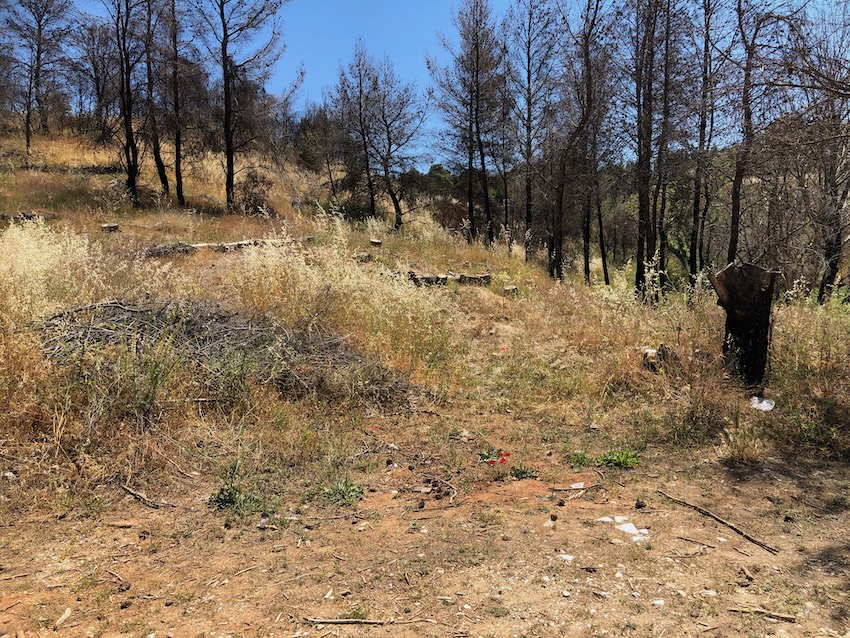
From the outskirts of the modern suburb of Penteli you head north, and then very soon branch off to the right on a narrow uphill path through burnt trees.

The signs of the recent fires are everywhere around you here, but also occasionally small signs of care and regrowth.
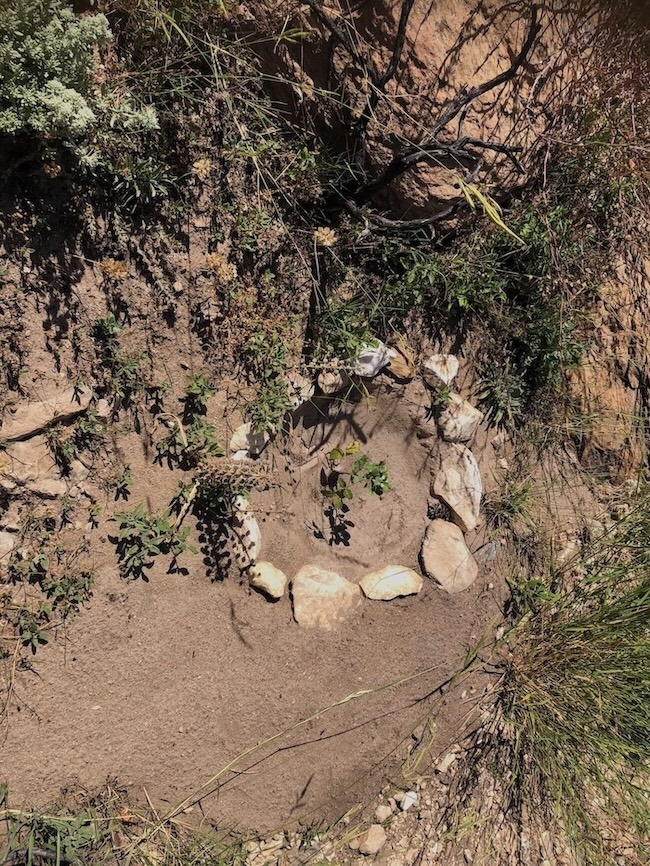
The path climbs steeply, zig-zagging up along the ancient road that was used for transporting marble down from the quarries.
At the top of the climb is the vast Davelis cave.

The route down takes a slightly more roundabout route to the west, with impressive views down to the quarries.

The start point for the route is here. The downloadable GPX file is below.
The round trip is about 6 km, with 290 metres of ascent.