This route takes you up on to the Koromilia peak of Mount Parnitha.
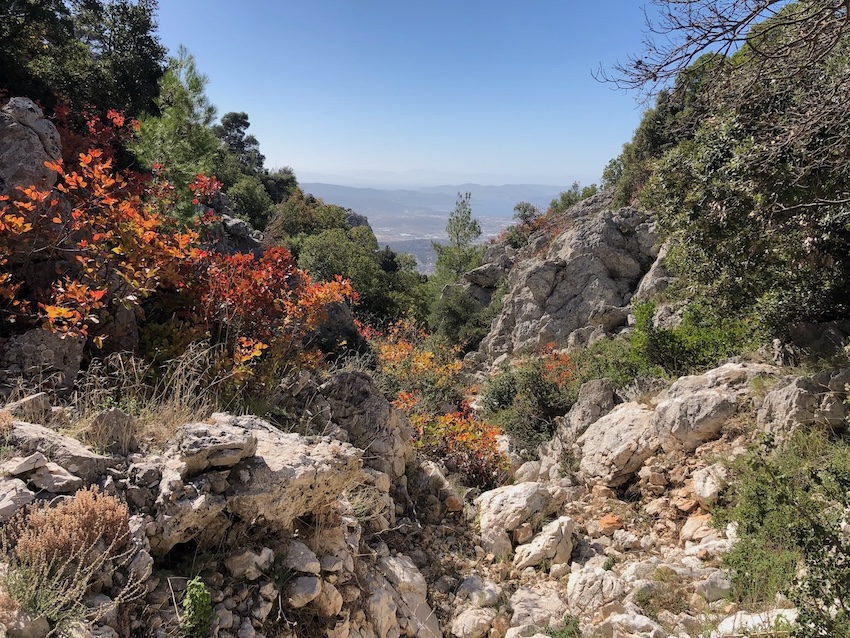
You’re not far from Athens here, but you get up very quickly into territory that feels quite remote and untrodden.
Mount Parnes in antiquity
More than any of the other hills around Athens, Mount Parnitha (Parnes in ancient Greek) feels like frontier territory. It’s a huge mountain. From the main summit the wooded upland stretches for many kilometres to the north and west.
It feels a long way from civilisation – although the terrible wide fires of 2023 are a devastating reminder of the impact of human culture even on the wildest mountain landscapes in Greece.
That’s very much the reputation it had in antiquity too: this was rough land on the very edges of Attica, a long way from the urban centre of Athens.
Parnitha has a rich but inaccessible archaeological heritage: there are remains of an ancient ash altar just below the highest peak, Karavola (1413 metres), uncovered during a rescue excavation for the building of a military base on the summit in 1959; also the famous Cave of Pan, a few miles to the south-west, which I will write about in another post.
What about the literary heritage of Parnitha?
Oddly the mountains of Attica don’t have a big presence in ancient mythology: it’s as if that aspect of their history is drowned out by their economic, military and religious significance.
But here I want to look at one remarkable (though not very well-known) text where Parnitha does have a fleeting but important role as an alternative to the sophisticated city culture of Athens.
Alciphron’s parasites
The text is one of the fictional Letters of Alciphron, written possibly in the third century AD. It’s a collection of more than 100 fictional letters, written in the persona of various low-life characters from a fantasy version of classical Athens half a millennium before. The letters are heavily influenced by the world of New Comedy, especially the plays of Menander.
Book 1 is letters from fishermen, Book 2 from farmers, Book 3 from parasites (i.e. the gluttonous hangers-on who in the Greek comic tradition attend dinners and drinking parties held by wealthy members of the elite, suffering regular humiliations in the process), and Book 4 from hetairai (high-class sex-workers, sometimes translated as ‘courtesans’).
The text I’m interested in is letter 27 from Book 3. The letter writer, a parasite, describes to a friend how the wife of his employer Phaidrias has had her baby exposed–in other words abandoned on the mountainside to die (following closely the plot of Menander’s play Epitrepontes).
This was a common fate for unwanted babies in ancient Greek myth and Greek comedy, and as far as we can tell sometimes in real life too. In ancient literature the baby is always rescued (they are always left with recognition tokens, so that there is at least a theoretical possibility of being identified in future) — but of course that’s not how it was in the real world…
In Alciphron’s version, the baby is exposed on Mount Parnes:
In the fifth month after the wedding Phaidrias’ wife has given birth to a male child. The women wrapped it in swaddling clothes, together with some necklaces and recognition tokens, and gave it to the belly-trailer Asphalion, to take up on to the heights of Mount Parnes.
Asphalion is a parasite, described here as trailing his (presumably very substantial) stomach almost on the ground like a snake.
The letter-writer threatens to tell his master Phaidrias what the women of the household have done, if they annoy him.
A city-dweller in the wilderness
In mentioning the mountain, Alciphron is appealing to a fantasy image of Parnes as a landmark in the literary landscape of pre-Roman Attica, for an audience many of whom would not have been there in person.
Parnes is important here above all as an anti-urban space.
Alciphron is fascinated in his Letters by the connections between country and city: the rustic fishermen and farmers inhabit an utterly different world from the urban parasites and hetairai, but every so often something happens that bridges between those two worlds.
This is one of those moments. Parnes could hardly be further removed from the city life of the letter writer and the characters he describes. The jewels left with the baby as recognition tokens, and the parasite charged with taking them there, are comically out of place in the mountain wilderness.
Can we imagine Asphalion trailing up there—unfit, overweight and hungry, no doubt wearing the most unsuitable clothing, in a rustic landscape he is utterly unsuited to navigate, carrying a baby he has no qualifications to look after—a soft city character out of place in the mountains?
Open paths and cultural heritage
Hiking in west Parnitha can be quite hard going. Certainly the paths on this route are badly overgrown in places.
That’s partly because of the fires: there are trees down all over the paths, and then you get into a vicious circle—the more the paths get overgrown, the less people walk there, the more the paths get overgrown…
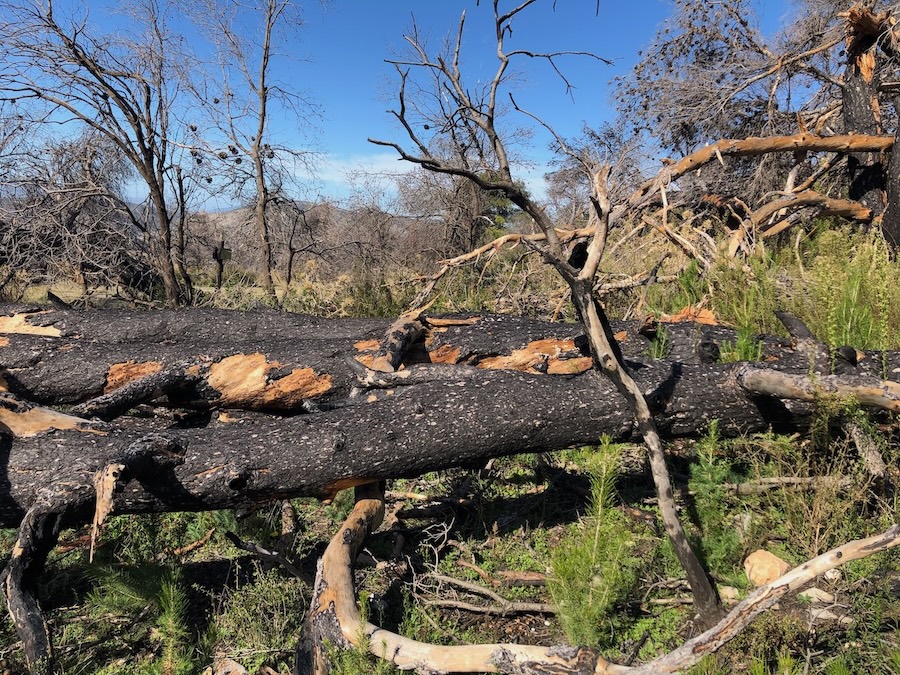
That makes it a perfect landscape for imagining the parasite Asphalion, fighting his way through the undergrowth with the baby in tow…
But it’s certainly not a relaxing place to visit. I hope this post will let you experience it from a distance, if that’s a more appealing prospect!
But if you do ever get the chance to hike on these trails, please do think about giving it a try. Every time you walk on one of these paths you are contributing to keeping it open and in use, and that’s an act of heritage preservation in itself…
The route
The route starts from the car park of the Kiprianos monastery.

The path winds its way up over the hillside, through the blackened trees. I saw red deer ahead of me on the path quite close to the monastery.
There are more and more fallen trees as you go on, until finally you come out on a stretch of meadowland, which gives some welcome relief.

You join a broad track that goes to the east, towards the peak of Keramidhi.
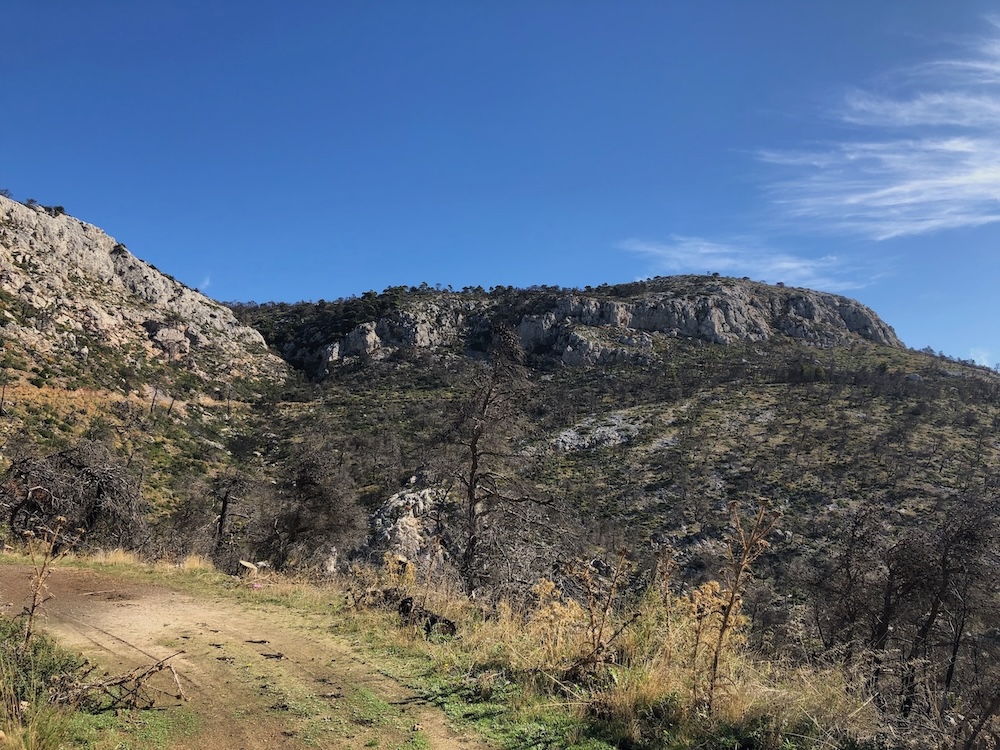
Before long you branch off left uphill into the undergrowth.
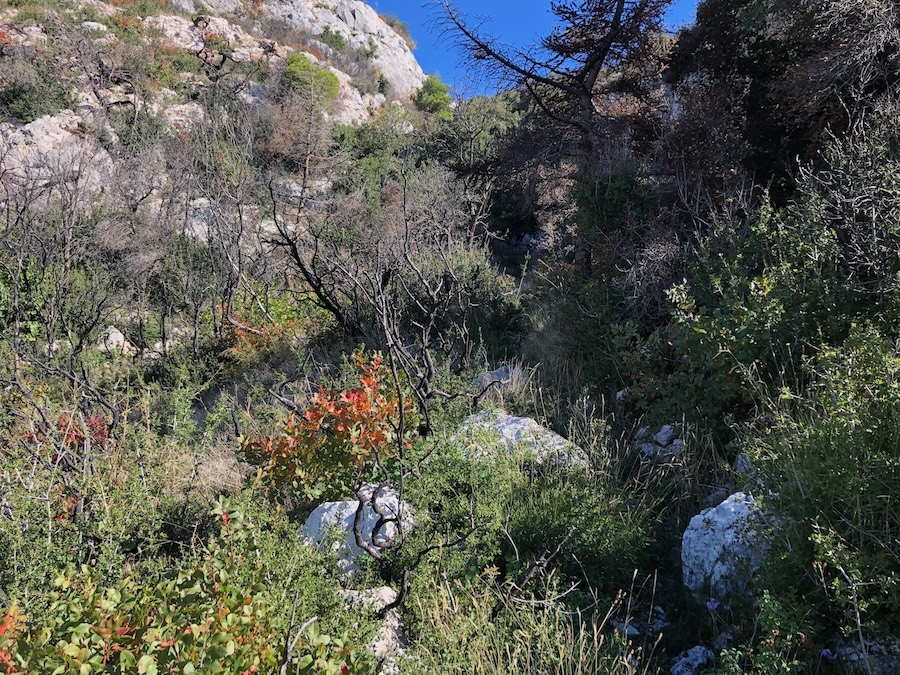
(The alternative on the way up is take the right fork that leads past the Armadhe well and joins the track exactly at this point. For a good account of that variant, plus an extension to the route up to the Tamilthi summit, and some great photos that show how all of this looked before the latest fires, you can have a look at the Olympus Mountaineering post here).
From there the path leads up a steep, overgrown gully, with only occasional signposting. I was wearing shorts and was covered in scratches for weeks afterwards from the spiky kermes oak that is everywhere here.
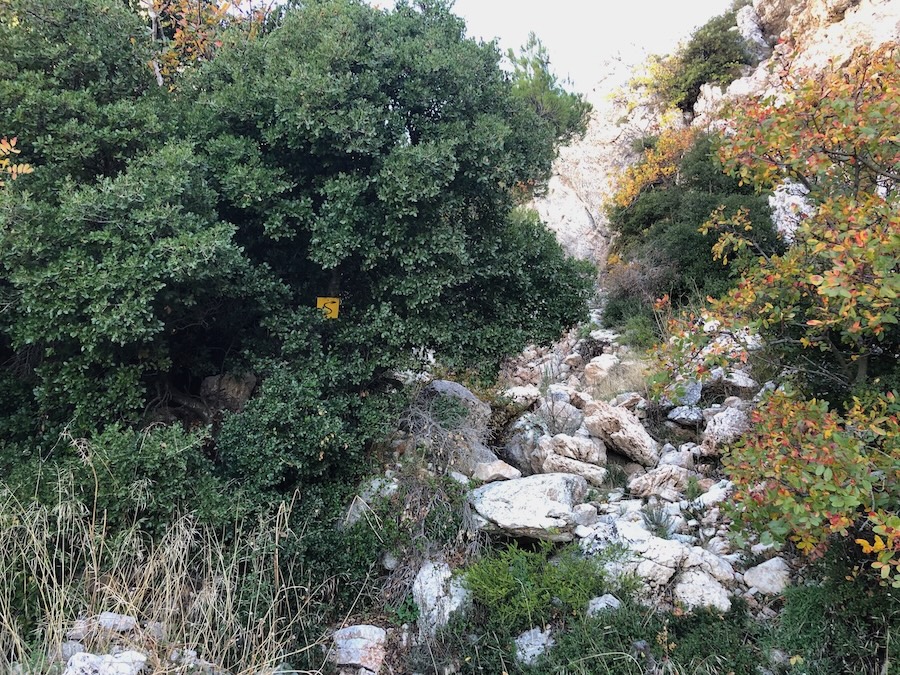
This is where I imagine the parasite Asphalion. Surely no-one will come here? Surely no-one will find the baby here?
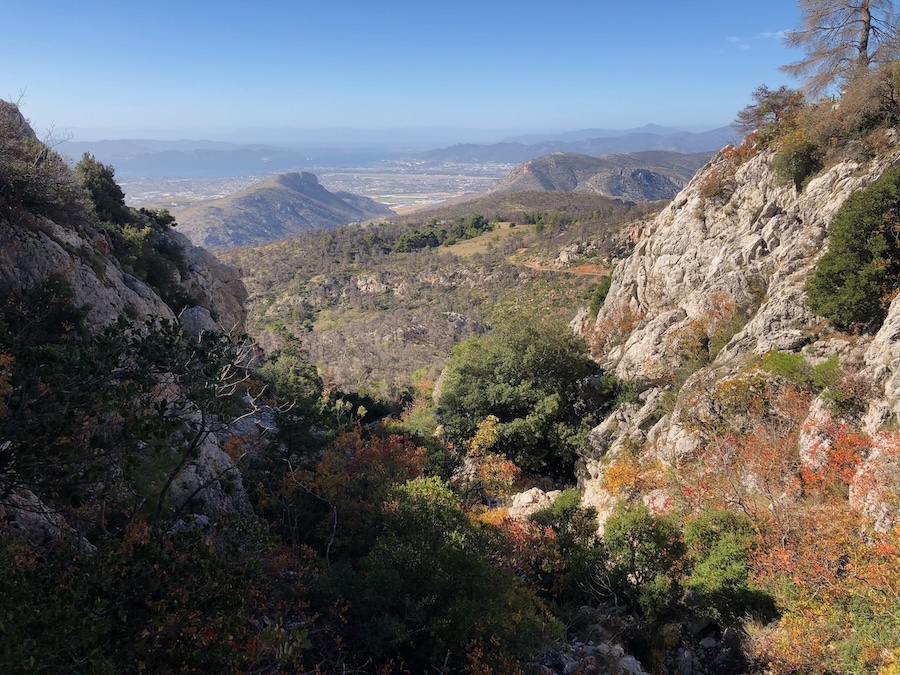
At the top of the gully you come out on to the mountainside, but again the navigation is complicated–there are fallen trees everywhere, and that means that many of the old route markers are not visible (it’s best to do it with GPS if you have that option).

Finally the path turns to the south, the trees thin, and you come out of the trees to the summit marker, with distant views down to Athens. There was just a single raven circling round me over and over again as I stood up there.

I retraced my steps by the same route, but it looks as though you could go south-west instead–there’s a path marked leading at least part of the way down from the summit on the Anavasi map.

The round trip is about 9 km (but they’re very slow kilometres!), with 500 metres of ascent.
The start point for the route is here. The downloadable GPX file is below.