This walk takes you up over the wooded slopes of Mount Kithairon on to the summit ridge, with amazing views south to the Gulf of Corinth, and north over the plains of Boiotia.

Kithairon in Ancient Greek Literature
Kithairon is one of the most written-about mountains in ancient Greek and Latin literature. Unless I’m missing something it’s the mountain that gets the most mentions after Olympus, Ida (in north-west Turkey), Pelion and perhaps Helikon (that claim comes from a non-systematic survey via topostext!)
The summit ridge of Kithairon is quite scarred by the huge wind farm there, so it doesn’t at first look like a promising place to visit, but it has some surprisingly atmospheric trails, and of course an astonishing literary and mythological heritage: there are passages set on Kithairon that still have the capacity to take my breath away even after reading them so many times (I will write more in some later posts!)
The festival of the Daidala
But just to get started here is a passage from Pausanias describing sacrifice on the mountain summit. It’s an account of a festival of the Great Daidala, which Pausanias says was celebrated every 59 years.
First Pausanias explains how the inhabitants of Plataia chose the wood for the statues used in the procession: he tells us that they would put out chunks of boiled meat in a nearby grove of trees, then they would follow the first crow that grabbed the meat; the tree it landed on was the one they used for the statue.
He also gives the most detailed surviving description of a mountaintop procession and sacrifice from ancient Greece (freshly translated here!)
They have fourteen statues ready, which have been prepared each year at the Little Daidala. These are allocated by lot to the people of Plataia, Koroneia, Thespiai, Tanagra, Chaironeia, Orchomenos, Lebadeia and Thebes … The less important towns contribute jointly. They take the statue to the river Asopos and put it on a wagon, together with a woman to act as bridesmaid. Then they draw lots again to determine their order in the procession. After this they drive the wagons from the river up to the summit of Kithairon. On the peak of the mountain an altar has been prepared for them. This is how they make the altar: they fit together squared blocks of wood and put them together just as if they were building a house with stones, and having raised the altar to a great height they pile on brushwood. The cities and their magistrates each sacrifice a cow to Hera and a bull to Zeus, and burn the victims on the altar, full of wine and incense, together with the statues. Private individuals sacrifice the victims one would expect from rich men; those who are less wealthy sacrifice smaller victims, and all the offerings are burned together. The fire seizes and destroys the altar along with them. I know of no other flame that reaches so high or is seen from so far off. (Pausanias, Periegesis 9.3.4-8)
Smoke columns and sacrificial community
That passage brings home the importance of smoke in mountaintop sacrifice. It wasn’t just the people present at the sacrifice on the mountain who were involved in it. Seeing the smoke from below must have made the people watching feel that they were part of what was happening on the summit.
Driving towards Kithairon from the north one of the first things that always strikes me is how close it is to Plataies at the foot of the mountain (i.e., the modern village close to the site of the ancient city of Plataia). It feels near enough almost to reach out and touch it.
Even people in cities much further afield, for example further north in Boiotia, would surely have felt some of that same sense of connection with the sacrifice on the mountain in the distance.
One amazing recent publication by Christina Williamson uses viewshed analysis to analyse the regional significance of the sanctuary of the god Zeus Stratios, on a mountain summit near to Amaseia in north-central Turkey.
What she shows is that the territory from which the smoke of sacrifice could be seen – not the mountain summit itself, but the very top of the smoke column that would have risen up from the sacrifices there – very closely corresponded to the territory on whose behalf those sacrifices were carried out.
I’m not aware of any viewshed analysis for Kithairon, but I suspect the column of smoke would have been visible on a clear day from half of Greece, and certainly well down into the Peloponnese to the south.
And when you stand there you can start to understand why Pausanias talks about it in the way that he does: ‘I know of no other flame that reaches so high or is seen from so far off’.
Viewing Mount Kithairon from Athens
I also hadn’t realised until recently that Kithairon is visible from the centre of Athens, at least from some more elevated vantage points. This photo is taken from the Areopagus. You can see the Kithairon summits peeping over the nearer hills.

Here’s a screenshot from the Peakfinder app (very useful if you want to know what mountains you are looking at in the distance!)

A lot of the recent scholarship on Greek tragedy (most famously in various publications by Froma Zeitlin) has discussed the way in which the city of Thebes in Boiotia is a kind of exotic imaginative space which the Athenians used to explore problems that were familiar in their own community.
The inhabitants of Athens could watch plays about the Thebes – for example about the family of Oedipus – down in the theatre of Dionysus.
Then with a short walk uphill they could see over to Kithairon, the mountain where Oedipus was exposed as a baby.
And if Pausanias is right about the festival of the Daidala on the summit (although actually there is no archaeological evidence for sacrifice on Kithairon) they would every so often have seen those vast columns of smoke rising up into the sky on the boundaries between Attica and Boiotia.
The route
This path rises up steeply from the Aghias Triadhas monastery, to the north west of the main summit.
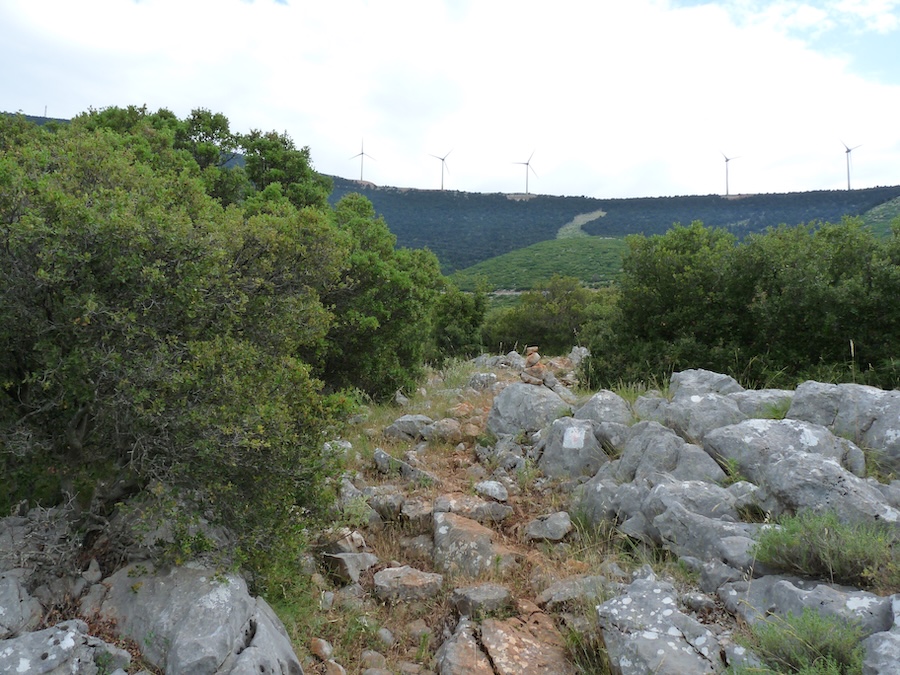
It’s actually quite a memorable path, perhaps surprisingly so given that it involves crossing the wind farm access road several times.
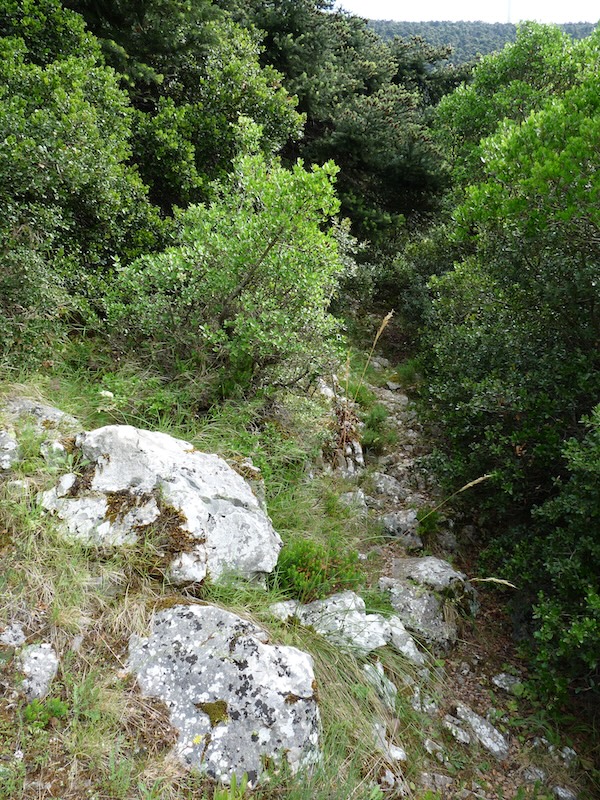
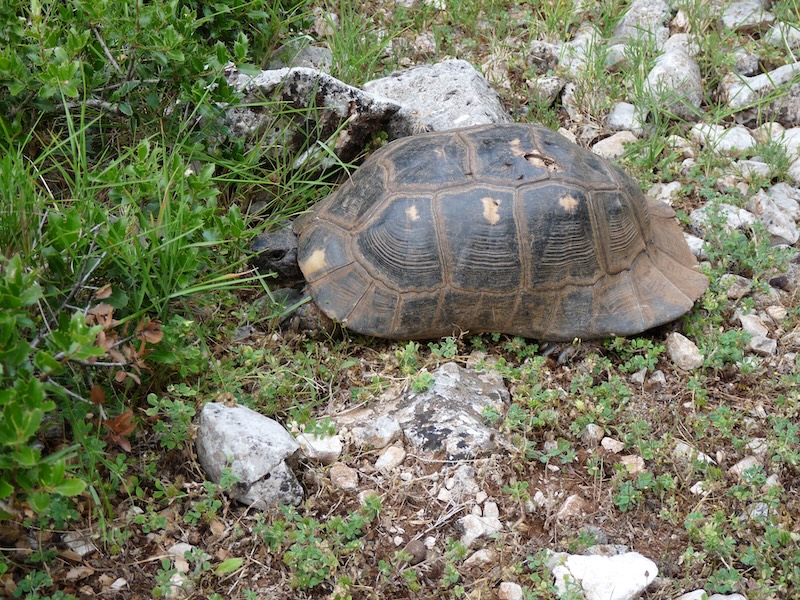
You can follow the markers for the national 022 trail that runs from Athens to Parnassos. You’re under tree cover much of the time. I saw several tortoises.
Then you come out into the open, on to the summit ridge, beneath the huge wind turbines. You can turn left and continue all the way up to the highest summit.
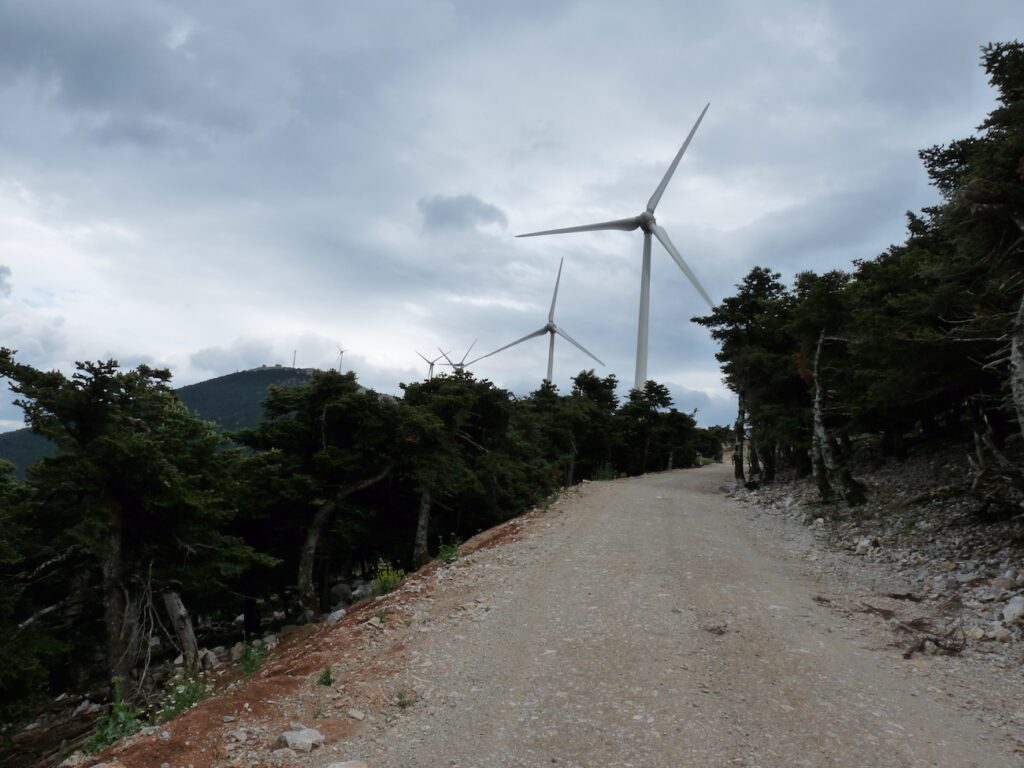
The surroundings aren’t exactly beautiful, with abandoned buildings and masts all around, and sometimes traffic – there’s a road right up to the summit, and plenty of people drive up there – but there’s an amazing sense of height, especially looking south over the flat plains of Boiotia.


To the summit and back is about 11 km, with 850 metres of ascent.
The start point for the route is here. The downloadable GPX file is below.