This walk takes you up to the archaeological site known as the ‘Pyre of Herakles’ on the southern slopes of Mount Oiti (Oita in antiquity), on a beautifully constructed and well signposted path.
Bandit country
Oiti in antiquity was bandit country.
One of the ancient Greek novels, Heliodorus’ Aithiopika (probably written in the fourth century AD) features a scene where the hero and heroine, Theagenes and Charikleia, elope together from Delphi. Theagenes organises some of his friends to create a distraction by pretending to kidnap Charikleia, and riding off to the north into Mount Oiti, while he slips away with Charikleia on board ship (4.22).
In another, earlier novel, Apuleius’ Metamorphoses (written in Latin in the second century AD), the hero Lucius is turned into a donkey. Just hours later he is stolen by a gang of bandits who take him to their mountain hideout.
Apuleius doesn’t tell us where the hideout is, but the fact that Lucius is in Hypata when he is stolen (the modern village of Ypati on the north-western edge of the Oiti massif) suggests that they have made their way up into the empty landscapes of Oiti to the south. Hypata in the novel is represented as a centre of magical practices: that’s why Lucius has come there, out of curiosity, but his curiosity backfires badly!
The terrain they travel through is wild and remote, full of steep cliffs and jagged rocks. On the journey one of Lucius’ fellow donkeys sinks to the ground out of exhaustion. The robbers don’t hesitate: Lucius tells us that they
drew their swords and cut through the hamstrings on his legs; then dragging him a little way from the road they hurled him, even now still breathing, off a very high precipice down into the next valley. (Apuleius, Metamorphoses 4.5)
Apuleius’ novel gives us a powerful glimpse of the brutality with which animals could be treated in antiquity. But even for ancient readers used to animal cruelty this would have been a shocking moment, all the more so for knowing that the human Lucius is there in his donkey’s body, at risk of the same fate—and it’s somehow appropriate to this wild mountain landscape. This is a place where normal civilised rules do not apply.
Herakles on Mount Oiti
But one aspect of Mount Oiti overshadows all others in ancient literature, and that is its association with the death of the hero Herakles.

Hercules on his funeral pyre, 1569

The basics of the story are easy enough to find online. Herakles puts on a poisoned shirt given to him by his wife Deianeira, who has been tricked by the centaur Nessus into believing that it will keep Herakles faithful to her.
His agonies are so great that he chooses to be burned alive on the mountainside to escape from them. Herakles gives his famous bow to Philoktetes, as a reward for being the only person who is willing to light the pyre. Herakles is then raised up to Olympus by Zeus before the fire can consume him.
You can still see the remains of the site that was associated with the Pyre of Herakles in antiquity. There was a small temple there and a stone altar, so it was more monumental than many sites of worship on Greek mountain slopes and summits: many mountain altars were made just from heaped-up ash, the remains of many centuries of sacrifice.
It seems to have been a place of sacrifice until well into the Hellenistic period – or at any rate we know (from the Roman historian Livy) that the Roman commander Manius Acilius Glabrio trekked up there to perform a sacrifice in the early second century BC, while fighting against the armies of the Seleucid king Antiochos III in northern Greece (Livy 36.20).
Seneca
But what is it like to delve into the ancient texts that tell that story?
As often some of the most memorable are in Latin. And many of them give a vivid portrait of the wider landscape of Mount Oiti.
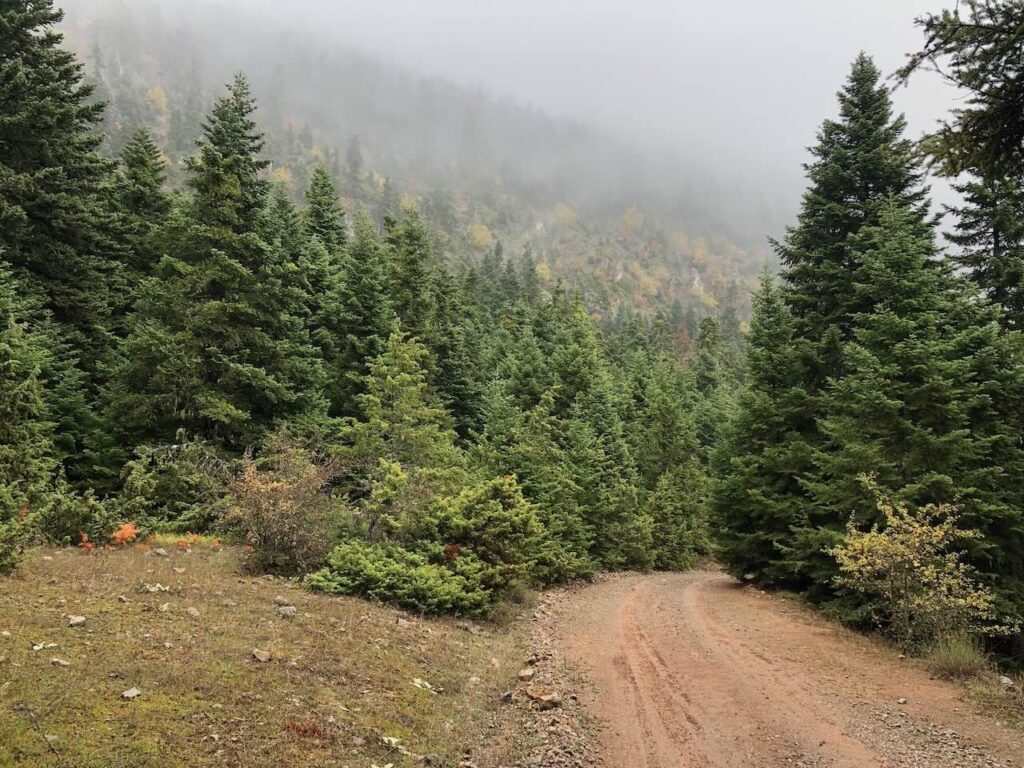
The tragic play Hercules Oetaeus (Hercules on Oiti), which was ascribed to Seneca but is now thought to be by a different, unidentified author, describes scenes of extravagant deforestation for the building of the funeral pyre:
At one man’s blows a beech tree gives up its shade, and lies cut down with its long trunk stretched on the ground. Another man ferociously overturns a pine tree that used to threaten the stars, calling it down out of the clouds (Hercules Oetaeus 1619-21)
–and so on for many lines.
That seems appropriate for Herakles, who was associated with extravagant acts of geoengineering and landscape alteration more than any other figure in Greek and Roman myth.
Even in death, Herakles is able to clear the mountain of its trees.
Ovid
Ovid in his Metamorphoses paints an even more extraordinary picture, particularly in his depiction of Herakles roaming over the slopes of Mount Oiti before the funeral pyre is built.
His body seems to be almost absorbed into the landscape:
Without delay he tries to rip off the poisonous garment. Where it is torn away it also tears his skin, and – hideous to say – either it sticks to his arms, from which he tries in vain to pull it, or else it lays bare his mutilated limbs and his huge bones. Even his blood hisses and boils from the burning poison, as when red-hot metal is dipped into cool water. Without limit, the greedy flames engulf his vital organs, and dark sweat flows down from his whole body, and his charred sinews making a cracking noise. (Ovid, Metamorphoses 9.166-74)
Herakles’ body becomes unfamiliar to him, so that it becomes actually like a mountain – cracking, like a disintegrating rock face; flowing with perspiration like a mountain stream.
Ovid tells us that he ‘filled wooded Oeta with his cries’ (9.155). He describes Herakles rushing across the mountainside, groaning and roaring, tearing up trees with his bare hands in his agony.
What can you hear, when you walk on Oiti? Can you hear goat bells? Can you hear the wind in the trees? Or can you hear silence? If so, can you imagine what that silence could be filled with?
The route
The route starts from a layby just to the north-east of the village Pyra (there’s plenty of space to park).
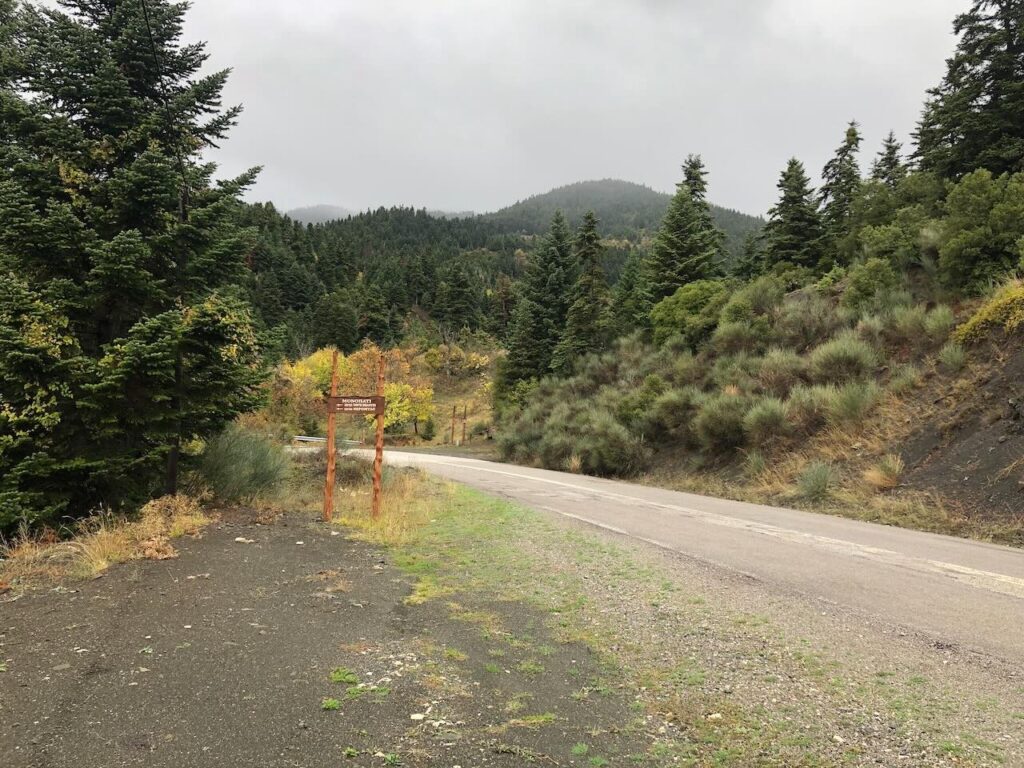
It’s a very straightforward route—well marked throughout, with a signpost every 200 metres or so. Most of the route is through trees, but then you come out into open meadowland towards the end.

At the top of the climb you can explore the stones scattered all over the ground at the archaeological site.

I can’t tell you what the view is like—we were in thick mist by that stage (in late October)!
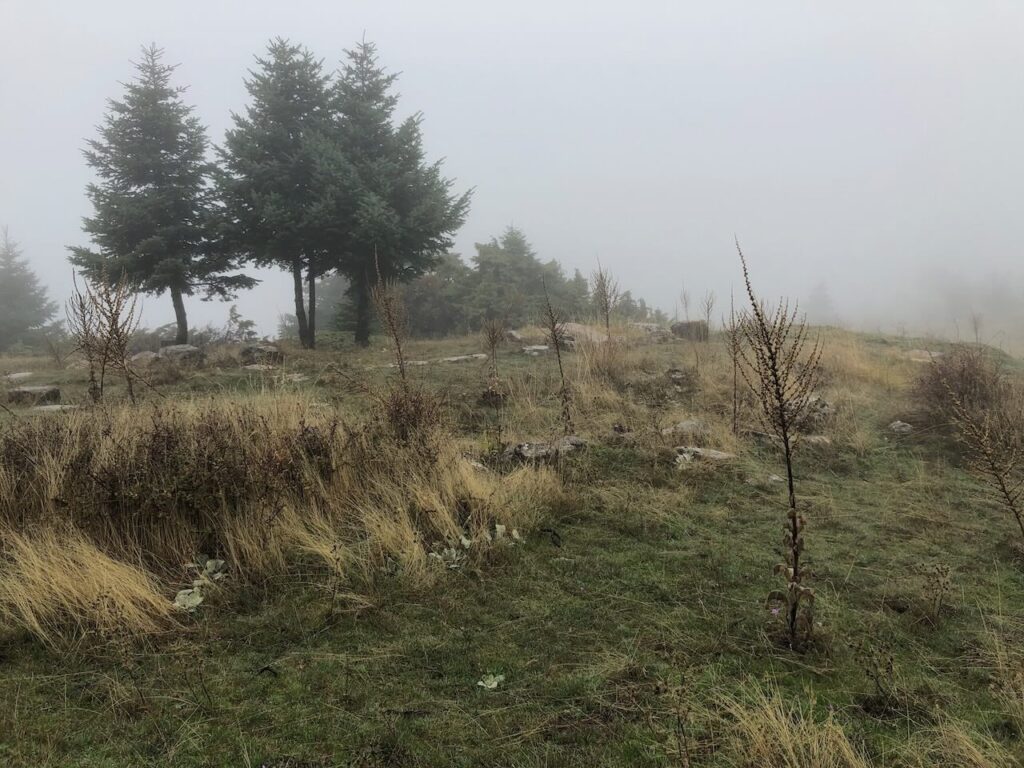
If you want to go further you can carry on up the zig-zagging track to get to the summit that lies directly to the east of the Pyre of Herakles, another 200 metres of ascent.
To get back down you can retrace your steps, or else if you want to do a loop you can carry on down the forest track to the south (muddy and covered in wild boar tracks when we did it!), with a final stretch of a few hundred metres along the road.
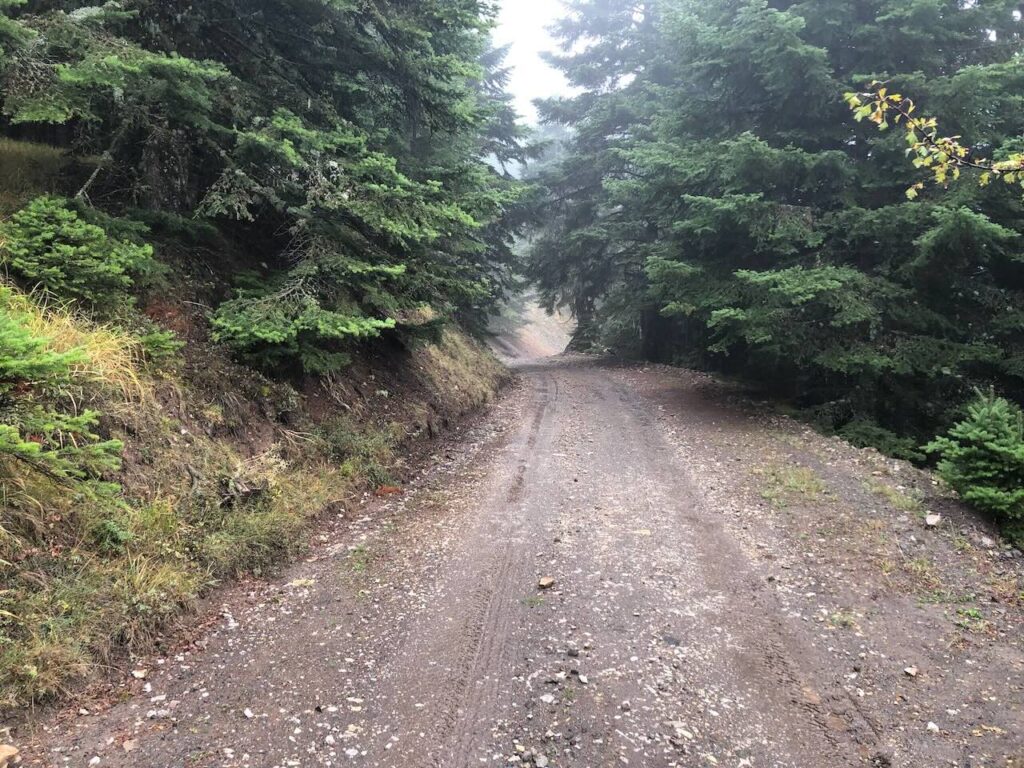

The start point for the route is here. The downloadable GPX file is below.
The round trip is about 8 km, with 400 metres of ascent.