This is a long day out! It takes you up the on the less used eastern route to Liakoura, the highest summit of Parnassos.
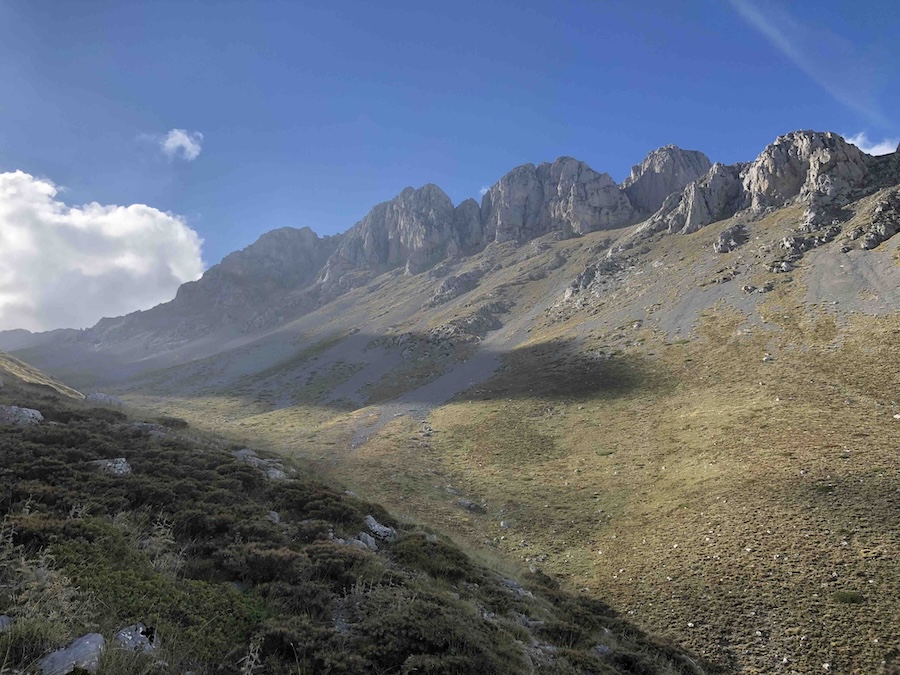
The mountain of Apollo?
Parnassos is a huge mountain, visible from a vast distance with its distinctive double summit.
Above all it was imagined in antiquity as a place for the gods. This was the mountain of Apollo: he is often described in ancient poetry not just occupying the sanctuary of Delphi down in the foothills, but also up on the summit.
For example, the Latin poet Statius describes Apollo shooting plague-bringing arrows down from the peak (Thebaid 1.627), and later sitting up there playing his lyre for the Muses (6.355).
That’s not to say that Apollo had it all his own way: other gods could occupy the highest peaks of Parnassos too.
In Ovid’s Metamorphoses Book 1, the god of love, Cupid (Eros in Greek), flies up to the summit in order to shoot Apollo with one of his arrows, making him fall in love with the nymph Daphne, in revenge for Apollo’s insults (1.467).
Cupid is challenging Apollo’s authority not just by making him fall in love, but also by usurping his control over the highest point on the mountain.
Deukalion and Pyrrha
But what images do we find in antiquity of human presence on the highest summits?
On the whole, not many. There’s no sign that the summit was visited regularly in antiquity: there is no archaeological evidence for sacrifice up there.
But there are two important and extraordinary exceptions.
The first is the story of Deukalion and Pyrrha, where Parnassos becomes the setting for one of the key moments in the history of humanity in Greek myth. It’s told in a number of different sources, for example by Apollodorus and by Ovid in Metamorphoses Book 1 (also by Hyginus, but he sets the story on Mount Etna).
Deukalion and his wife Pyrrha survive the great flood and wash up in their boat on the summit of Mount Parnassos after the wholesale destruction of their fellow humans.
Once they have disembarked and offered sacrifice to Zeus (in Apollodorus’ version), they pick up some rocks and throw them over their heads: the rocks Deukalion throws become men, and the rocks Pyrrha throws become women.

Peter Paul Rubens, Deucalion and Pyrrha, 1636

Parnassos is the place from which the earth is repopulated. On that account we are all descendants of the mineral fabric of the mountain. This is where we come from!
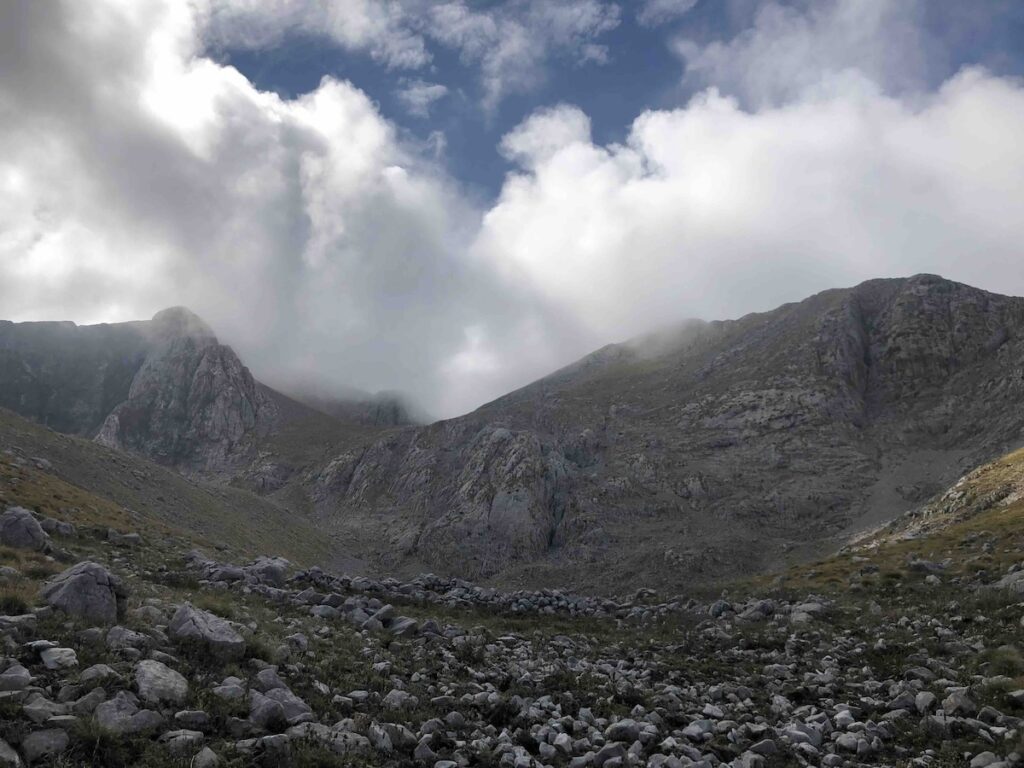
Bacchic ritual on Mount Parnassos
The second exception involves the female worshippers of the god Dionysus. The ancient descriptions of their activity involve some stunning images of movement through high-mountain terrain.
Pausanias gives us a glimpse:
from the Korykian cave it is difficult even for an active man to reach the summit of Parnassos; the peaks are higher than the clouds, and the Thyiades rave there in honour of Dionysus and Apollo. (Periegesis 10.32.7)
The Thyiades were a society of women who worshipped Dionysus at a regularly occurring winter festival through a kind of ritual frenzy on the mountainside.
We have evidence for similar rituals of oreibasia (‘mountain-going’) from elsewhere in the Greek world too, most famously from Miletos in Asia Minor.
Clearly their rituals didn’t involve anything as extreme as the murderous madness of the Bacchic women who rip Pentheus to pieces at the end of Euripides’ Bacchae.
But equally it wasn’t just a predictable and sedate ceremony. It does seem to have involved a trance-like state. It was an attempt to experience or at least enact divine presence and divine inspiration in a mountain environment.
There is one famous story, from Plutarch, of the Thyiades from Delphi wandering down from the mountain, still in a state of trance, to Amphissa, west of Parnassos, and falling asleep in the centre of the town. The women of Amphissa find them there in the morning and stand around them to protect them before they wake, knowing they are at risk because of the hostility between the two cities (On the Bravery of Women 249e-f).
An icy rescue
There are dangers up on the mountainside too.
Another passage from Plutarch (in the context of a scientific discussion of the hardening effects of cold temperatures) records an occasion when the Thyiades had to be rescued from Mount Parnassos after being trapped there in a snowstorm. It’s one of the best examples we have of an ancient mountain rescue operation:
In Delphi you yourself have heard about the men who climbed Parnassos to rescue the Thyiades, when they were trapped by fierce wind and snow — how their cloaks became so stiff and wooden as a result of the ice that they broke and split apart when they were opened out. (Plutarch, De primo frigore 18)
It’s a tantalising reference. We don’t know anything else about the incident Plutarch is referring to. His opening words (‘you yourself have heard’) hints that it might be recent, but we can’t know for sure.
Plutarch knew what he was talking about. He was not just a philosopher but also a priest at Delphi. We know that one of his addressees, the priestess Klea, who seems to have been a member of the educated elite, acted as leader of the Thyiades.
Parnassos in the winter can be a pretty forbidding place.
Can you imagine them up there in the snow and the ice and the wind?
The route
I had only ever hiked up Parnassos from the west before, by the standard route under the ski lifts. Doing this ascent from the east last October was a revelation: it’s an amazing route.
There’s actually not much sign of ancient authors taking an interest in these eastern slopes of Parnassos: the centre of gravity is Delphi and the western slopes.
But even so this is a fascinating and dramatic way to approach the highest summit of Liakoura.
The route starts in the village of Tithorea.
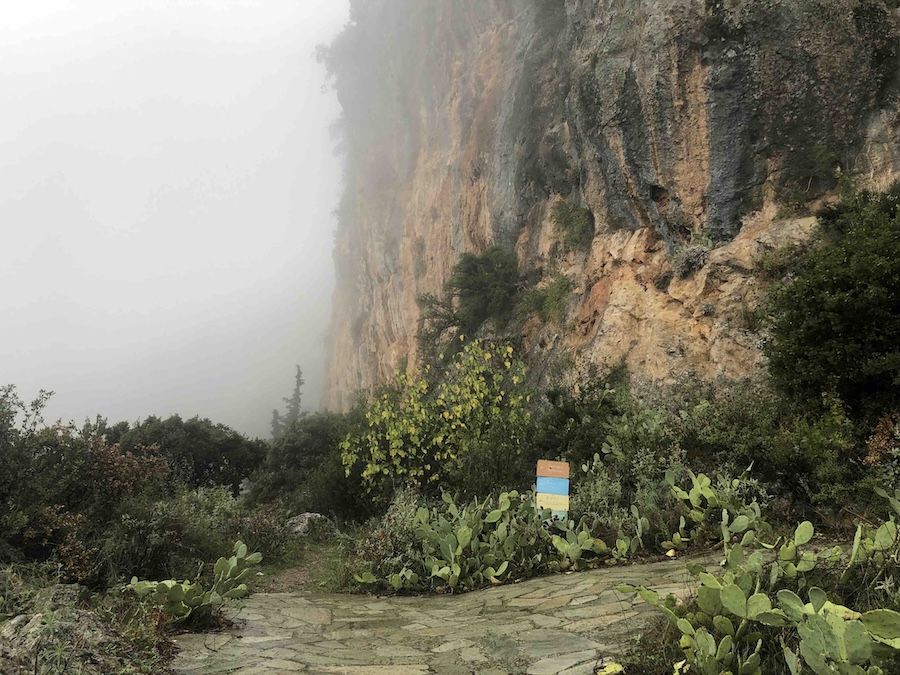
First you cross the extraordinary gorge just to the south of the village. You will need to follow the paint splashes carefully here to find the route over the valley floor and up the other side, rather than relying too closely on GPS–it might not be reliable with the steep walls on both sides.

From there you go up over grassy slopes. There’s a small chapel after 2.5 km.

Just after that you need to take a left fork signposted to the Parnassos summits (Κορυφές Παρνασσού).
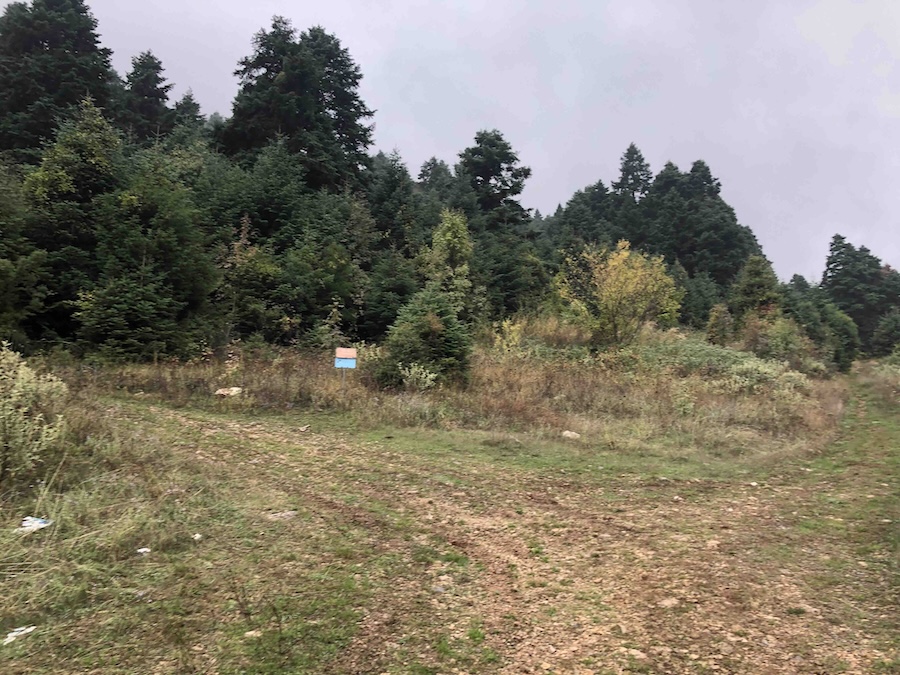
From there it’s a steady ascent up and up through the woods.

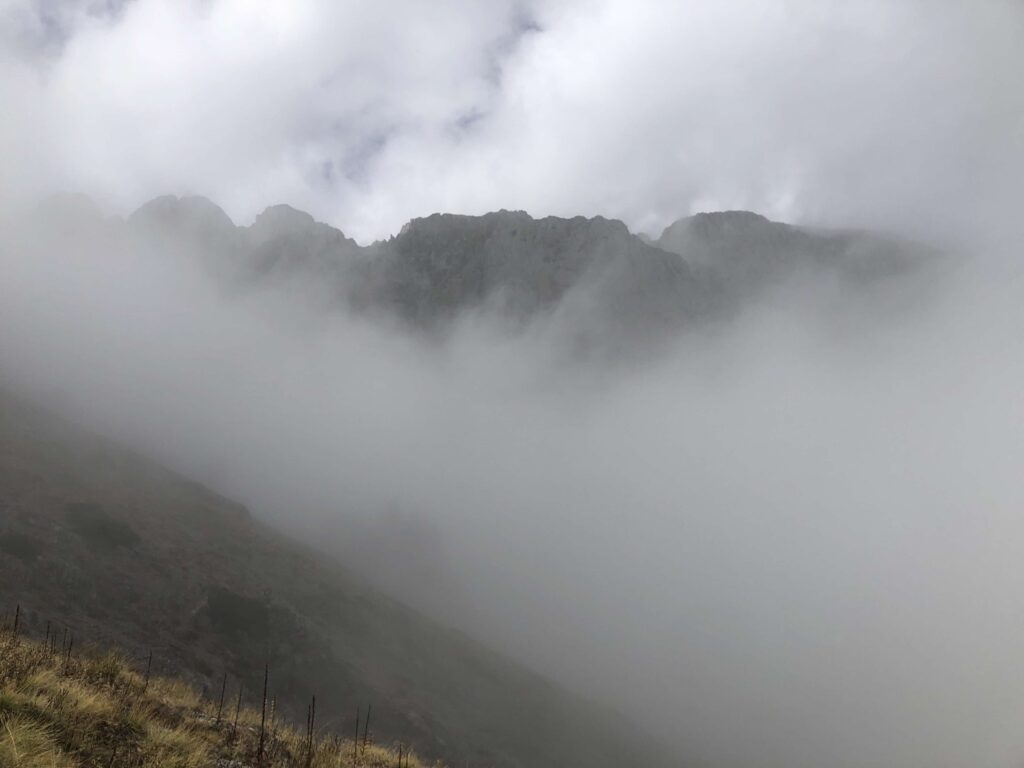
After about 7km the track level outs and becomes more undulating for about 1.5 km–a welcome relief! Once you have crossed over the stream at Tsares you immediately start to climb steeply again, past Psilo Kotroni. Soon you come out above the treeline with the cliffs of Liakoura ahead of you.
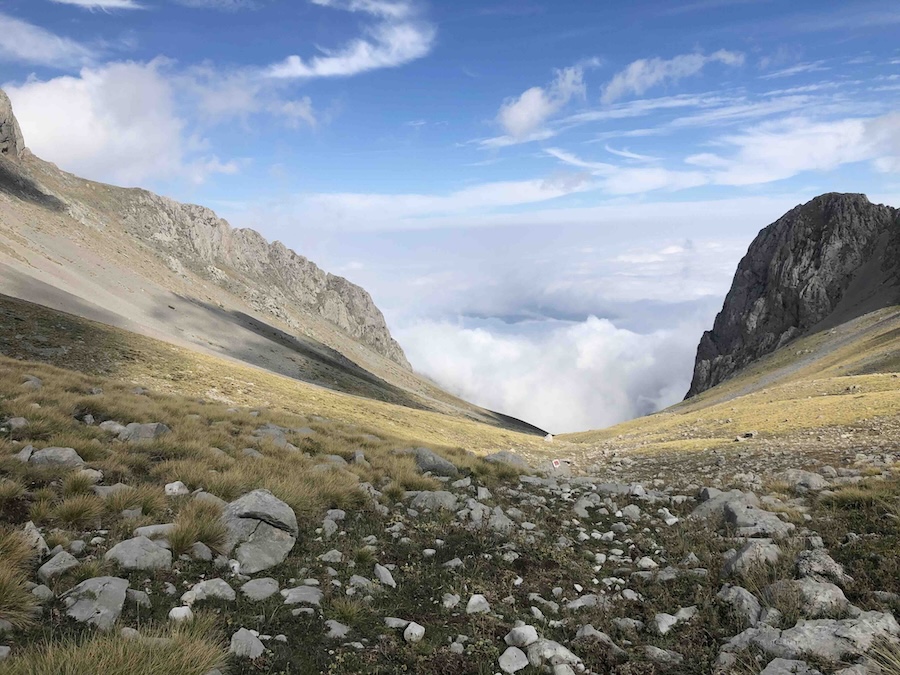
You climb up a spectacular, steep-sided valley to the col (the image below is the view looking back down).
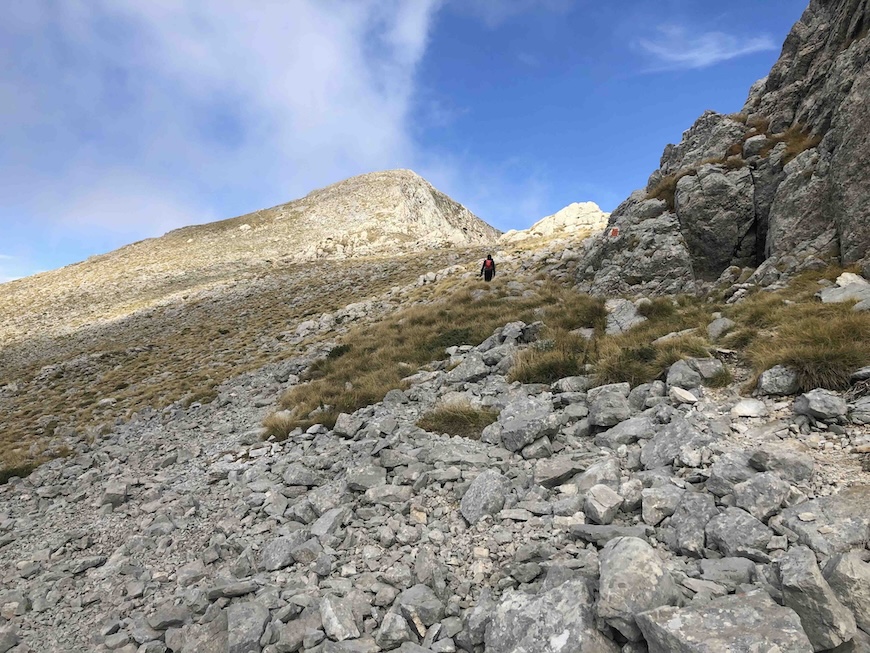
Then it’s a final ascent even more steeply, first over scree slopes, then following the ridge line to the summit.
It was very cold up here in late October: I was glad to have a down jacket and a hat!
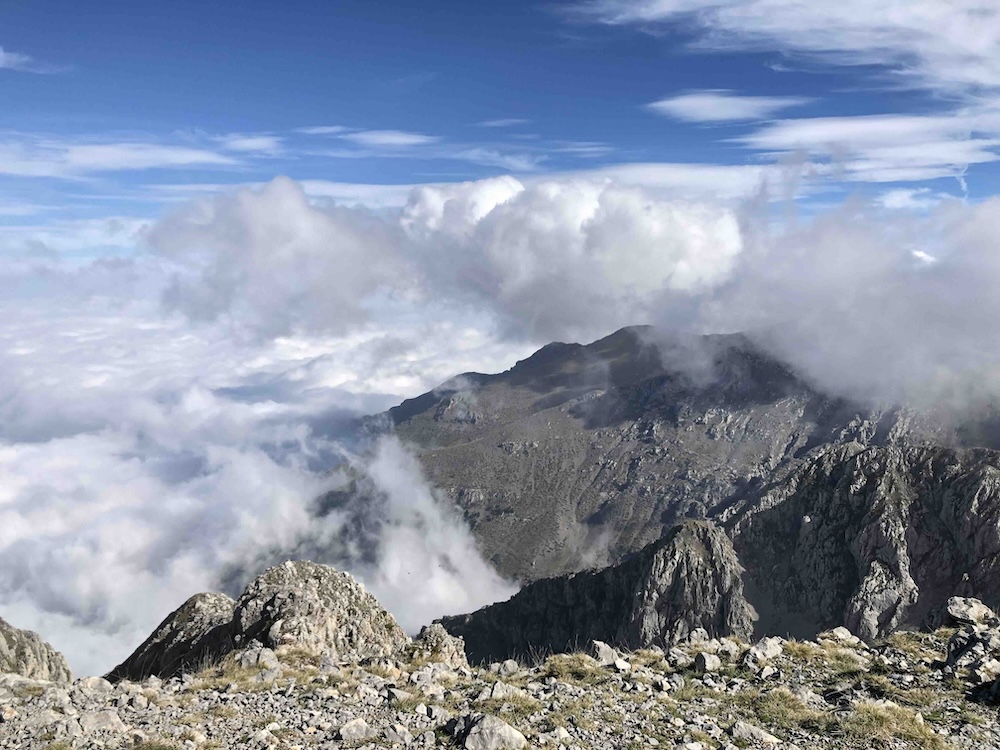
We didn’t see another human being all day, except on the very low-altitude trails just south of Tithorea.
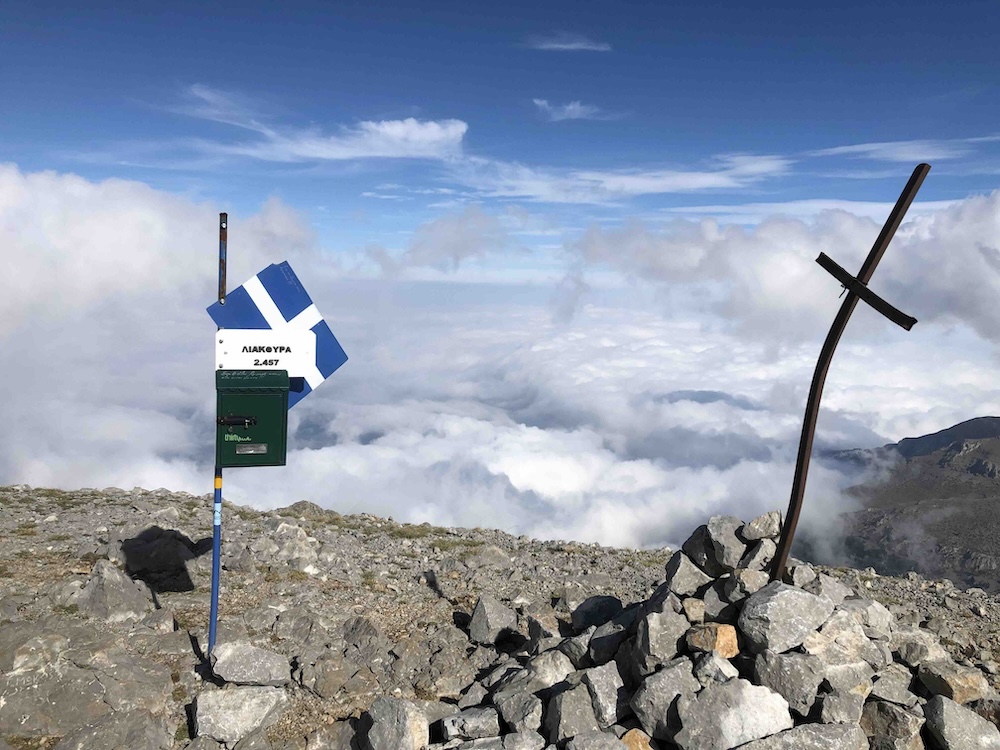
We did the route in about 6.5 hours, not including breaks (4 hours up to the summit and 2.5 down), but that involved some running on the flatter segments and on the way down, and I think it could easily take 10-12 hours overall if you’re going at a more leisurely pace, so probably the best time is June or July with plenty of light.
Best of all of course is if you can get someone to pick you up at the ski centre to the west, and then you can carry on from Liakoura without having to traipse all the way back down!

The round trip is about 22 km, with 2100 metres of ascent.
The start point for the route is here. The downloadable GPX file is below.