If you stay in the town of Olympia and walk down to the ancient Olympic site first thing in the morning you will see crowds of people coming off the tourist buses and heading straight for the ticket offices.
Olympia is an amazing place – it’s one of my favourite sites in Greece – but I still think it’s bizarre that almost no-one seems interested in climbing Mount Kronion, the hill that stands just outside the site entrance.
I think that’s a typical example of the way in which mountain heritage tends to be sidelined in standard tourist routes, in favour of more monumental sites down at ground level.
Of course this is hardly a ‘mountain’ in the sense that we would usually understand the term, but it was described like that in antiquity (often though not always with the ancient Greek word oros). Absolute height wasn’t the only thing that mattered in determining what counted as a mountain in the ancient world: prominence from the surrounding landscape, and even cultural significance could be just as important.
It’s only a ten-minute hike up to the top, and you get to visit a site that was crucial for the way in which Olympia was represented in antiquity, and a fantastic view over the stadium and the rest of the sanctuary. You will probably have it all to yourself.
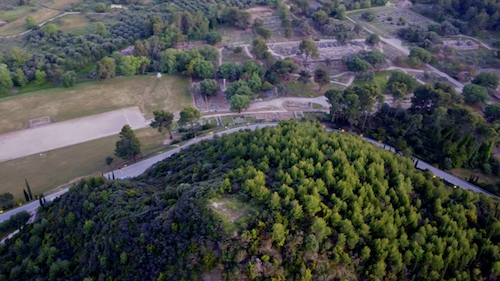
Zeus and Kronos
The site of Olympia was said to have been the place where Zeus defeated his father Kronos:
Some say it was there that Zeus wrestled with Kronos himself for the kingship, others that he founded the festival in commemoration of Kronos’ defeat. (Pausanias, Periegesis 5.7.10)
That power struggle shaped the ways in which the site was understood in antiquity, and Mount Kronion in particular.
This was a place under the control of Zeus. Pausanias tells us that there was a stone platform at the bottom of the hill with bronze statues of Zeus next it, paid for by fines to athletes who had been caught cheating in the contests.
But the memory of Kronos’ power was still there, as an older strand of divine presence lying behind the triumph of Zeus and other Olympian gods. There’s no archaeological evidence to back up his claim, but Pausanias tells us that officials known as the basilai (‘kings’) sacrificed on the summit to Kronos each year at the spring equinox.

Pindar
But the ancient author who gives us the most evocative portrayals of the role of Mount Kronion and of Kronos’ importance for Olympia is Pindar.
His Odes, composed in the fifth century BCE, are verses in celebration of victories at the Olympic and other festivals. They are some of the ancient world’s most dense and difficult poems: they often have a slightly cryptic or oracular quality; they also include some breathtaking and extraordinary images.
Sometimes Pindar uses the hill of Kronos simply as a locational marker of Olympia. In Olympian 1 he anticipates celebrating a future success at the Olympics by his patron Hieron, tyrant of the city of Syracuse in Sicily:
I hope to celebrate an even sweeter victory with swift chariot, having found a helpful road of words, after coming to sunny Kronion. (Pindar, Olympian 1.109-11)
In Olympian 8 too the hill of Kronos is associated with victory:
Timosthenes, fate has allotted your family to Zeus, your ancestor, who made you famous at the Nemean games, and made Alkimedon an Olympic victor beside the hill of Kronos. (Olympian 8.15-18)
In other poems talking about Mount Kronion is a way of looking back to the distant history of the whole Olympic site.
Olympian 5 includes praise for Zeus, hinting at the story of his struggle with his father:
Saviour Zeus, high in the clouds, who inhabit the hill of Kronos and honour the wide-flowing river Alpheus and the sacred cave of Ida. (Olympian 5.17-18)
In another ode Pindar tells the story of how Herakles brought olive trees back from the Danube to improve the shadeless landscape of the Olympic sanctuary:
The land of Pelops was not flourishing with beautiful trees in the glens of Kronion. (Olympian 3.23)
Elsewhere he describes Iamos, son of Euadne and the god Apollo: Apollo leads his son to Olympia, and gives him the gift of prophecy, making his family guardians of the altar of Zeus:
And so they came to the steep rock of sheer Kronion, and there the god gave him a twofold treasury of prophecy. (Olympian 6.64-6)
For modern visitors, it’s the stadium and the temple of Zeus that are the main visitor attractions. But Mount Kronion was there before them. When you stand up there on the summit you are standing in a place associated in antiquity with the very beginnings of the Olympic festival.
The route
The route is short but sharp—just a few minutes up and down.
From the road by the ticket offices you go through the Botanic Garden and round to the north side of the hill.
Mount Kronion’s beautiful tree cover was badly damaged by the fires of 2007, but it’s now thickly wooded again.
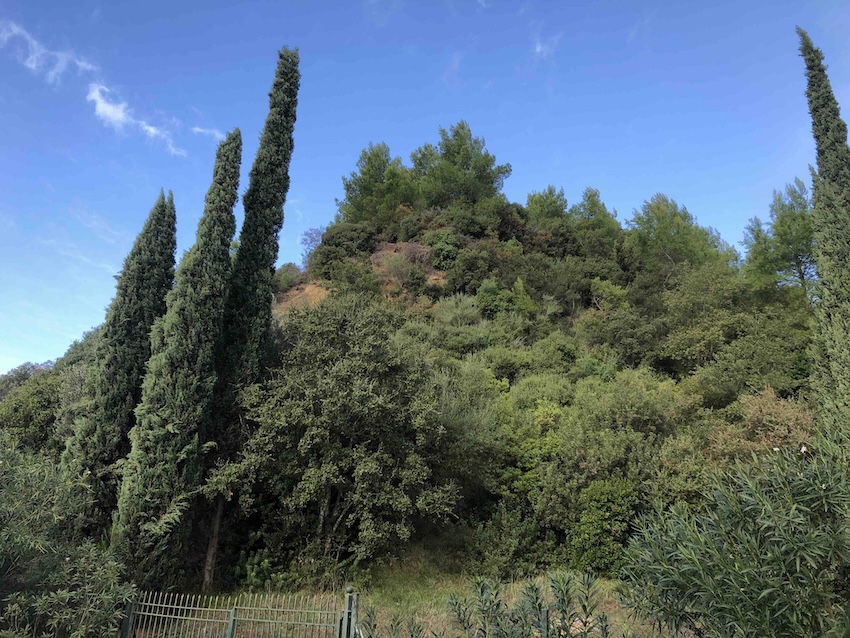
You follow the ridgeline steeply up to the open ground at the top.
The descent route takes you on the zig-zag path down the west side of the hill.

You can walk round the base of the hill too, with a good site of the stadium through the fence.

The round trip is about 1.5 km, with 70 metres of ascent.
The start point for the route is here. The downloadable GPX file is below.