This walk takes you up to the Profitis Ilias peak west of the village of Asea in the central Peloponnese, and explores the region’s association with Odysseus.
Mount Boreion
The village of Asea is south-west of Tripoli in Arkadia.
One of the landscape features associated with this area in antiquity was the mountain referred to by Pausanias as Boreion:
from Asea there is a route to the mountain called Boreion, and on the summit there are traces of a sanctuary. It is said that the sanctuary was constructed by Odysseus in honour of Athena Saviour and Poseidon on his return from Troy. (Pausanias, Periegesis 8.44.4).
There seems to be some confusion about what mountain or what sanctuary Pausanias is referring to–not helped by the fact that this is the only surviving mention of Boreion in surviving ancient literature.
The standard view is that it is the sanctuary on the hill known as Kravari east of Asea, at the high point of the Vigla pass, here.
Alexis Belis’ fantastic PhD thesis (‘Fire on the mountain’) lays out the evidence clearly (it’s number 15 in her catalogue, in Volume 2).
This seems to be the best fit, partly because it’s in more or less the right place for the journey Pausanias is describing, from Asea to Tegea.
That impression is backed up by finds related to Poseidon in the sanctuary, including three trident-shaped metal votive offerings, probably dating from the 7th or 6th century BCE.
However, lots of online sources still identify Boreion (almost certainly wrongly) with the peak to the west of Asea, here.
That too has a ruined temple, in a pretty spectacular location just below the summit, with the remains of an ash altar nearby. It’s number 76 in Belis’s catalogue .

It’s that western hill, Profitis Ilias (1117 metres above sea level) that is covered in the route description below.
Odysseus in the Peloponnese
Even if the Profitis Ilias peak is less likely as the site of Pausanias’ Boreion it’s still a powerful place for thinking through the implications of the story he tells about Odysseus.
The oddity is that it’s a very long way from the places standardly associated with him.
Odysseus is from Ithaca, off the coast of north-west Greece. The Peloponnese is not his usual territory.
Sparta to the south is the land of Menelaus and Helen; Argos to the north east is the home of Agamemnon; and Pylos, on the south-west coast of the Peloponnese is the home of Nestor.
In the first four books of the Odyssey, Odysseus’ son Telemachus travels through the Peloponnese in search of news of his father. He goes to Sparta and Pylos.
When Telemachus arrives in Pylos, in Odyssey Book 3, the people of the city are engaging in a huge sacrifice in honour of Poseidon on the beach. Poseidon is the god who has made Odysseus’ life a misery, keeping him from his home for ten long years in revenge for Odysseus’ blinding of Poseidon’s son, the Cyclops Polyphemus. Pylos is a place Odysseus would not be comfortable.
And yet we see him in Pausanias’ version right in the heart of the Peloponnese, founding a temple in honour not just of his guardian divinity Athene, but also of his enemy Poseidon.
What is going on?
Odysseus after the Odyssey
This is just one of many ancient sources from antiquity that tell alternatives stories about Odysseus’ post-Odyssey future.
Plutarch even describes him being sent into exile in Italy in punishment for his killing of the suitors (Plutarch, Greek Questions 14).
The Pausanias story seems to be giving us traces of something along similar lines–a future Odysseus displaced from his usual territory.
When you stand on the top of the Profitis Ilias peak you are about as far away from the sea as you can be in the Peloponnese: it’s about 50 km to the nearest coastline.
From the summit you can see the peaks around Argos away to the north-east, Taygetos above Sparta to the south, Mount Lykaion to the west. These are the mountains that stand above the territory of Odysseus’ fellow generals from the Greek army, places he usually has no connection with.
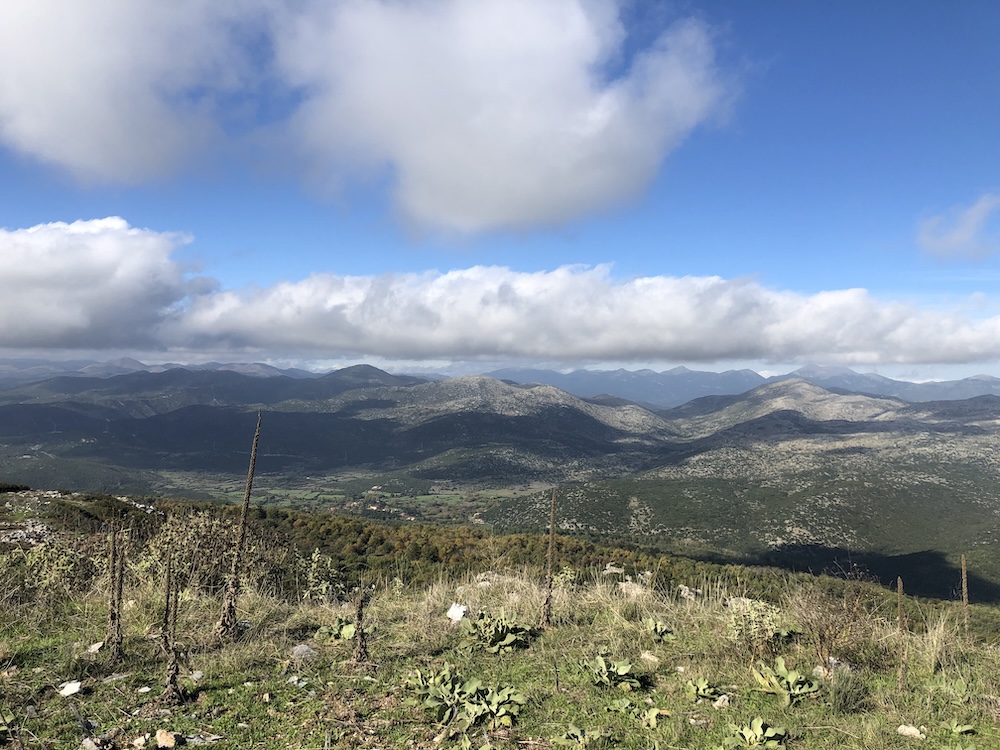
What is Odysseus doing here?
The answer in fact may lie in the Odyssey itself, in one of the most puzzling and enigmatic passages of the poem. When Odysseus visits the underworld in Odyssey Book 11, the prophet Teiresias tells him that he must leave Ithaca, carrying with him an oar
until you come to men who do not know the sea, and who eat food not mixed with salt, and who know nothing of red-cheeked ships or well shaped oars, which are a ship’s wings … And when another traveller meets you and says that you have a winnowing fan on your glorious shoulder, then planting the well-shaped oar in the ground you must make handsome offerings to king Poseidon. (Homer, Odyssey 11.122-30)
Is this where Odysseus ends up, among the mountain-dwelling Arkadians, who would barely recognise an oar if they saw one? Is this where Odysseus decides that the time has come to obey Teiresias’ command and seek reconciliation with Poseidon at last?
The one thing you can’t see from this summit is the sea.
The route
I haven’t been to the Vigla pass sanctuary — I will write up another post on that site if I get the chance — but I did make it to Profitis Ilias peak above Asea in October 2025.
It’s a great option if you are driving south through the Peloponnese to Kalamata and want to stretch your legs for a couple of hours: it’s very close to the main road.
You can park by the road to the north of the village. From there it’s just straight up the smooth and winding track.

You’re sheltered by trees for much of the route up. There were fallen chestnuts all over the ground in late October when I went up. Higher up the forest thins out and you are surrounded by oak trees.

And then in the final stretch you suddenly get above the treeline with a view of mountains opening up on all sides.
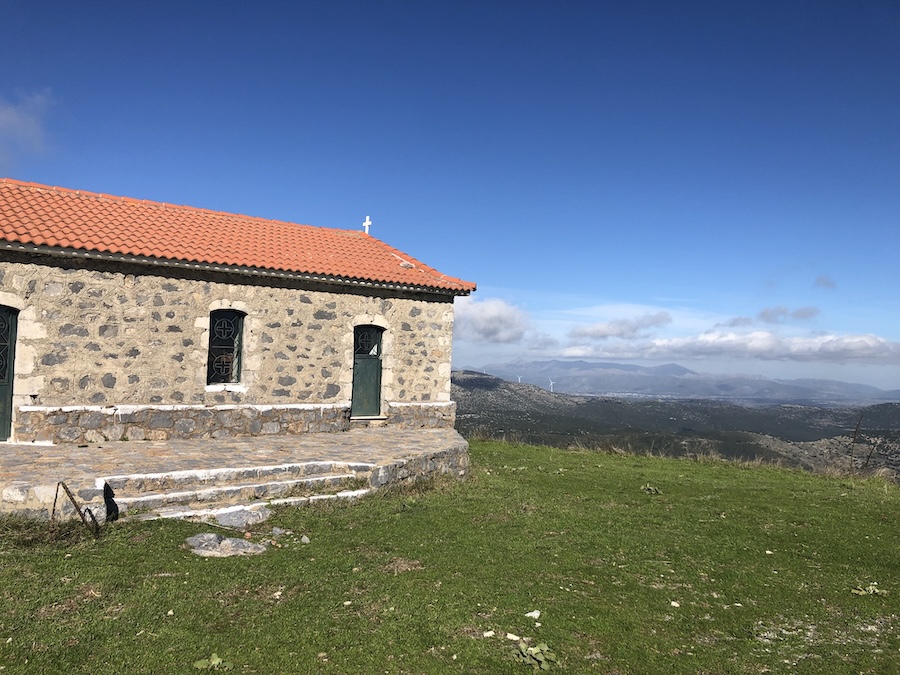
You can go right up to the modern chapel on the summit and look down on the ruins of the temple from above.

It feels like you are in the very centre of the Peloponnese.

The round trip is about 7 km, with 250 metres of ascent.
The start point for the route is here. The downloadable GPX file is below.