Thanks to Megan Houston for this guest post, and to the St Andrews Research Internship Scheme for funding Megan’s work on the project!
This route leads you to the former temple site of Aphrodite, patron goddess of Corinth, high up on the summit of Acrocorinth.
Acrocorinth as fortress
Acrocorinth (574 metres), situated southwest of and overlooking ancient Corinth, is one of the most distinctive sights of the northern Peloponnese: it dominates the view as you drive south from the Corinth canal.
It is well-known for its military importance to the ancient city. The mountain’s steep slope lent natural protection to the urban centre, and it is famed for its fortifications, the earliest of which were utilised by Corinthian tyrants in the seventh or sixth centuries BCE.
Acrocorinth was subsequently used as a garrison base, falling into the hands of Hellenistic rulers, Macedonians, and Romans. The alteration of fortified structures and their reuse even continued into later periods (until at least the early nineteenth century).
The later periods of use largely drive the tourism of Acrocorinth today, mainly because of the greater visibility of their extant structures. For those interested in ancient history, its military use is usually the main attraction.
However, this mountaintop has much more to tell us about the ancient world. Like many others in the Greek landscape, this peak was not only a place of warfare, but also a place of worship.
The lost temple of Aphrodite
We have evidence for the existence of the temple of Aphrodite on Acrocorinth via several writers, including Strabo and Pausanius.
The summit has a small temple of Aphrodite, and beneath the summit happens to be the Peirene Spring, which does not have an outflow, but is always full of transparent, fresh water. (Strabo 8.6.21)
There is reason to believe, then, that it was placed at the highest point of the mountain peak. Alongside this temple, there were also three statues, which included one of ‘armed Aphrodite’.
At the apex of Acrocorinth, there is a temple of Aphrodite. There are statues of Aphrodite, armed, and Helios, and Eros, holding a bow. (Pausanias 2.5.1)
Excavations were undertaken in 1926 by Carl Blegen to try to locate this ancient temple, but the results were unsatisfactory. There were few architectural remains, and the cuttings in the bedrock (though they indicate levelling for laying foundations) were not enough to indicate the exact size or position of the temple.
These details, as well as that of the temple’s destruction, can never be truly known, as its place was taken over by later structures.
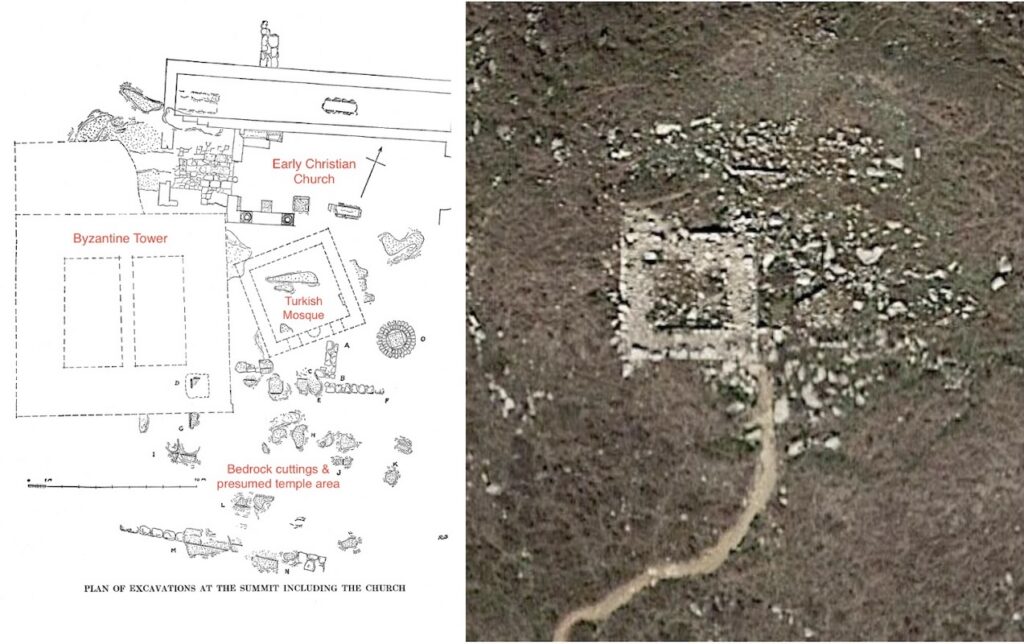
Left: Plan of the summit area from Blegen, Acrocorinth: Excavations in 1926 (1930). Right: Satellite image of the site from Google Earth (2018).
However, these later structures paradoxically form part of the evidence for the temple’s existence. Within them, as well as around the summit, poros stones of Greek workmanship were found. They were likely recycled to avoid having to transport more material up to the summit.
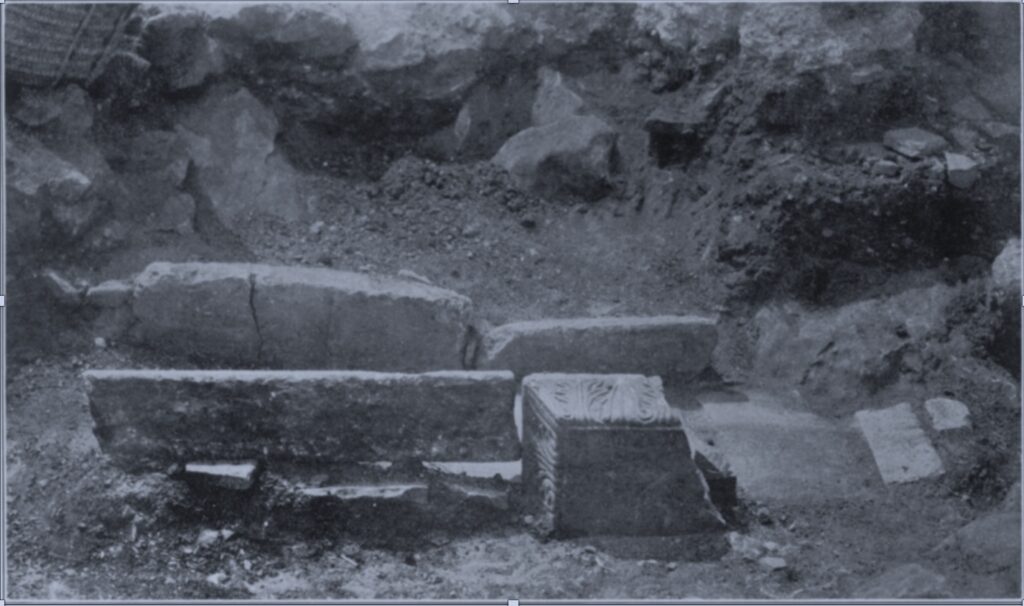
Byzantine cist-grave made of reused materials, Blegen (1930), Fig. 9.
The stones were dated to around the fourth century BCE, providing an estimate for the foundation of the temple building.
Aphrodite at Acrocorinth
Aphrodite was an important cult deity in Corinth. Her worship would have pre-dated the temple’s construction and had probably begun by the period of synoikismos (the unifying of villages into a singular city-state) in the eighth century BCE. Some scholars even suggest that her worship could have dated to as early as the late eleventh century BCE – though there is not yet enough evidence to support this.
The means of Aphrodite’s introduction to Corinth are also unknown, though some speculate (based on early inscriptions and figurines) that she may originally have been introduced there as Astarte – an eastern goddess and precedent to Aphrodite. Her cult was well-established at Corinth by the fifth century BCE as that of Aphrodite Ourania (‘Heavenly Aphrodite’), and was worshipped at several shrines throughout the city.
One parallel often drawn between Aphrodite Ourania and Astarte is their relation to sacred prostitution. Strabo documents this aspect at Corinth, claiming:
And the temple of Aphrodite was so rich that it had acquired one thousand temple-courtesans: prostitutes, whom both men and women had dedicated to the goddess. (Strabo 8.6.20)
It is important to note that the reality of ‘sacred prostitution’ is something contested by many scholars.
Nevertheless, the city certainly held a reputation for prostitution. Some hetairai (elite courtesans) even achieved fame within the city – such as the captivating Laïs, as mentioned by Alciphron, in a fictional letter from the hetairai of Corinth to the hetarai of Athens:
Now there is one woman exciting the whole of Greece – just one. Laïs in the barber shops, Laïs in the theatres, in the assemblies, in the lawcourts, in the councils, everywhere. Everyone talks about her, by Aphrodite, and the mute gesture to each other about her beauty. In this way, Laïs produces gossip even among those unable to speak. (Alciphron, Letters 4.20)
There is even one story (recorded in Athenaeus, Deipnosophists 13.32) that prayers from the hetairai of Corinth to Aphrodite for the safety of Greece contributed to Greek victory against the Persians..
Aphrodite was also well-known for her protection of ancient Corinth. As both Pausanias and Strabo identified, she was represented in her statue as ‘armed’ (hoplismene) Aphrodite; only at Corinth did she assume this important position as protectress of the city.
Furthermore, this tradition continued into the Roman period with her epithet Aphrodite Hoplismene, and iconography on Roman coinage.
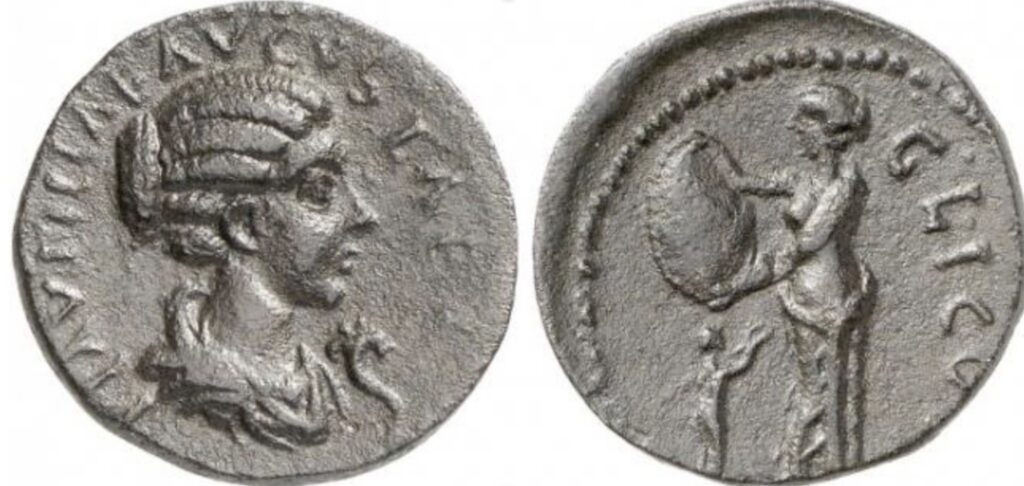
Left: the obverse of a coin from Corinth (c. 202-203 CE) depicts Roman Empress Plautilla, the short-lived wife of Emperor Caracalla. Right: the reverse shows Aphrodite holding the shield of Ares (with Eros below on the left).
The nature of the cult may have transformed, and the temple on the summit was probably considered too small to hold all the cult facilities, since some cultic activities were moved to the lower city in Roman times. However, the idea of Armed Aphrodite’s protection likely remained associated with the summit of Acrocorinth, given the sheltering, shielding presence of this peak.
The route
The route leads from the site of the ancient city and up the mountain for a more authentic experience. However, if you would prefer a shorter, less intense hike, you may avoid the first 3.9km (and ~380 metres of ascent) by instead parking at the car park on Acrocorinth itself.
Entry to Acrocorinth is free, but be sure to check the opening times when you visit, since these are reduced in the winter.
The route starts in the village car park. It leads around the site of Ancient Corinth – which you will get a great view of, but is certainly worth a visit in its own right (along with its archaeological museum)!

About 2 kilometres in, you will pass another sanctuary site at the base of the slope. The area is restricted, but you may be able to catch a glimpse of it from the upper fence (see below).

This is the Sanctuary of Demeter and Kore, which was in use throughout the Greek period and was expanded under Roman occupation. Cultic activity here may have taken place as early as the Archaic period, since votive material from the late eighth century BCE has been discovered here.
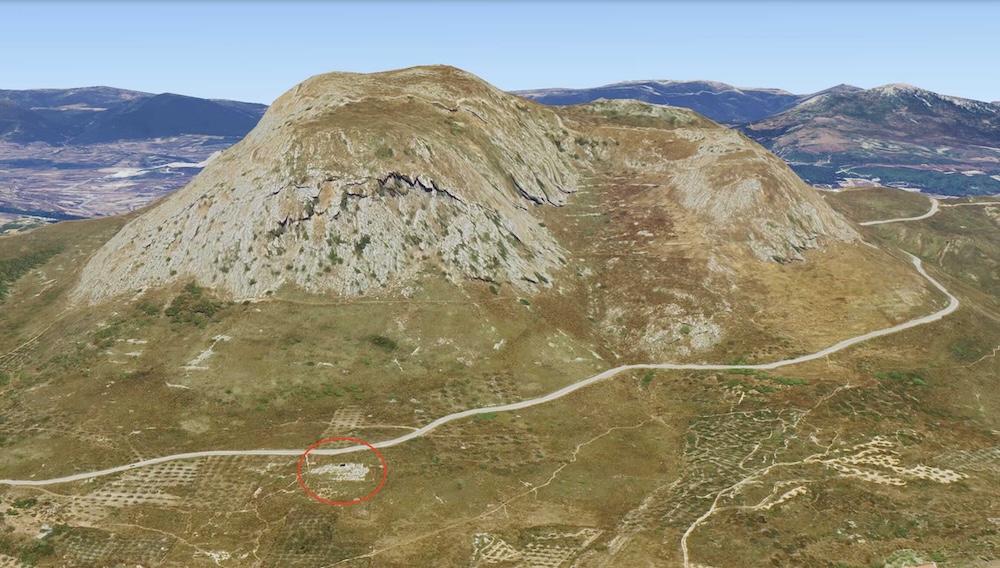
The route continues along this road, ascending gradually from the north to the west side of Acrocorinth. The ascent steepens as you near the site car park and entrance.
Once in the site, the route leads around points of interest: the Church of Saint Dimitrios, the remains of mosques, and, of course, the many fortress ruins.
At the top of the eastern summit, you will reach the site of the ancient temple of Aphrodite, along with the later, extant structures described in this blog. You may use the site plan to orient yourself with the remains around you, or simply take in the breathtaking view of the city and coastline below.

The descent mostly follows the same route down, but veers south to pass the famous spring of Upper Peirene. You will also pass a scenic viewing point near the Frankish tower before leaving the western summit.
On the way back through the village, you will pass by the other side of the ancient site of Corinth before reaching the car park.

The total route is c. 10.7km, with c. 500m of ascent.
The start point is here, and the downloadable GPX file is below.