This write-up follows the standard route to the Profitis Ilias summit of Taygetos — described already in our earlier Taygetos post — but extends it by following the ridgeline beyond the summit to the south, before descending and looping back along the E4 long-distance path to the Taygetos refuge.

Inaccessible Mount Taygetos?
I was very lucky to have a few days doing some routes on and around Mount Taygetos in the southern Peloponnese a couple of weeks ago.
It’s definitely one of my favourite mountains in Greece. The huge ridgeline is a spectacular place to be: it runs for more than 20 km, counting just the southern half, which has all the main peaks over 2000 metres (and much longer if you count the lower, northern section as well).
When it’s covered in snow in the winter it can look really inaccessible. Even in late May 2026 there were still lots of snow patches on the higher slopes (much more than when I was there this time last year).

We know that people went up there regularly in antiquity. Apart from anything else there are still ancient boundary markers inscribed in the rocks on the summit ridge: if you want to hear more about those you can listen to our recent podcast interview with Socrates Koursoumis.
But you wouldn’t necessarily guess that from the ancient literary evidence. I don’t know of any account of a historical individual climbing to the summit or even to the summit ridge in ancient Greek literature.
Sparta and Taygetos in Aristophanes’ Lysistrata
What we do have instead is one fantastic mention of not climbing to the summit of Mount Taygetos!
The passage is from Aristophanes’ play, Lysistrata.
It was first performed in Athens in 411 BCE, at a late stage in the Peloponnesian war. In the play the women of Greece force their husbands to accept peace by implementing a sex strike, and by seizing the Acropolis and cutting off Athenian funding for the war.
Early on in the play we see the women gathering to discuss their plans. They are not just Athenians; they include a women called Lampito, a representative from Athens’ enemy Sparta. She speaks her lines in a strong Spartan dialect.
They begin to discuss what they would do for peace. Lampito answers without hesitation:
I would even climb up Mount Taygetos, to catch a glimpse of peace from there. (Aristophanes, Lysistrata 117-18)
What is the function of this passage?
One of the things it does is to present Lampito for an Athenian audience as a stereotype of Spartan toughness.
The Spartans were known for their tough upbringing. That was often associated with their closeness to Taygetos, for example in the famous story that weak babies were thrown into a chasm at the foot of the mountain (Plutarch, Lycurgus 16.1).
A few lines before this one, one of the other women praises Lampito for her beauty and her strength:
What beauty you display. What a good complexion you have. How strong your body is. You could even strangle a bull! (78-81)
The mention of mountain climbing extends that portrayal of Lampito’s physicality.
Climbing for peace
But how should we read the association between mountain climbing and peace?
Over the last few decades the idea of mountaineering for peace or hiking for peace has become quite widespread, for example through multicultural expeditions designed to bring together people from different communities.
See also here for a really interesting discussion (from the University of St Andrews online Museum of Peace) of the association between rock-climbing and personal peace, experienced through a sense of absorption and accomplishment.
But in Aristophanes’ case the mountain climbing imagery is used to communicate a sceptical attitude to the prospect of peace.
Alan Sommerstein in his commentary on this passage of the Lysistrata suggests that Taygetos ‘rising as it does almost sheer from the plain of Sparta … would have seemed to an ancient Spartan literally impossible to climb’.
That’s clearly an overstatement, but even so the difficulty of the challenge is clearly part of the point here.

The previous speaker says she would be willing to cut herself in half to access a plan for peace.
Lampito seems to be imagining something similarly extreme, something difficult even for a tough Spartan like here: she is so desperate for peace that she would even climb the mountain.
But the other important aspect of this is the idea that the mountain is a place from which peace might be visible. The point is that peace is so elusive, so hard to spot, that you need to climb the highest mountain even to have a chance of seeing it.

Perhaps there is even a hint of the mythical story of the hero Lynceus looking down with supernatural clear-sightedness from Mount Taygetos and spotting his enemies far in the distance: if you want to read more on that you can have a look at our earlier Taygetos post here.
That’s what it would take, when peace is so far away even after 20 years of fighting.
The route
The first section of the route follows the standard path up to the highest summit, Profitis Ilias, from Manganiari, via the Taygetos refuge.
I was thinking of Aristophanes’ Lampito as we trudged up the steep final slopes, detouring from the path every so often to avoid the last of the snow patches.

You can see a long way from the summit!
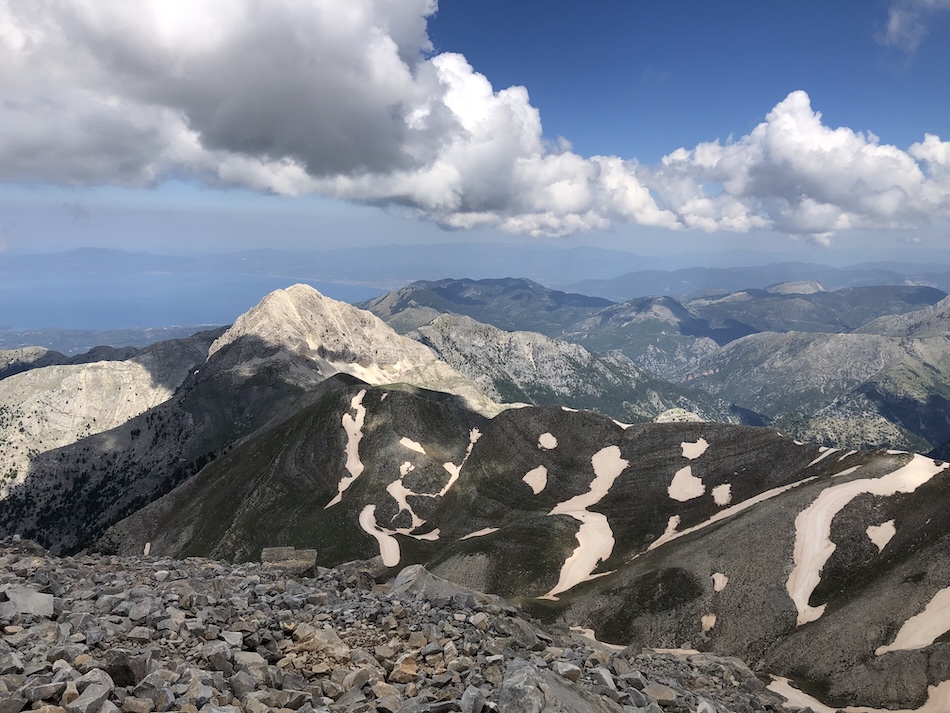
From there you carry on southwards along the ridge. The path up to Profitis Ilias was busy, but we saw only one other pair of hikers for the whole of the rest of the route.

You can stick to the main path which mostly runs just below the ridgeline, sometimes to the east and sometimes to the west.

Alternatively there are some nice scrambling options if you want to stay higher up.
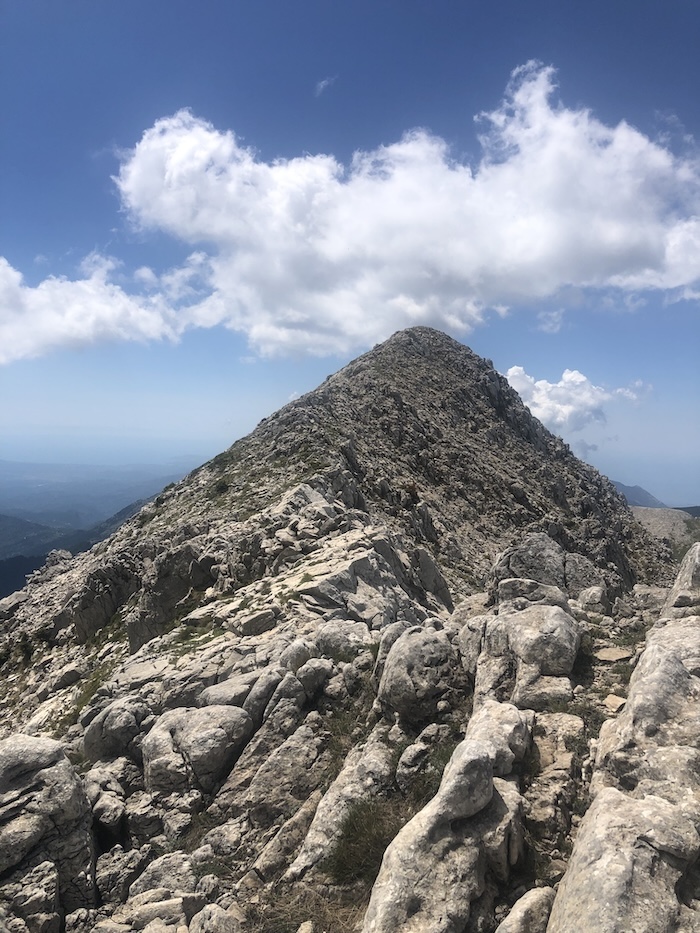
Eventually you drop down into a meadow area, at Mousgia.

The route goes down through the trees to Agios Dimitrios.

The E4 route heads north from there through dense forest, but with good signposting.

My hiking companion saw a huge wild boar ahead on the path. I was too slow to see it, but apparently it was ‘bigger than a dog, as big as a cow’ (I think in width rather than height!) We heard cuckoos over and over again as we walked.

A couple of kilometres before you get to the refuge you come to the abandoned settlement of Pentavli. Just beyond that you go past a waterfall and clamber over rocks, and then up some metal stairs fixed to the cliff.

The route is number 2 in the Anavasi Taygetos guide+map (Hike and Explore 8.1).
The round trip is about 22 km, with 1900 metres of ascent.
The start point for the route is here. The downloadable GPX file is below.