Thanks to Chris Trinacty for today’s post! Chris is Professor of Classics at Oberlin College in Ohio. He has a long-standing interest in the island of Aegina: see here for the website from his recent exhibition on the island.
Mount Oros is the highest peak on the island of Aegina (535 metres). It commands a panoramic view of the Saronic Gulf – on a clear day you can see from Athens to Sounion in the east, and Epidaurus to the west, with Poros appearing in the south.

In antiquity the summit included a shrine to Zeus with finds dating from the Mycenaean period, but today the most visible remains date from the Classical and Hellenistic periods and are located at the northern base of the mountain.
In the ancient world (and today), Oros has been a sort of “barometer” for weather conditions in the area. If clouds surround the peak, rain is on the way, and, in times of extreme drought, a procession carrying the icon of the Virgin from the monastery of Chrysoleontissa concludes here with a prayer for rain.
Zeus Hellanion and Aeacus
Ancient Greek myth details how Aeacus was king of Aegina and son of Zeus (Iliad 21.189).
At some point, either because he was lonely (Apollodorus 3.12.6) or because of a plague (Ovid, Metamorphoses 7.490-660), Zeus changed ants into men, who were called Myrmidons (the ancient Greek word for ‘ant’ is myrmex (μύρμηξ)). These autochthonous men became the first Aeginetans, and were known, according to Ovid for their “tenacity, thrift, and hard work” (Met. 7.656).
Later, Aeacus was begged by representatives from other Greek territories to help during a drought afflicting the region. Aeacus went to the summit of Mount Oros and asked his father to end the drought. Zeus answered his son’s call and sent rain to Greece. Pausanias tells the story as follows:
Greece had been withering under a drought: neither inside the isthmus nor outside it would the god rain, until they sent to Delphi to discover the reasons and ask for relief. The Pythian priestess told them to placate Zeus, but, if he were to listen, it had to be Aeacus who made the ritual supplication. They sent men from every city to beseech Aeacus; he sacrificed and prayed to Panhellenic Zeus, who brought rain to Greece. (Pausanias, Periegesis 2.30.6, trans. P. Levi, slightly modified; compare Isocrates 9.14-15).
Embassies continued to worship Zeus on Aegina from the seventh century BCE through at least the Hellenistic period. Additionally, the summit of Mount. Oros has an ancient shrine, and material finds date from as early as the Mycenaean period (many displayed at the museum in the Aegina port).
In spite of the intense rivalry between city states, it would appear this local cult did become Panhellenic, and Pindar could celebrate Aeacus and his sons in songs at Delphi (Paean 6) and other locales.
(For more on Pindar and Aegina you could have a look at the studies by Burnett (2005), Pindar’s Songs for the Young Athletes of Aigina or Fearn (2010) Aegina: Contexts for Choral Lyric Poetry; or Polyinskaya (2013) A Local History of Greek Polytheism: Gods, People and the Land of Aigina, 800-400 BCE for the religious history of the island more broadly).
Trade and propaganda
Aeacus was an important hero/founder for the island and two of his sons, Telamon and Peleus, important figures in their own right. Aeacus’ tomb became a shrine in the center of the main city, and the myths around Aeacus were useful for the self-image (and propaganda) of the people of Aegina.
As merchants who sailed the Aegean and larger Mediterranean (they set up a temple to Zeus Hellanion in Egypt and Hesiod claims men from Aegina invented sailing,Catalogue of Women fr. 205), such a myth worked wonders. As Burnett elucidates, “A Founder-King who saved Greece from famine was a splendid hero for a community of merchants who regularly supplied grain where local crops were insufficient” (20).
The xenia of Aeacus and his family was paralleled then by the exemplary honesty that the aristocratic merchants of the island were said to embody. Known for his piety and just rule, Aeacus becomes one of the judges in the Underworld after his death.
The route
The route leads from the base of the mountain with the Classical terrace and Hellenistic building remains, past two ancient cisterns (souvales), to the summit itself with further ancient remains and ashlar blocks built into the Byzantine Church of Profitis Elias (for more on the Byzantine history of the island, see Pennas (2005) Byzantine Aigina.).
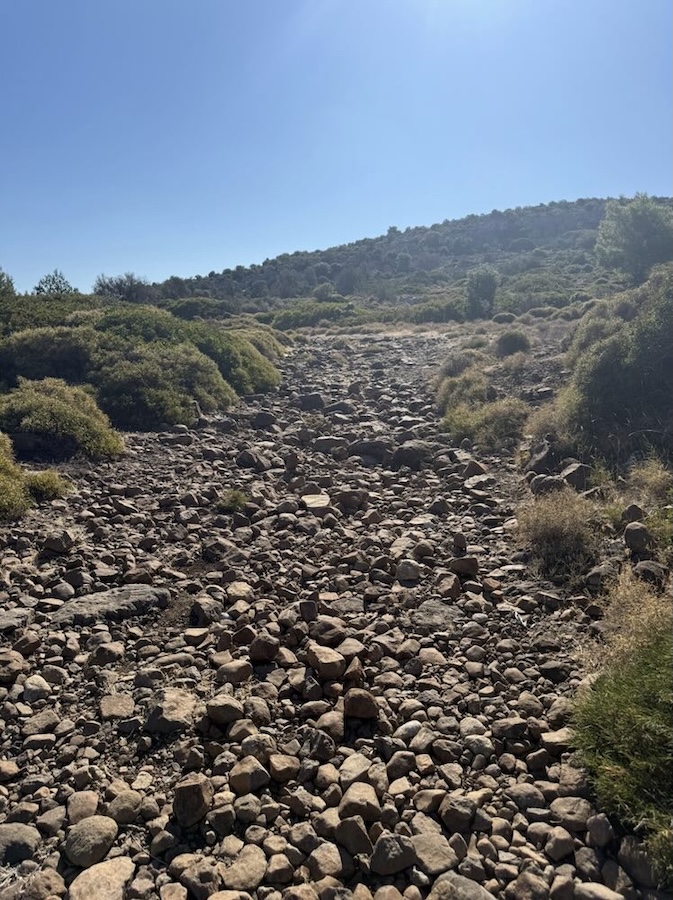
After a short initial walk in from the parking place, one begins by moving south-southeast along the trail for Ελλανίοu Διός. Directly ahead is a grove of old olive trees. This trail is marked out by intermittent red paint and signs.
After a couple switchbacks, you will come to the ramp and impressive wall of the terrace. This would have been an area for worshippers of Hellanion Zeus to gather either before or after performing sacrifices at the shrine on the summit.
The church of the Taxiarchis is at the top of the ramp and features spolia from the site. The church is usually locked, but if you can get a look inside you will see frescos from the 13th century, with a particularly evocative representation of Jacob’s Ladder and angels moving between heaven and earth.
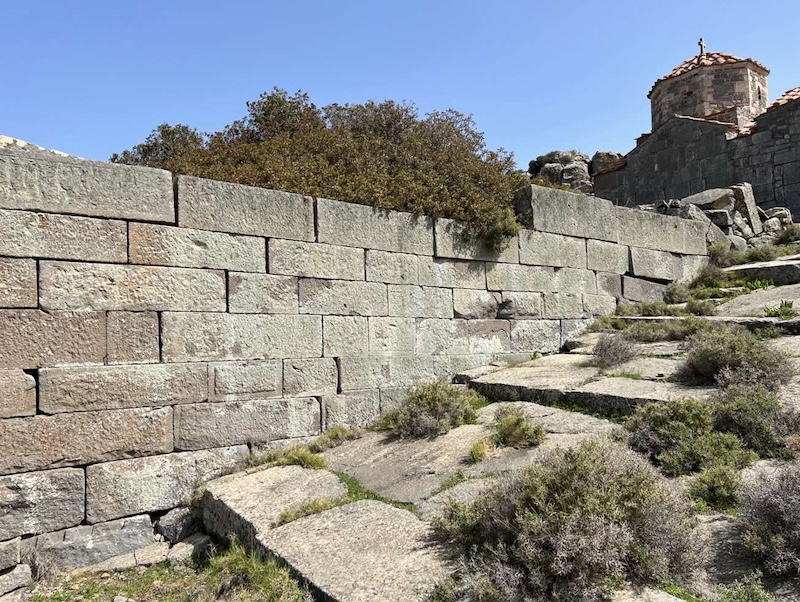
Ramp with retaining wall and church of the Taxiarchis.
This performance area could, possibly, have been where Pindar’s choruses sang their epinician songs for victors from Aegina (there are more Pindaric odes to Aeginetan athletes than any other city).
Could this be the spot where Pindar, Nemean 5 was sung, with its evocation of the altar of “Father Hellanios” (Nemean 5.10)?
In the Hellenistic period, a large “Π”-shaped stoa was added to this area, showing that it continued to be important into the 3rd and 2nd centuries BCE. Ancient pottery sherds still can be found throughout the site.
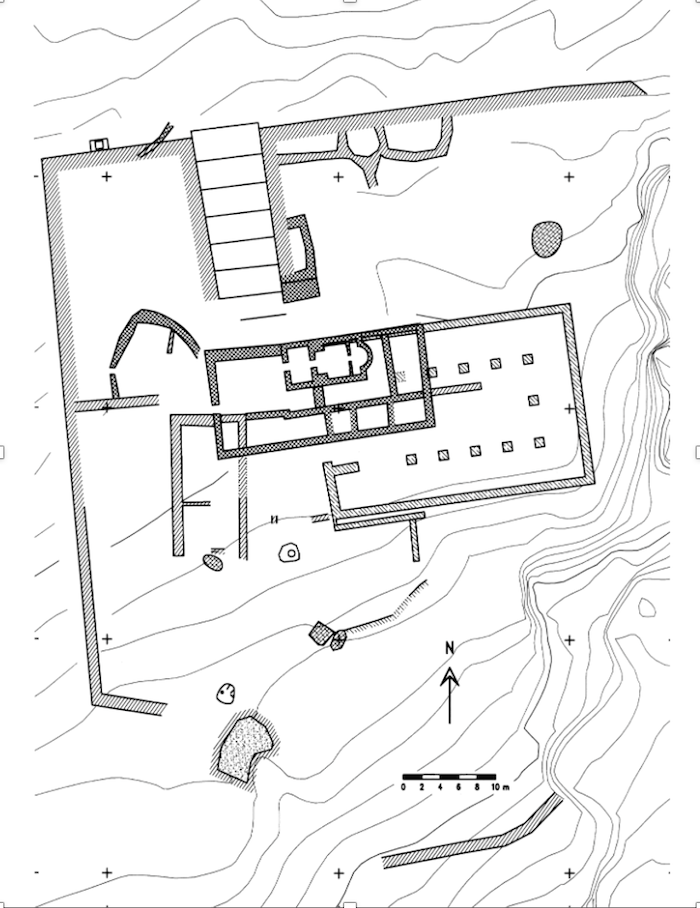
Sanctuary of Zeus Hellanios, taken from Goette (2001) Athens, Attica and the Megarid, p. 347.
The trail continues south from this point and runs close to two souvales, ancient man-made cisterns that were originally covered with roof tiles, but now are open to the air. These impressive hydrological features continue to hold water and shepherds have taken blocks and made drinking troughs for their goats and sheep near these souvales.

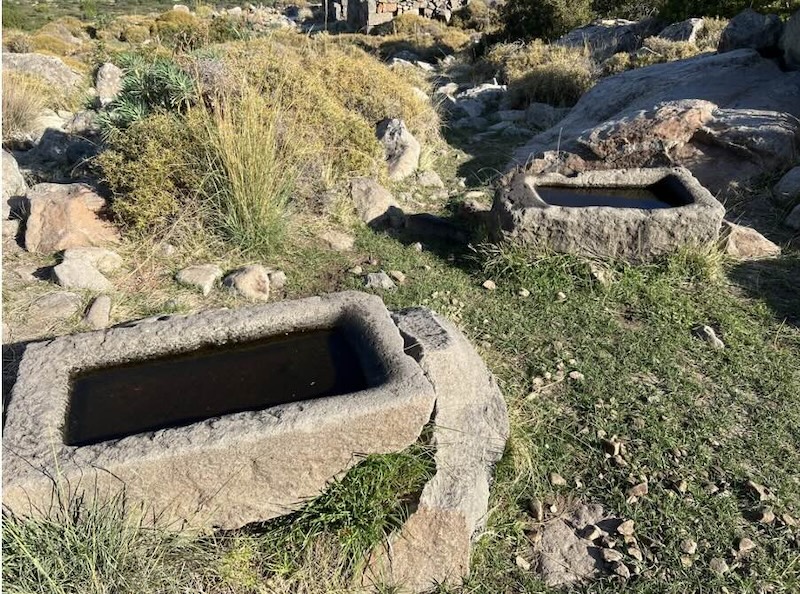
The trail splits and one can visit the upper cistern (worth a visit), but then will have to turn back to continue to the summit. From the upper, and larger, cistern a bronze bowl with an inscription was found that dates to the 5th century BCE. Additional finds from the area include a particularly nice miniature bronze of Zeus.
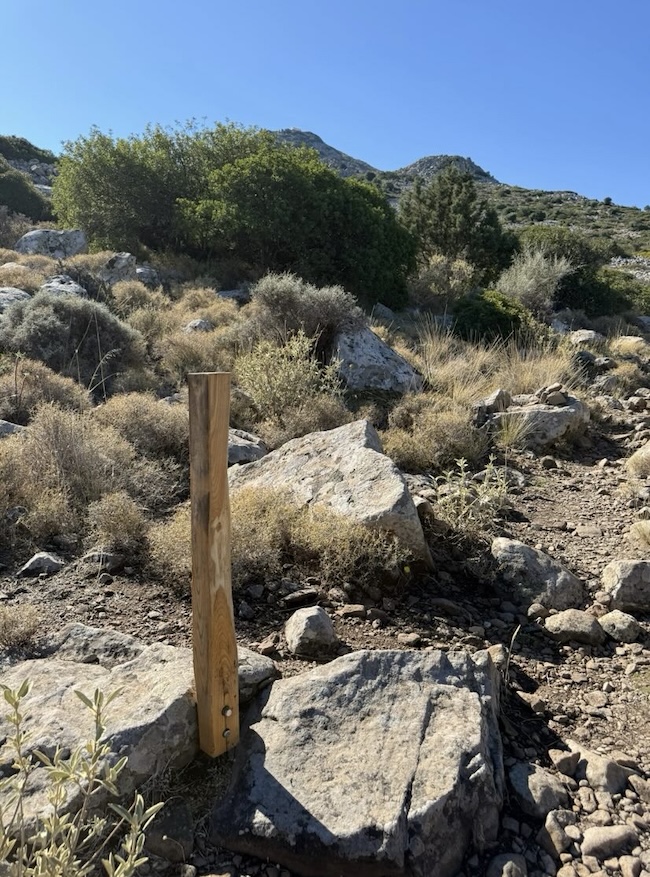
Trail marker. To the left one finds the larger cistern, to the right one ascends to the summit.
The trail continues to the south and begins to gain in elevation. The path is relatively easy to follow, but there are quite a few thorn bushes. In mid-October, you could spot butterflies still alighting on sporadic flowers and a number of small songbirds, and, as one ascended, the cool breeze increased dramatically. The bells of a flock of goats were ever-present.

The path moves southwest and one can see the ancient terrace wall.

A final steep push leads to the summit where there are some ancient remains and the trenches of the Hellanion Oros Project (a joint project of the Swiss School of Archaeology, who are excavating and surveying Oros). From the church of Profitis Elias, which incorporates ashlar stones from an archaic shine, you can enjoy 360-degree views of the Saronic Gulf.
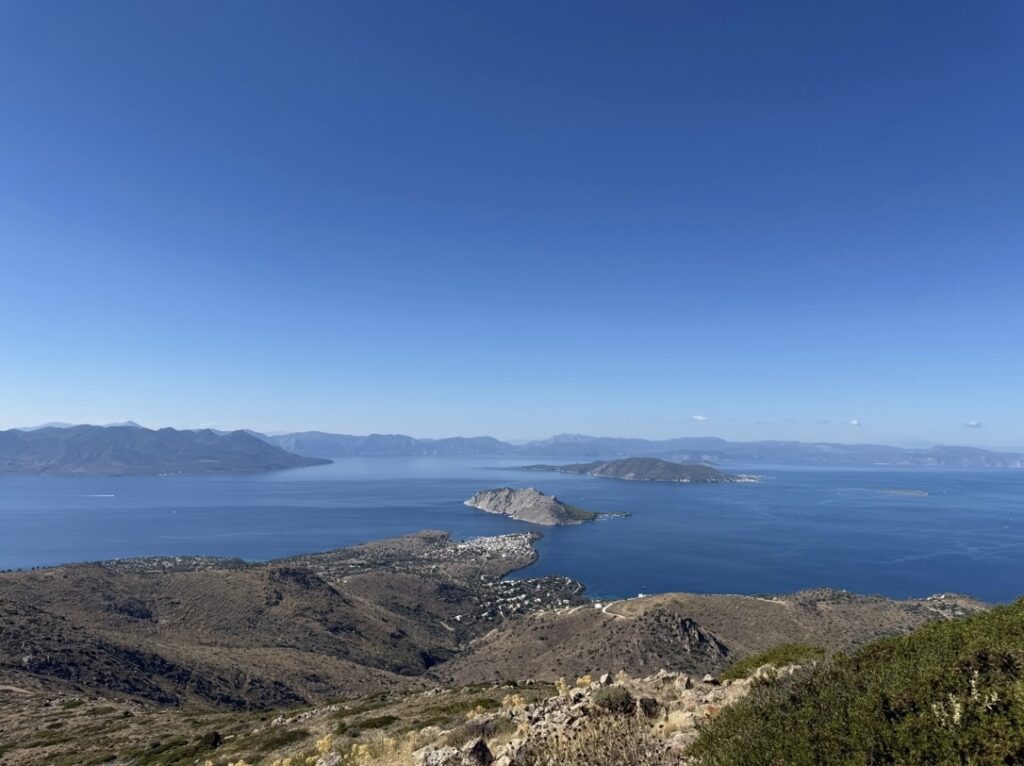
Moni Island, Angistri, and the eastern Argolid in the distance.
One can either hike back along the same route or cut to the road and walk down the road. When I did so, the goats were the only traffic I encountered.


To the summit and back is about 5 km, with 250 metres of ascent.
The start point for the route is here. The downloadable GPX file is below.