Chelmos (otherwise known as Aroania) is the middle of the three great mountains of the northern Peloponnese, flanked by Erimanthos to the west and Kyllini to the east. Taygetos in the south is the only mountain in the Peloponnese that is higher than those three.
This route starts from the Chelmos ski car park, which is by far the most accessible option if you’re staying in Kalavryta: it gets you up quite quickly on to the breathtaking summit ridge.

The other option is to approach from the north east, from the villages of the Peristera and Solos. That route takes you up to waterfall of the Styx: I will write about that in another post.
Pan and Syrinx in the mountains of Arkadia
The Styx waterfall was by far the most famous landmark on the mountainside in antiquity, but Chelmos also has some other fascinating and not very well known mythological associations.
The Latin poet Ovid famously tells the story of the nymph Syrinx, who is pursued by the god Pan and turned into a clump of reeds, which is then made into pan pipes. But I don’t think it is often noticed that Syrinx seems to be an inhabitant of Mount Aroania:
Beneath the frozen mountains of Arcadia, among the Nonacrian hamadryads, there was one very famous naiad: the nymphs called her Syrinx. (Ovid, Metamorphoses 1.689-91).
Nonacris is the name of an ancient settlement that was situated not far from the modern Peristera. Even in the second century CE it was in ruins: we know that from the travel writing of Pausanias.
There’s no particular reason to think that Ovid had a precise knowledge of the geography of the Peloponnese. And the word ‘Nonacrian’ in Latin seems to be used quite interchangeably for ‘Arcadian’.
But even so, the text opens up the option of seeing Syrinx as a nymph of Aroania. It’s hard to imagine her up on the bleak summit plateau, but she fits well in those wooded northern slopes that you can see below you as you stand on the main summit. The hamadryads are wood nymphs, whereas naiads are water nymphs, so Syrinx stands out from her companions in some ways, but they are both in their element there.
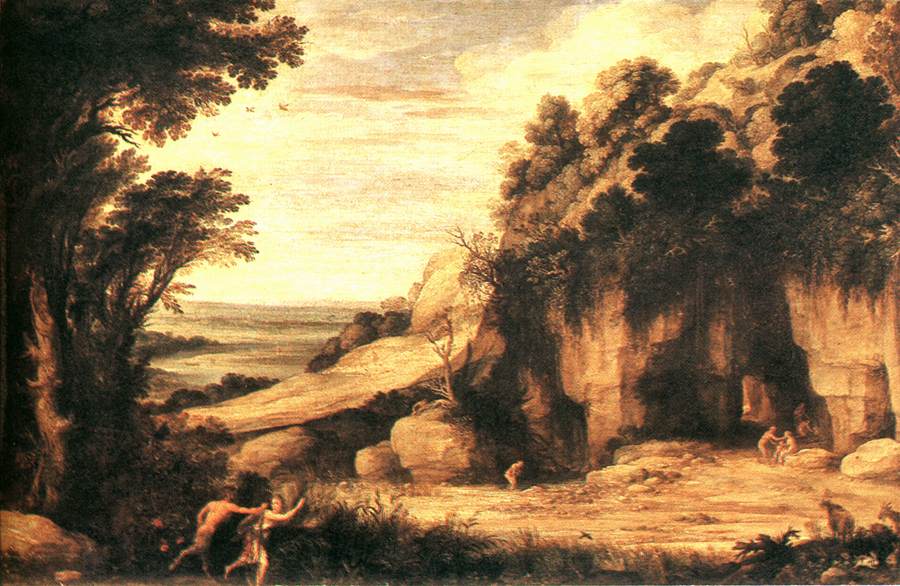
Paul Bril (1554 – 1626), ‘Pan and Syrinx’

The rest of the story takes place further south: Ovid tells us that Pan saw her ‘as she was coming back from Mount Lykaion’ (Lycaeus in Latin). As so often, these divine and semi-divine figures from Greek myth move from one Arkadian mountain to another at will: these are fantasy spaces of divine activity.
Syrinx flees as far as the river Ladon, which is between Lykaion and Aroania. I would like to think that she is trying to get home.
The Cave of the Lakes and the Daughters of Proitos
And then there is the even more shadowy story of the daughters of Proitos. Pausanias has the following:
Above Nonacris are the mountains that are called Aroanian, in which there is a cave. They say that the daughters of Proitos fled to this cave when they were afflicted with madness; Melampous by secret sacrifices and purifications brought them down to a place called Lusoi. (Pausanias, Periegesis 8.18.7)
It seems likely that Pausanias had in mind the cave now known as the Cave of the Lakes on the western slopes of Chelmos.
There were many different versions of the story of the daughters of Proitos. Most of them survive only as brief snippets mentioned in passing by various ancient authors. They are said to have attracted suitors from the whole of Greece. On some accounts they offended Hera, on other accounts Dionysus, which led to terrible punishment. Some say they thought they were cows, others say they were afflicted by a terrible itching. In some versions their madness spread to all the women of Arcadia. Some say that Melampous demanded one third of Proitos’ kingdom in exchange for curing them.
And so it goes on, with alternative versions profilerating more abundantly the more you look.
But amidst all that messy tangle of narrative traditions I love the way Pausanias gives us a fantasy landscape to cling on to – an imaginary space which we can use to conjure the story into life. It’s a place of calm both for us as we seek to imagine what happened, and for these three girls in the story.
Can we imagine them wandering up there together, a tightly knit herd of three, grazing as they go – odd human equivalents of the cattle of Apollo concealed by Hermes in his cave on Mount Kyllini.
Melampous (‘Blackfoot’) was a prophet and healer. There is a vast and intriguing network of stories about him, again surviving in snippets and fragments. He was renowned for his ability to talk to animals. Can we imagine him tracking them up on to the mountain slopes and coaxing them down into the town?
The Route
The route starts at the ski car park, south-east of Kalavryta.
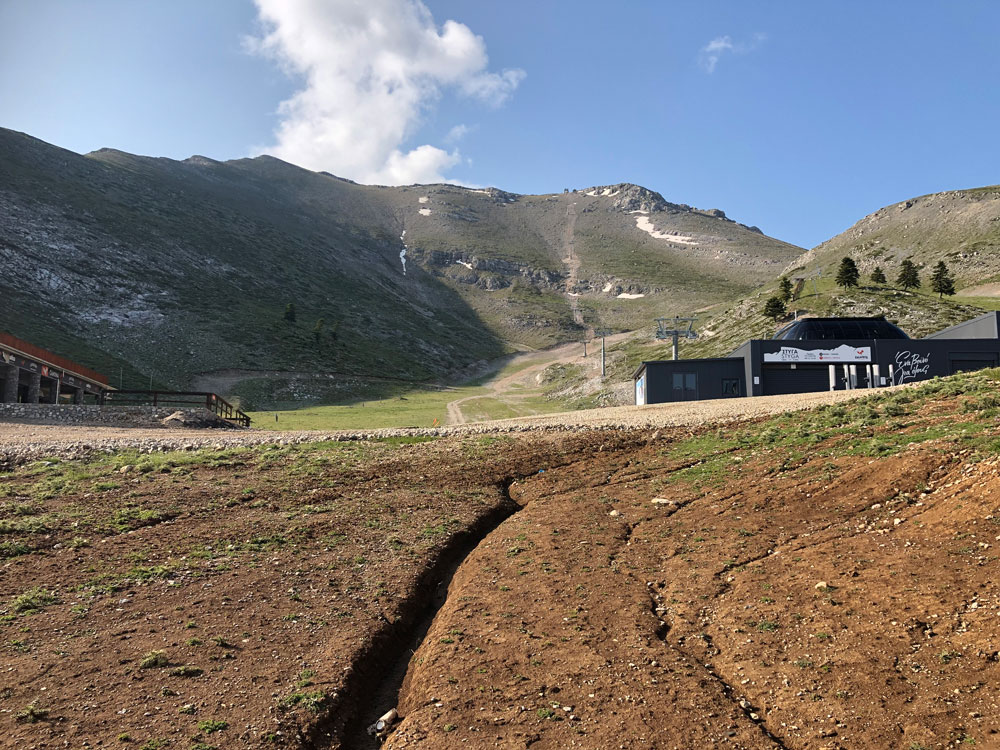
It follows the ski lifts for a short distance, then branches off to the left, just before you get to the ski run with the refuge standing above it.
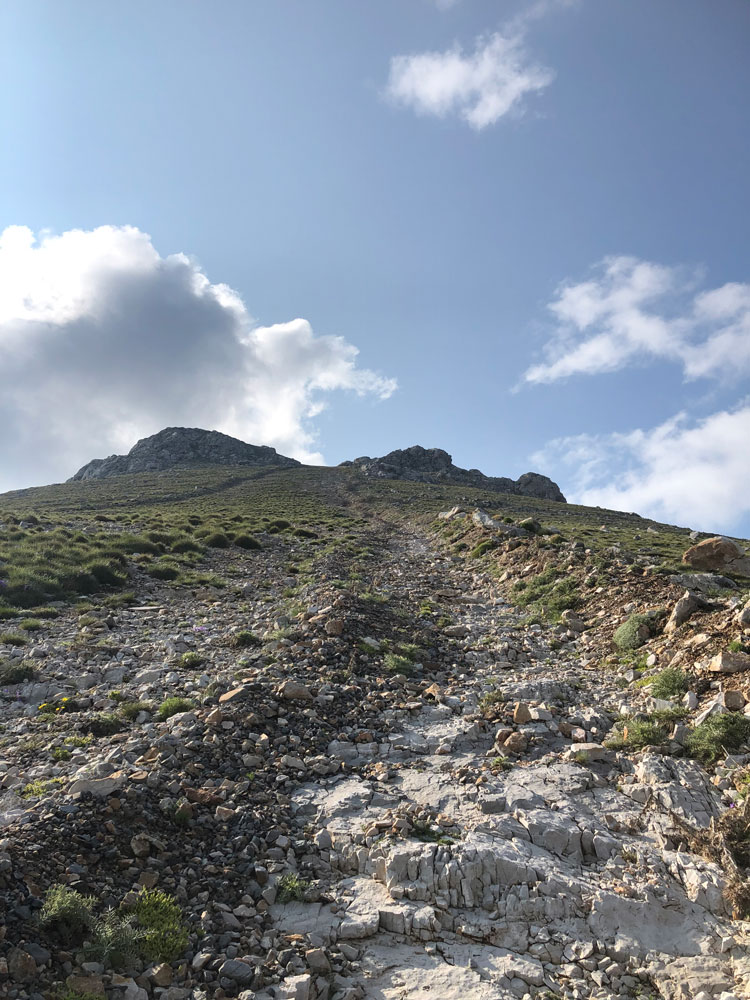
You go up a steep slope, following the faded red paint splashes, then skirt to the right beneath the rock band, before winding your way up to the building that houses the Aristarchos telescope.

From there you can follow the ridge round to the highest summit, Psili Korfi (2355 metres), with very wild views over the other peaks of the Chelmos range, including Dourdouvana to the south.

To get back to the telescope you can retrace your steps, or if you are feeling more ambitious you can drop down to the Styx waterfall, then complete a very steep loop up from there.
From the telescope you have the option to go back the way you came, following the ski lifts back to the car park, or else you can follow the line of the Neraidorachi ridge northwards , via the path marked on the Anavasi map. The latter is more scenic, but it’s a very rough track, and you need to be careful about the steep drop to the right of the summit ridge.

The full loop is 13 km, and about 1350 metres of ascent.
If you go just to Psili Korfi and back, it’s 10 km and 800 metres of ascent.
The start point for the route is here. The downloadable GPX file is below.