This walk takes you up to the summit of Mount Kynortion. It gives you a taste of the hills around Epidauros where the god Asclepius is said to have been abandoned as a baby.
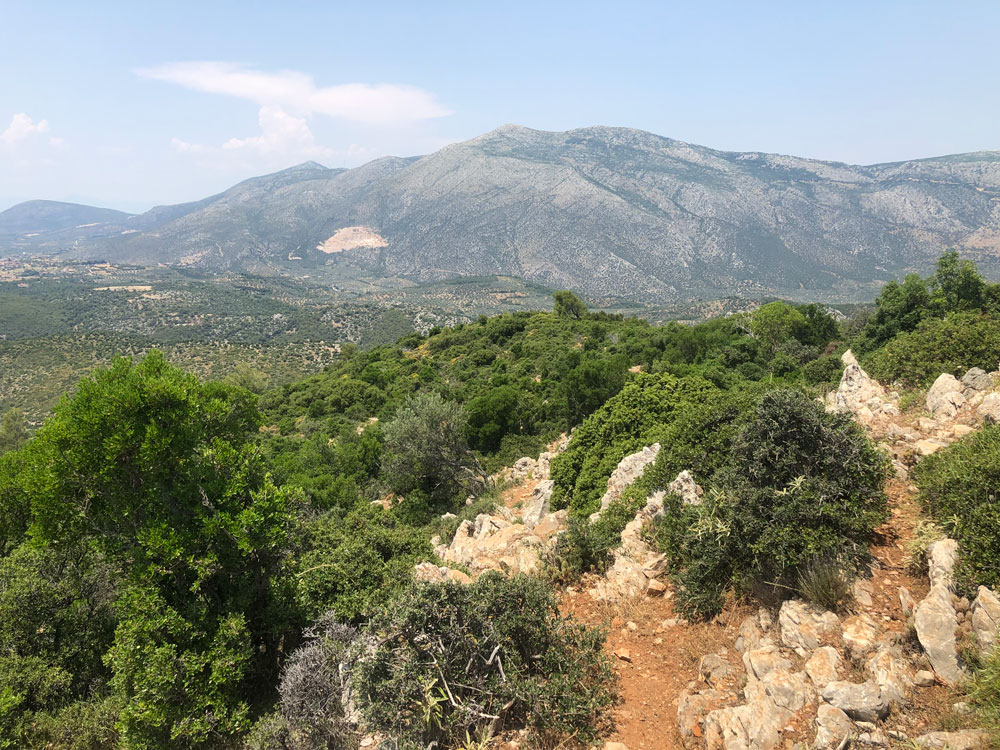
Mount Kynortion and the religious landscape of Epidauros
Mount Kynortion and the other hills around it are not the most beautiful summits in Greece, but they have an amazing historical and mythological depth.
Most people will have encountered them without noticing them much, in the background to the ancient sanctuary of the healing god Asclepius at Epidauros.
But in fact the Asclepius sanctuary down in the valley, which is the place most visitors go to, was a relatively late addition. The mountains came first.
On the lower slopes of Mount Kynortion is the sanctuary of Apollo Maleatas. It’s the older of the two by many centuries: the site was in use even in the Bronze Age, whereas the Asclepius sanctuary was founded in the fifth century BCE.
If you walk up the short distance from Asclepius sanctuary you will be retracing a regular processional route. We know about it from an inscription which records this as an annual event, and gives the text of a hymn to be sung to Asclepius. The ritual was established by a member of the Epidaurian elite called Isyllos in the Hellenistic period.
It’s hardly surprising that they were connected: Asclepius was son of Apollo.
Mount Kynortion had a visual connection with the Asclepius sanctuary, as well as a ritual one. The summit (at 856 metres) would have been be directly visible in the background from many points in the sanctuary, not least to anyone setting foot in the monumental entry-way (propylaia).

Asclepius exposed
The hills around Epidauros were also the place where the god Asclepius was said to have been exposed (in other words abandoned) as a baby.
Pausanias sets the story on a hill he calls Mount Titthion (‘Nipple’). He tells the story of Koronis, the mother of Asclepius, travelling to the Peloponnese with her father Phlegyas:
When he went to the Peloponnese, his daughter came with him. She had concealed from her father the fact that she was pregnant by Apollo. After giving birth in the land of the Epidaurians she exposed her son on the mountain which these days they call Titthion, but at the time was called Myrtion. As the child lay there exposed, one of the goats being pastured on the mountain gave him milk, and the watch-dog of the herd kept watch over him. (Pausanias, Periegesis 2.26.4)
The mountains of Greek myth are crawling with exposed babies, many of them suckled by animals, but even by those usual standards, this one is special: Pausanias says that lightning flashed as the goatherd approached the baby.
Asclepius goes on to be a great healer, and associated with healing sanctuaries across Greece, but the Epidaurians always had a special claim on him through this story of his birth and suckling, which they celebrated repeatedly with statues and coin issues.
Dogs in the sanctuary of Asclepius
We might wonder why Ascelpius is so often accompanied by a dog in these images.
In the example below you can just pick out a dog lying under the throne where Asclepius is seated.

Silver drachma coin, Epidauros, 350-330 BCE, licensed by CC-BY-SA-4.0.

Pausanias tells us that the statue of Asclepius in the temple at Epidauros was half the size of the statue of Zeus at Olympia (in other words still very big indeed!), and that it had the statue of a dog lying by its side.
There is evidence that sacred dogs were kept in the sanctuary, and thought to cure patients by licking, or even that patients of Asclepius were sometimes fed dog flesh.
But one other possible explanation of these images is that they are meant to recall the story of his discovery by the goatherd and his dog. There’s even an alternative story where Asclepius was suckled by a dog rather than a goat.
Some of the coins show the full story of the goatherd finding the baby on the mountainside, with cypress and olive trees on the edge of the coin.
Identifying Mount Titthion
The problem is that we don’t know which of the hills around Epidauros is Mount Titthion.
Some identify it with hill above the village of Adami, at 686 metres (although that may be another hill referred to by Pausanias as Coryphus).
Some identify Titthion with the hill now called Pouliou Rachi (599 metres), a little further to the east, just south of the sanctuary of Apollo Maleatas.
Others identify it with Theokafto at 471 metres, north west of the sanctuary.
There is even a theory that it is the hill at ‘the easternmost extent of the Arachneo range, now named Profitis Ilias, west of the village of Anastasopouleika … It has a distinctive female breast shape when seen from the east particularly. Further, outcrops on its southern face suggest the shapes of a goat and sleeping dog both of which are protagonists in Asklepios’ birth narrative’ (Webb and Windell, ‘Following Pausanias’).
Others have suggested that Titthion is just another name for Mount Kynortion, which has a more breast-like shape than any of the other hills surrounding the sanctuary, even though Pausanias says that they are two different peaks.
We can’t know the answer to that question, but I like to imagine the baby Asclepius lying up on the rough slopes of Mount Kynortion, or one of the other very similar hills around it, waiting for the goatherd and his dog.
The route
The route below starts from the Palaia Epidauros road to the north of the sanctuary. There are plenty of options for parking by the side of the road. You follow a dirt track that branches off from the main road by some farm buildings.
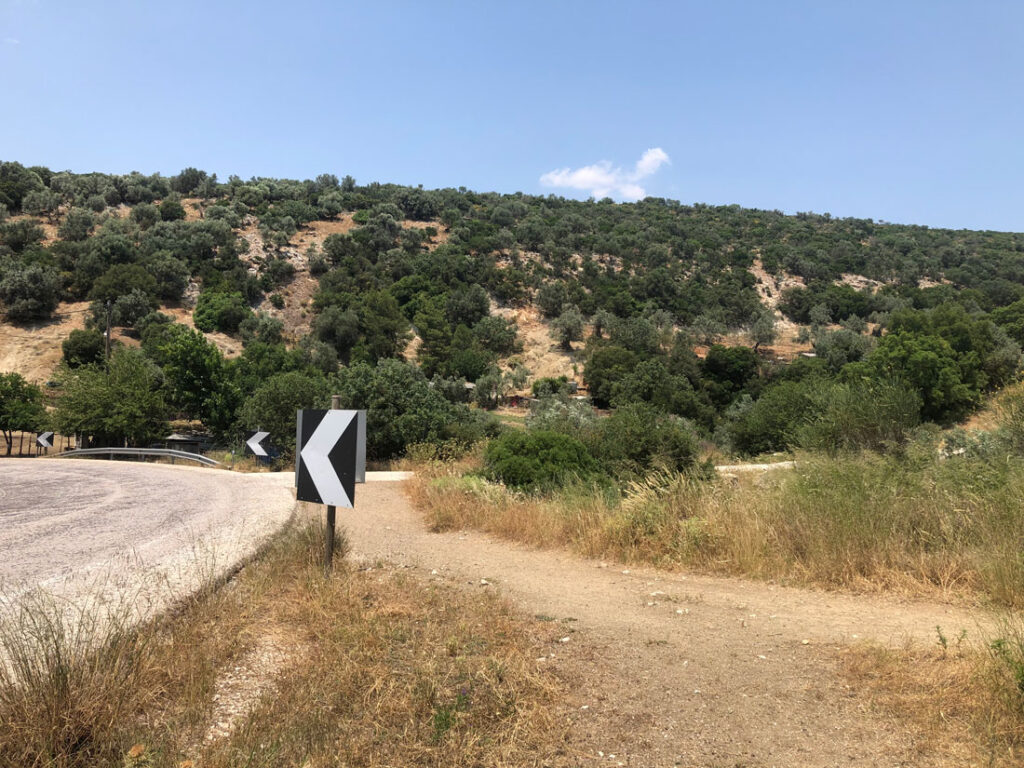
The track swings round to the left, and then to the right, climbing steadily, and then you branch off on to the mountainside, skirting around a fenced area, and straight up until you get to the summit.

From a distance it doesn’t look promising, but close up I thought it was a beautiful route, with bright yellow foliage everywhere (in early June), and the option to choose your own trail, following the goat-tracks up through the undergrowth (I couldn’t see any waymarkers).

There are good view across to Mount Arachnaio, and down to the theatre at Epidauros.

The downside: there’s no shade! I stumbled over a goat or sheep skull on the way down (I’m not sure which–suggestions welcome!) This would not be a good place for the baby Asclepius, lying out in the sun…


From the road to the Kynortion summit and back is about 8 km, with 550 metres of ascent.
The start point for the route is here. The downloadable GPX file is below.