Thanks to Cynthia Marti for today’s guest post! Cynthia is a PhD candidate in Classical Archaeology at the interdisciplinary research training group ‘Staging Religious Atmospheres in Ancient Cultures’ at Marburg University. In her project, she focuses on religious atmosphere in ancient Greek mountain sanctuaries. You can find more about the research training group on their website.
This hike takes you up to Agios Antonios, one of the majestic peaks of Mount Olympus.
A sanctuary on Agios Antonios
In ancient times, mountains were often seen as places inhabited by deities, making them into sacred landscapes. For this reason, sanctuaries can be found on many mountain peaks across Greece, a practice that began in the Bronze Age and was partially maintained into the Roman period.
As the seat of the twelve Olympian gods, Mount Olympus is a particularly sacred mountain. Although there is no sanctuary on Mytikas, the highest peak of Mount Olympus, for topographical reasons, traces of past worship have been found on the summit of Agios Antonios, which is just 100 metres lower (2,817 metres).

Photo: Riko Süssenguth
The aerial photo above shows Agios Antonios in the foreground and Mytikas in the background. Agios Antonios is less rocky than Mytikas and has more gentle slopes, which makes it a good place for a sanctuary.

Photo: Cynthia Marti
From the summit, there is a fantastic view into the Enipeas Gorge and all the way to the Aegean Sea. Within a short distance, the landscape rises from sea level to almost 3000 metres.
Archaeological evidence
Solinus, an author from the 3rd or 4th century AD, wrote about an altar of Zeus on the summit of Mount Olympus. According to his descriptions, offerings placed there are not affected by the weather and remain as they were laid down.
To date, the number of archaeological finds in the Olympus range has been moderate, but the finds on Agios Antonios are the most important exception.
In 1961, a weather station was built on the summit of Agios Antonios, which lead to the discovery of archaeological remains. A rescue excavation was then carried out by Basil Kyriazopoulos and George Livdas to secure and document the finds.
During the excavation, layers of burnt earth were found, which the archaeologists interpreted as the remains of an ash altar. The finds also include various ceramic fragments – mostly from small vessels – and burnt animal bones, mainly from goat and sheep that come from animal sacrifices, which was a common ritual practice in mountain sanctuaries.
In addition, fragments of marble steles and coins were found, as well as iron nails, which based on their shape and context are possibly Roman shoe nails.
Some of the marble steles bear inscriptions that have been severely weathered. Nevertheless, it was still possible to read the name Zeus Olympios and the name of a priest and possibly a donor of the steles. This suggests that the summit sacrifices were part of an organised cult of Zeus, perhaps based in the city of Dion at the foot of the mountain.
The finds also included fragments of marble statues, specifically the fragment of a leg. Unfortunately, it is no longer known who these statues depicted, but based on the size of the fragments and a statue base that was found, they were life-size images of deities (maybe Zeus himself?) or perhaps humans.
The finds from the summit are now displayed in the archaeological museum in Dion.

Photo: Cynthia Marti
The finds date back to the Hellenistic period and show that people visited this place from the 4th century BC to approximately the 5th century AD.
The high altitudes of Mount Olympus are barren, snow-covered in winter and only partially suitable for pastoralism, which raises the question of why people in ancient times climbed Agios Antonios.
The special atmosphere and awe-inspiring aura of the mountains certainly drew people to these heights to come face to face with Zeus and make sacrifices in his honour. The site is not a large sanctuary, but rather a small, open-air space without any architectural features such as temples (the structures in the photo below are all modern buildings). The landscape speaks for itself.
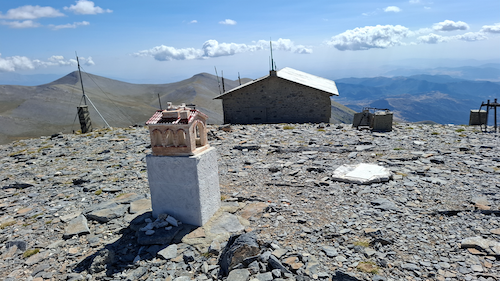
Photo: Cynthia Marti
The route
The best season to climb Mount Olympus is from June to October, when there is no snow on the mountains. Most travellers choose to climb Mount Olympus from the village Litochoro via the Agapitos refuge (see this post on Mytikas: you can adapt that route to reach Agios Antonios as well as Mytikas and Skolio, if you are looking for an ambitious hike with several peaks).
My partner and I chose another route and climbed Agios Antonios from the other side, which requires less technical skill. From the starting point to the summit, you will climb a little over 1000 metres in altitude.
We drove to the Olympus Ski and Training Centre (KEOAX) that is run by the military and left the car there. To start the hike, you have to pass through the military camp, where you must show your ID-card, leave your phone number and say whether you are returning the same day or staying overnight. The whole procedure is less complicated than it sounds, and the soldiers were very friendly.
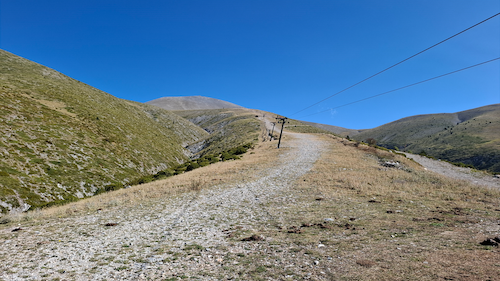
Photo: Cynthia Marti
The path to the summit initially runs alongside ski lifts. At this point, the path is rocky, steep and not particularly exciting to walk (and it is much steeper than it looks on the photo!).
But that all changes once you get to the highest point of the ski lift: there you come to the Costas Migkotzidis Emergency Shelter that is equipped with beds and everything needed for an overnight stay expect food and water.
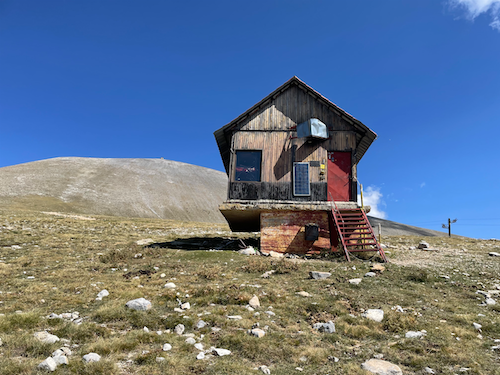
Photo: Riko Süssenguth
From the refuge, a steep but well-maintained hiking trail leads on towards the summit. At this point, the tree line has long been left behind and the route traverses a barren and rocky alpine landscape with very little vegetation where you can see herds of Balkan chamois grazing and running across the slopes.

Photo: Cynthia Marti
After the climb, you reach a ridge where the path splits: to the left, you can continue hiking to Skolio; to the right, you head to Agios Antonios. Once you have reached the ridge, the most difficult part of the route is behind you and the final ascent to the summit is easily manageable. When you reach the top, you will be rewarded with a spectacular view. However, the summit is very exposed and windy, so even in peak summer you should not forget to bring a jacket and sufficient warm clothing!
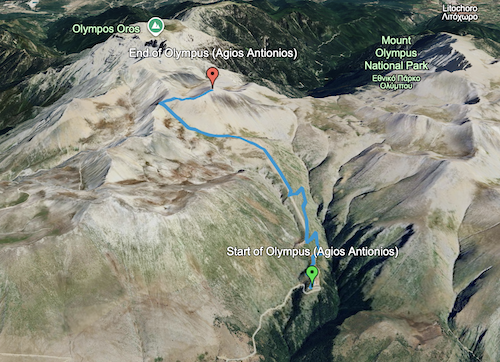
The round trip is about 13 km, with 1100 metres of ascent.
The start point for the route is here. The downloadable GPX file is below.