Thanks to Clémence Weber-Pallez for photos and route advice!
This post offers a pair of short hikes that give you an overview of the ancient religious landscape of the Hermione peninsula in the eastern Peloponnese.
Pausanias in Hermione
The fullest ancient description of Hermione (modern Ermioni) comes, as so often, from the travel writing of Pausanias.

He describes an extraordinary urban landscape, teeming with temples and festivals associated with odd local customs. He mentions more than 20 different sanctuaries to different gods: quite a lot for a very small town!
The holy places include a sanctuary of Dionysus of the Black Goatskin, who is honoured every year with music contests and swimming and boat races, a chasm in the earth where Herakles is said to have brought up the dog (usually called Cerberus, although not named by Pausanias) from the underworld, and a sanctuary of the goddess Demeter where cows are sacrificed by four old women who slash them with scythes inside the temple.
Healing stories from Halieis
From Ermioni, Pausanias than travels westwards to the ancient town of Mases, which is mentioned in the Catalogue of the Ships in the Iliad, and which seems to have occupied the site of Koilada.
He also visits Halieis (he refers to it as Halike) on the south of the peninsula, which seems to have stood more or less on the site of the modern village of Porto Cheli.
Pausanias explains that Halike has been abandoned by the time he visits, in the second century CE, but he also notices that some inhabitants of the town are mentioned in healing inscriptions from the sanctuary of Asclepius at Epidauros, a little way to the north west.
Remarkably that claim is backed up by inscriptions that have been uncovered in modern explorations of the site., celebrating the healing interventions of the god Asclepius (IG IV2, 1121).
They include three short stories about inhabitants of Halieis, as part of a longer list commemorating miraculous cures. The first is a man called Alketas, who is cured of blindness after dreaming that the god has opened his eyes with his fingers.
The second is a boy called Aristokritos, who dived down into the sea and got trapped in a rocky place with a supply of air: his father discovers where he is thanks to a dream sent by Asclepius, and finds him seven days later after digging through the rocks
The third is a man called Thersandros, who is cured of consumption. He fails to see a dream after sleeping at the sanctuary overnight, which would usually mean that the cure has failed, and is taken back to Halieis, but one of the sanctuary’s sacred snakes travels back coiled around the underside of the waggon and heals him after her gets home.
Mount Kokkygion
But the most sensationalistic story of all is associated with the two small hills that stand immediately to the west of Ermioni.
The lower hill, closer to the town, was called Pron in antiquity. According to Pausanias it held sanctuaries of Hera and Demeter.
The higher peak, further west, just 227 metres above sea level (named as Profitis Ilias on modern maps), was known as Kokkygion, from the ancient word for cuckoo.
Pausanias says that it held a sanctuary of Zeus. There are archaeological remains on both the east and west summits of Kokkygion (identified by the Stanford Argolid Exploration Project). They include an ash altar, inside a stone enclosure, with lots of pottery fragments, but no reported remains of animal bones.
Hera and the cuckoo
But what makes this hill so special is the set of stories it gives us access to. They are quite often summarised in passing online, but not translated in full.
The crucial passage is from an ancient scholiast (commentator) on the Hellenistic poet Theocritus. Theocritus Idyll 15 describes two women, visiting a festival in the city centre in Alexandria. One of them says in passing: ‘Women know everything, even how Zeus married Hera’.
The scholiast takes that as an invitation to tell the story of Mount Kokkygion (Mount Cuckoo). He repeats the story from another writer called Aristokles, who he says has written a sacred history of Hermione.
Here are the crucial bits of the passage:
Zeus he says came up with a plan to have sex with Hera, waiting until he saw her separated from the other gods. Wanting to be inconspicuous and not be seen by her, he changes his appearance into a cuckoo, and sits on the mountain that used to be called Thornax but is not called Kokkygion. And on that day Zeus made a terrible storm. Hera, travelling alone, came to the mountain and sat on it, at the place where there is currently a temple to Hera Teleia [i.e. in her role as goddess of marriage]. The cuckoo, when he saw her shivering and cold from the storm, flew down and sat on her knees. Hera, seeing the cuckoo, felt pity for it and embraced it with her cloak. Zeus immediately changed his form and grabbed hold of Hera. When she refused to have sex, on account of their mother [Zeus and Hera are brother and sister], he said that he would make her his wife.

Haliakmon’s voyeurism
And then in another equally obscure source, Pseudo-Plutarch’s On the Names of Rivers and Mountains, we find a story of unintended voyeurism:
Haliakmon, a Tirynthian by family, was shepherding his flock on mount Kokkygion when he accidentally saw Zeus and Hera making love. He became mad and swept along in an impulsive rush threw himself into the river Karmanor, which was renamed Haliakmon after him. (18.1, tr. Campbell)
The eastern Argolid was traditionally the territory of Hera, just as the western Argolid was associated with Artemis. Pausanias reports lots of sanctuaries and statues of Hera in the area, some of them holding a sceptre with a cuckoo on top. Zeus has come to the right place.
But Hermione seems like the right place for this story in other ways too, sticking out at end of the Argolid. It’s a place you don’t go to by accident, a place where Zeus wouldn’t expect anyone else to see what happens. Haliakmon is unlucky, in the wrong place at the wrong time!
The routes
These hills are not much walked on, but you can get to the summit of Kokkygion easily enough from the main road that runs northwest from Ermioni, starting from here. The route is just 1.5 km, and 200 metres of ascent.
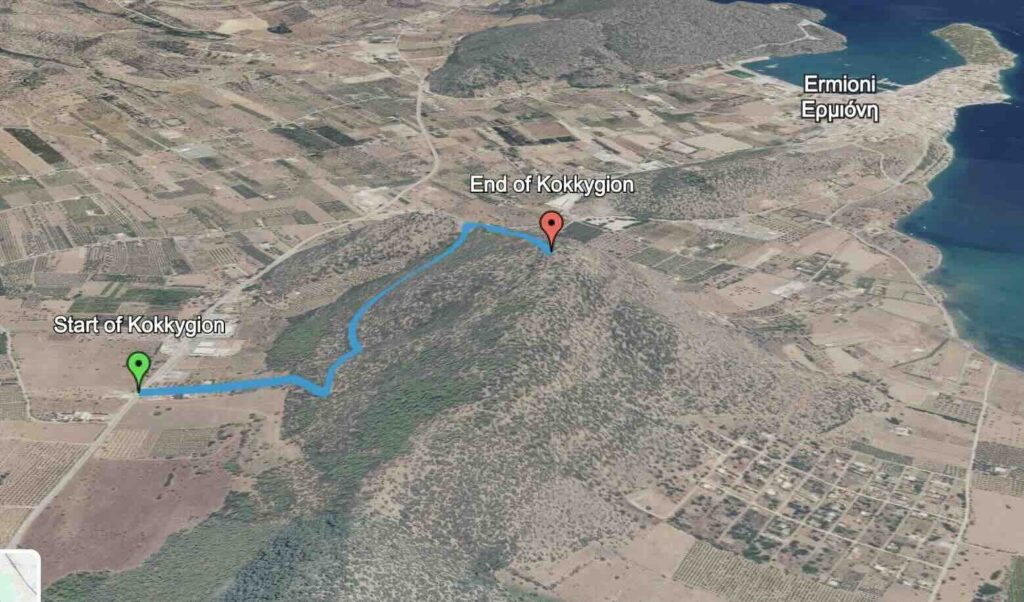
See here for good photos from the summit.
If you follow that road further west across the peninsula you can then access other viewpoints.

Particularly good is the hike up from Kranidi to yet another Profitis Ilias summit. There are views across to Mases (Koilada) and south to Halieis (Port Cheli), as well as back along the valley towards Ermioni.
It’s a great place to get a feel for the geography of the whole peninsula as Pausanias describes it.
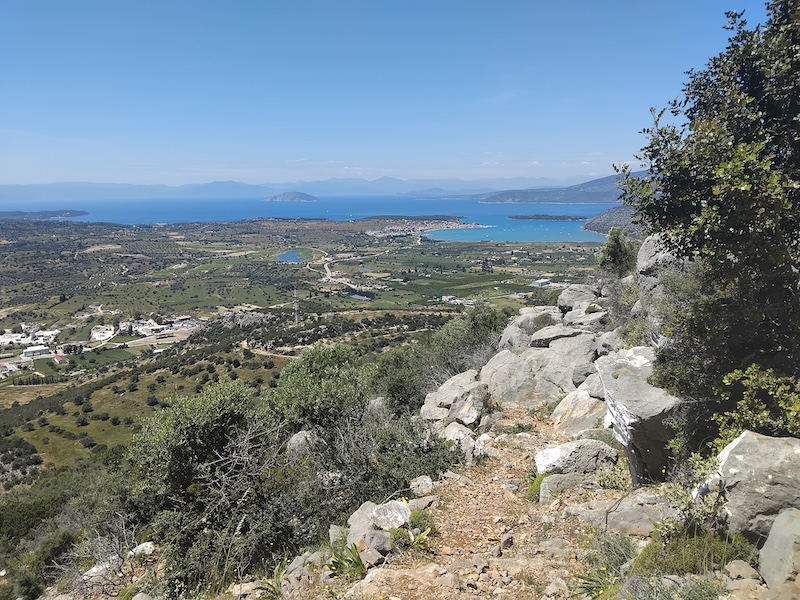
View east to Koilada.

View south to Porto Cheli.

View east to Ermioni.

You have the added bonus of tea and coffee and water available in the chapel on the summit, along with a guest book!
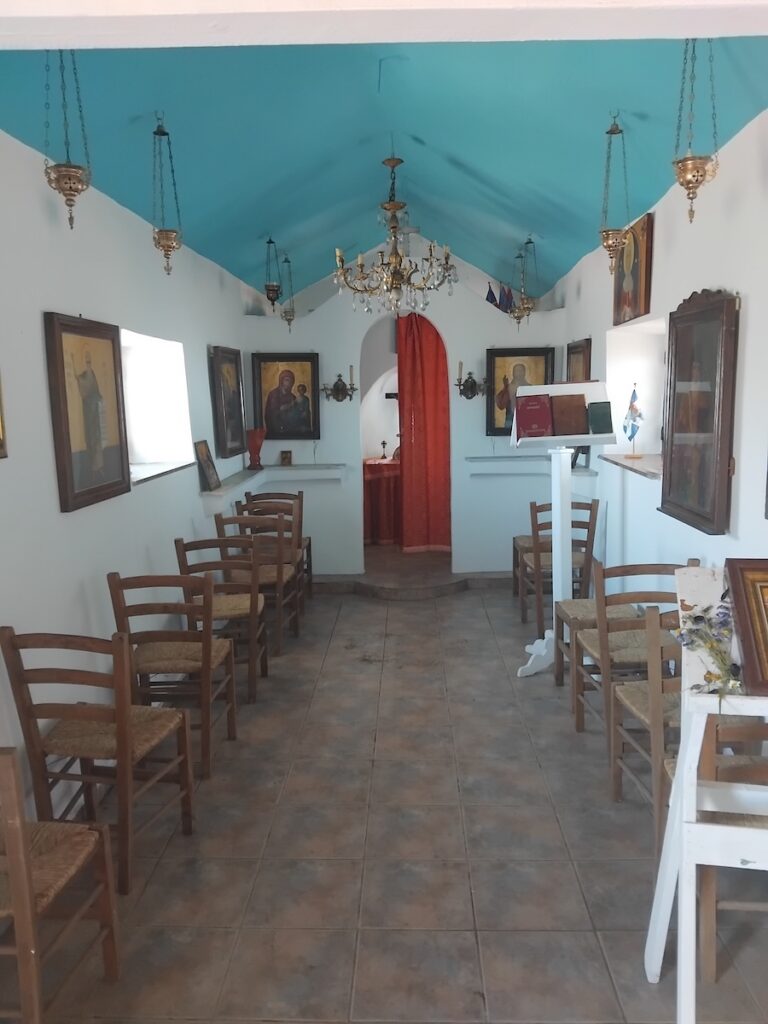

The hike from the road to the summit is about 1.5 km, with 280 metres of ascent (quite steep!)
The start point for the route is here. The downloadable GPX file is below.
For a good account of scrambling along the whole line of hills north of the Ermioni-Kranidi road (without many paths!), ending at Profitis Ilias (Kranidi), see here.