This is the first in a series of Cretan mountain posts!
This route takes you to the Diktaian Cave above the Lasithi plateau.
It’s a standard tourist site, and if you’re there any time from late morning onwards you will probably end up standing in a queue for ten minutes for tickets at the top of the climb.
It wasn’t always like this: my father-in-law remembers visiting in the 1960s and finding just a small boy sitting outside the cave with a pile of newspapers and no-one else in sight. The boy lit one of the newspapers as a torch and took him down a little way into the cave, walking over a carpet of burnt paper scraps!
Zeus’s Cretan pigs
The famous story about the cave is that Zeus’s mother Rhea left him in the Diktaian Cave after his birth to keep him safe from his father Kronos, who had developed a bad habit of eating his newly born children.
The story turns up among other places in Apollodorus’ Library, his mythological compilation from the Roman empire:
Angry at this, Rhea arrived in Crete, being pregnant with Zeus. She gave birth to Zeus in the cave of Dikte, and she gave him to the Kouretes to bring up, and to the nymphs Adrasteia and Ida, the daughters of Melisseus. They nourished him on the milk of Amaltheia, and the Kouretes, guarding the child in arms in the cave, clashed their spears on their shields, so that Kronos would not hear the voice of the child. (1.1.6-7)
That story is summarised over and over again on the signposts and tourist websites associated with the cave, but usually in very cursory ways, without any exploration of the other stories associated with Zeus’s birth and with the cave.
For one thing there is an alternative, much more mundane version of the masking of Zeus’s crying, in Athenaeus’ Deipnosophists, another Roman-period compilation:
Concerning pigs, and the fact that that animal is sacred among the Cretans, Agathokles of Babylon, in his book On Cyzicus, writes as follows: ‘In Crete they tell the story that the birth of Zeus happened on Mount Dikte … It is said that a sow offered her breast to Zeus, and as she wandered about she made the crying of the baby inaudible to those who were nearby with her grunting’.
Crete has never had a population of wild boar, so maybe we are meant to envisage these as domesticated pigs, although I didn’t see any of those either in my latest trip to Crete—only vast numbers of sheep and goats!
Three snapshots
There is also a whole series of brief mentions of the cave in later Greek literature. In all cases there is some association with Zeus. Often it is described as a hiding place or a base for Zeus and those who associated with him.
Here are three of them!
First: In Apollonius’ epic poem the Argonautica, Jason and his Argonauts encounter the winged monsters the Harpies. They reach land on the Bosphorus and meet King Phineus, who has been punished by Zeus for misusing his gift of prophecy: Zeus has blinded him and condemned him to have his food snatched away by the Harpies whenever he eats. Zetes and Calaïs, the sons of the north wind Boreas, chase them all the way to Crete, and later describe to their fellow Argonauts how the Harpies had ‘plunged fearfully into the immense cave of the Diktaian cliff’ (2.433-4).
Second: Dionysius of Halicarnassus tells us that king Minos of Crete used to come here when he needed some divine advice. Dionysius is writing about the legendary Roman king Numa, who is said to have ‘imitated the wisdom of Minos the Cretan and Lycurgus the Spartan’:
for the former of these claimed to be an associate of Zeus, and going frequently to the Diktaian mountain, where according to the Cretan myths the newborn Zeus was brought up by the Curetes, he used to descend into the sacred cave and having composed his laws there he would bring them up, revealing that he had received them from Zeus. (2.61.2)
This is the Cretan equivalent of the story from the Hebrew Bible of Moses receiving the laws on Mount Sinai.
Third: the Greek satirist Lucian, writing in the second century CE, retells the story of Zeus’s abduction of the mortal woman Europa (Dialogues of the Sea Gods 15). Zeus disguises himself as a bull and tempts Europa on to his back, swimming over the sea from Phoenicia to Crete. When they reach land he finally turns himself back into divine form and carries her off to the Diktaian cave.
Perhaps this is meant to be a comical anti-climax compared with the alternative of a new home on Olympus? Or would the cave have been viewed as a place of luxury and exoticisim, with its elaborate stalacmites and stalactites (a bit like the cave of Hermes on Mount Kyllini), perhaps even a place of seduction.
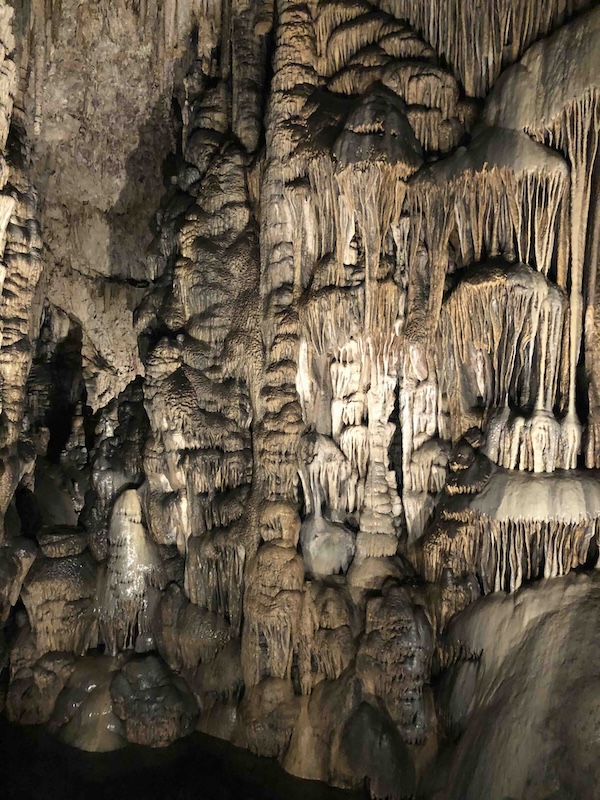
There is extensive archaeological evidence for human occupation as far back as the Neolithic period, and for large numbers of devotional offerings. The cave seems to have been much less used from the eighth century BCE onwards. But it continued to have a powerful presence as a place of the imagination in the Greek literature of the Hellenistic and Roman periods.
The route
The way up from the village of Psychro is very straightforward. There are two options, both fairly short hikes up a series of steep switchbacks—or you can ride by mule instead (this one is called Leonidas).

You can go quite deep down into the cave to see its odd rock formations.
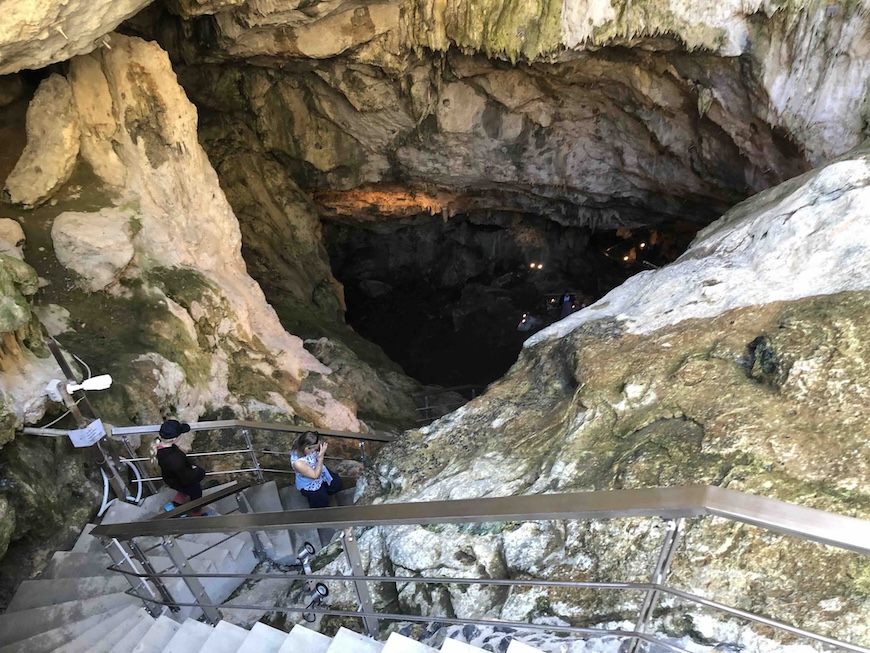
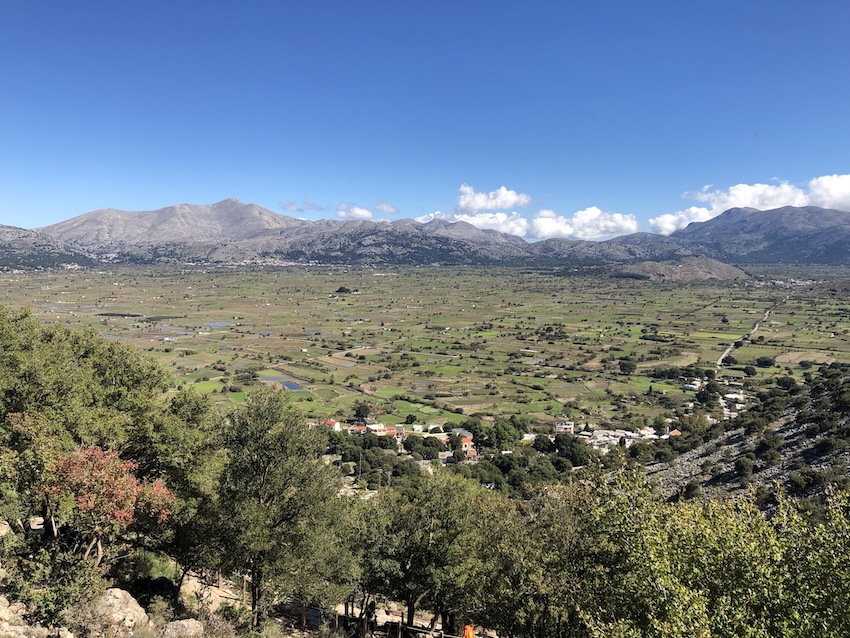
From outside the cave you get amazing views from above down on to the extraordinary flat landscape of the Lasithi plateau with its famous windmills.
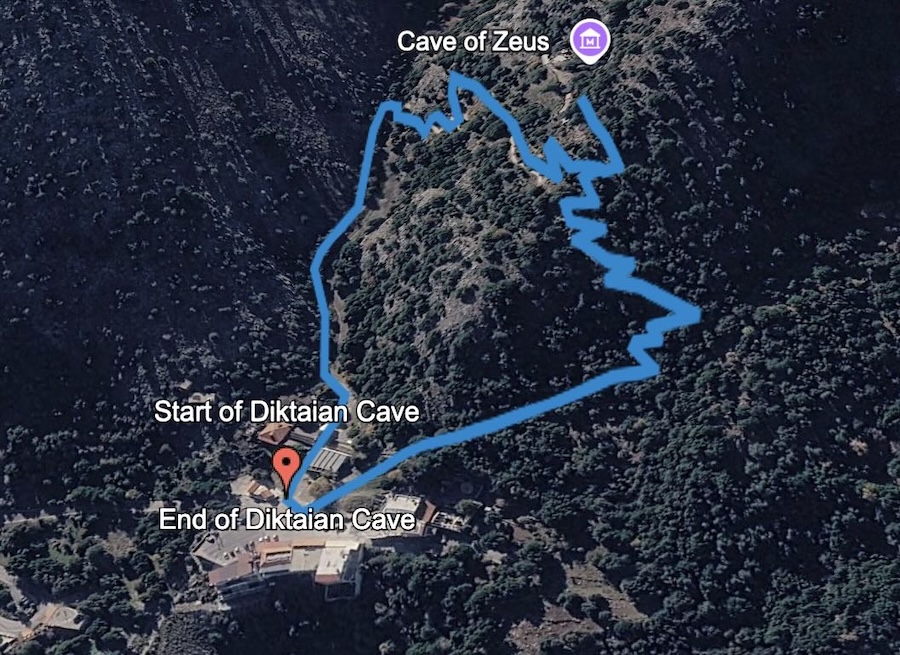

The climb to the cave is about I km, with 100m ascent.
The start point for the route is here.
You don’t really need a .gpx file for this one–it’s hard to miss the path–but here it is just in case!